

Let's replicate the business practices of our hometown people in our hometown!
(Baonghean) - Currently, many localities have correctly recognized the natural potential, diligence, dynamism, and aspiration of people to escape poverty and become rich on their own land, encouraging and replicating good models in farming, livestock breeding, and developing other industries...
(Baonghean) - Currently, many localities have correctly recognized the natural potential, diligence, dynamism, and aspiration of people to escape poverty and become rich on their own land, encouraging and replicating good models in farming, livestock breeding, and developing other industries...
Adding more traditional brocade weaving villages in the Western region.
To date, the province has 5 brocade weaving establishments that have been certified as traditional craft villages by the Provincial People's Committee, including: Ban Na weaving village - Huu Lap commune; Noong De weaving village - Nam Can commune (Ky Son district), Hoa Tien weaving village - Chau Tien commune (Quy Chau district), Dan 1, 2 weaving village - Tien Phong commune and Co Noong weaving village - Muong Ngoc commune (Que Phong district).
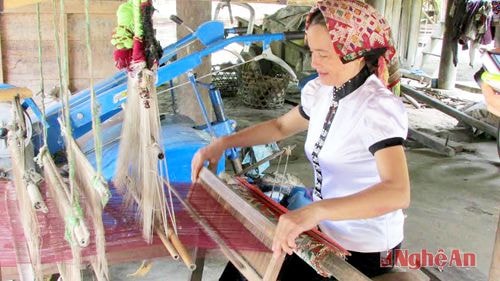 |
| Weaving brocade in Hoa Tien village, Chau Tien commune (Quy Chau district). |
Visiting Co Noong weaving village at the beginning of 2015, I witnessed the entire village rejoicing and celebrating the provincial People's Committee's certification as a traditional craft village. Thus, after many years of fragmented production, the weaving craft of the Thai people in Co Noong village, which seemed to have been lost, has been restored and is gradually developing. Mr. Lo Minh Tung, a cultural officer of Muong Ngoc commune, said that preserving the craft is valuable, but the local authorities and the households involved are still concerned about how to make a living from it. Even a skilled worker, proficient in all weaving techniques, takes 20 days to produce a piece of raw fabric about 30 meters long. The current market price for this product is about 2.4 million VND. After deducting the costs of raw materials, yarn, and colored threads, the villagers only earn about 1.5 million VND. This means the income for each worker involved in the craft in the village is only about 2 million VND per month. For products that have undergone embroidery, the cost is higher, and it also requires more time investment... So there are still many difficulties!
It's difficult, but the fact that the province continues to expand with another traditional brocade weaving village is encouraging. According to Mr. Tran Van Huy, Head of the Policy Consulting Department of the Provincial Cooperative Union, in the coming time, the Cooperative Union will coordinate with relevant agencies to create a legal framework and mechanisms to promote the development of the brocade weaving industry in the Western region. At the same time, they will develop a plan to provide systematic vocational training for workers, meeting the increasingly high demands of today's market economy; encourage production facilities to register trademarks, expand designs, and improve the effectiveness of market research and trade promotion departments so that products can reach more countries in and outside the region.
Phuong Thao
Rice cultivation is a specialty in Tho Thanh.
Yen Thanh is known as the "rice homeland." With its current development, Yen Thanh is no longer solely dependent on agriculture; its people have become wealthy through diverse industries and services. However, there are still places and individuals who have quietly become rich thanks to cultivating rice in their homeland.
Mr. Ta Hao Quang, Vice Chairman of the People's Committee of Tho Thanh commune (Yen Thanh district), said: "In 2013, Tho Thanh organized land conversion. After the land conversion, the area of public land was consolidated into one zone, and the People's Committee of the commune allocated more than 20 acres to Mr. Ho Sy Quang's household. This household has introduced mechanization into production such as tillage machines, transplanters, and harvesters; this model has shown clear effectiveness, solving labor problems for the people. In the future, the People's Committee of the commune will organize cooperation to bring about higher efficiency in the following years."
In Hamlet 3, Tho Thanh, we met Mr. Ho Sy Quang, who said that after deducting all expenses, his family earned a net profit of 400 million VND over the two winter-spring and summer-autumn seasons of 2014. He said: “After working abroad for a long time (in Hungary), I returned to my hometown in 2011 and noticed that some farmers were concerned about the lack of profit in agriculture. I wanted to try my hand at it. When I found some land that was both far away and of poor quality, I leased it, invested in bringing in plows, transplanters, harvesters, and pesticide sprayers, completely breaking away from the fragmented and low-productivity farming methods of the past in my hometown.”
In terms of efficiency, according to Mr. Quang's calculations, in the land preparation stage, hiring laborers to plow 25 acres would cost about 50 million VND, while owning a tillage machine like his only costs 10 million VND in fuel, resulting in a profit of 40 million VND in labor costs. Then, hiring people to transplant seedlings costs 200,000 VND per acre, while using a machine only costs 100,000 VND for seedling preparation. Calculated over 25 acres, his farm yields a profit of 25 million VND in labor costs. In addition, there are costs for supplies, fertilizers, and motorized pesticide spraying, resulting in double the profit compared to fragmented manual labor.
The integrated, closed-loop rice production model is encouraging farmers in Tho Thanh commune to find ways to get rich on their homeland.
Quynh Trang
"Transforming" green eggplant in Hoa Son
In line with the policy of shifting the structure of crops and livestock, in recent years, many farmers in Hoa Son commune (Anh Son district) have switched to growing green eggplant on land previously used for two rice crops, achieving positive results.
In Hoa Son, green eggplant is grown intensively in designated areas across many fields in Hamlet 4, covering over 15 hectares. Many households invest in 4 to 5 sao (approximately 0.4 hectares), while even the smallest plots are nearly 1 sao. On average, 1 sao of eggplant yields approximately 1 ton of fruit, bringing in 10-15 million VND per sao, 3-4 times higher than growing rice and other crops. For example, in the spring of 2015, Ms. Nguyen Thi Anh's family in Hamlet 4 planted 3 sao of eggplant on land previously used for two rice crops. Compared to growing corn and rice previously, growing green eggplant requires less care, has a longer harvesting period, and yields higher productivity. From the very first harvest, Ms. Anh's family harvested nearly 1 ton of fruit, selling it at 15,000 VND/kg, providing a significant income. She said: "Growing eggplant is much more efficient than other crops, the harvesting period is long, traders buy directly from home, and the prices are stable..."
Thanks to the success of growing green eggplant, Hoa Son commune has found it easier to encourage people to change their crop structure, investing in transferring home garden crops to field gardens for intensive cultivation.
Huyen Trang
Raising goats in herds in Nam Hung
Commercial goat farming has been established as a key sector, providing a significant source of income for many farmers in Nam Hung commune (Nam Dan district). Mr. Nguyen Dinh Binh, Chairman of the Nam Hung Commune Farmers' Association, said: “Nam Hung is a mountainous commune with abundant natural land and vegetation, making it a very favorable condition for farmers to develop goat farming. The challenge is finding a model to replicate. To date, the replication has been effective, with many households establishing goat farming models to gradually build a reputation for ‘Nam Hung goat’ products, supplying the culinary market in the district, neighboring districts, and Vinh City...”
A prime example of successful goat farming in Nam Hung is Mr. Tran Van Hien in Hamlet 3/2, who earns a profit of 50-60 million VND annually from goats. He shared: “I started raising goats in 2000 and only began raising them on a larger scale in 2006. Maintaining this profession requires experience because although goats rarely get sick, the risk is very high when they do. Therefore, it is necessary to vaccinate them fully and on schedule, and to ensure proper feed rations.”
Mr. Nguyen Dinh Binh added: “To see the full benefits of raising goats, you need to strive to maintain a herd of 30 or more. In reality, the income from goat farming is not large compared to many other economic models, but for a difficult mountainous commune like Nam Hung, this is a viable poverty alleviation model. Goat farming requires little investment but yields high economic benefits and stable sales; traders come directly to the farm to buy the goats. The key is knowing how to care for them and applying the correct farming techniques…”
Hong Suong
Reaching further with Quy Hop granite
The Thung Khuoc small industrial zone in Quy Hop district is famous for its processing of white stone, a local resource. However, it's rare for a local person to start a business, open a factory, and then expand branches throughout the country; and for a disabled person... it's extremely rare!
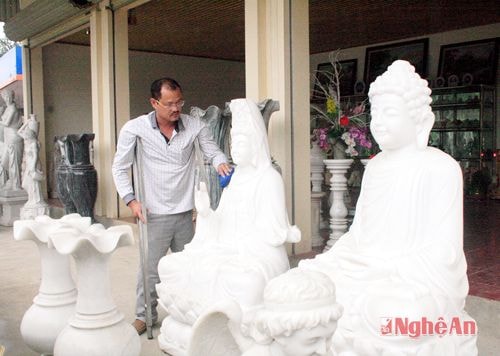 |
| Mr. Nguyen Cong Bang with his completed products. |
Born in 1970, Nguyen Cong Bang suffered from a malignant fever at the age of two, resulting in paralysis of both legs. At 12, he moved with his parents from Yen Thanh to settle in Quy Hop. Suddenly, this man from the "rice-growing region" became a "stone-producing region." At 17, Bang enrolled in the first course at the Nghe An Small-Scale Handicraft School, training in fine arts and crafts, to pursue the stone carving trade, a "specialty" of his new hometown. From a small roadside workshop, Nguyen Cong Bang now owns a fine arts stone carving factory in the Thung Khuoc Industrial Park, providing employment for seven skilled craftsmen. His products made from Quy Hop white granite have reached Malaysia, China, South Korea, and other countries. He has also opened two branches in Vinh City and Ninh Binh City.
Nguyen Cong Bang's success is the aspiration of many young people with the ambition to build their businesses on the potential and land of their hometown in Quy Hop. This is proof that the potential of every region awaits human effort to awaken it, as long as there is passion, ambition, and love for one's homeland.
Thanh Quynh