

The highlight is defense cooperation.
(Baonghean) - Indian Prime Minister Narendra Modi has just concluded a two-day visit to France and is now heading to Germany. Looking back at his two-day stop in France, it's clear that India and France reached several important agreements, particularly regarding defense cooperation, with a new fighter jet sales contract between the two countries. Expanding defense cooperation with France – a major arms exporter – will allow India to diversify its defense capabilities.
(Baonghean) - Indian Prime Minister Narendra Modi has just concluded a two-day visit to France and is now heading to Germany. Looking back at his two-day stop in France, it's clear that India and France reached several important agreements, particularly regarding defense cooperation, with a new fighter jet sales contract between the two countries. Expanding defense cooperation with France – a major arms exporter – will allow India to diversify its defense capabilities.
In Paris, Indian Prime Minister Narendra Modi announced India's purchase of 36 Rafale fighter jets from France in a contract worth over $4 billion. While some terms remain to be discussed before the official signing, French President Francois Hollande stated that French Defence Minister Jean-Yves Le Drian will travel to India to finalize the agreement. This is considered a breakthrough in the Rafale aircraft sales deal that the two countries initiated three years ago. To date, negotiations for the $20 billion contract in 2012 for France to sell 126 Rafale aircraft to India have remained unresolved. According to sources from the Indian Ministry of Defence, the main sticking point is the technology transfer clause for the production of 108 aircraft in India. However, this agreement differs from the previous one. It appears that with this contract, India wants to acquire 36 of France's advanced Rafale fighter jets as soon as possible.
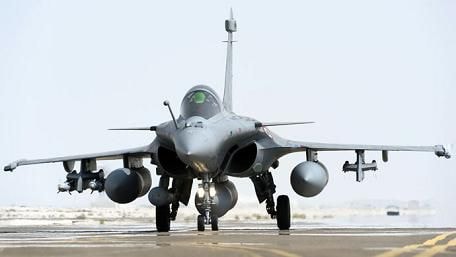 |
| A French Rafale fighter jet. Photo: AFP |
In recent years, France has emerged as a reliable supplier of fighter jets and submarines to India. Through cooperation with France, India aims to modernize its national military forces, especially its air force, which currently possesses equipment considered outdated. India is reportedly in urgent need of replacing its fighter jets starting in 2017 to enhance its defense capabilities against neighboring countries, particularly Pakistan and China, two countries with which India has territorial disputes.
In reality, the Indian Air Force is still primarily equipped with older fighter jets such as the Mirage 2000, MiG 27, and MiG 21, which have caused numerous accidents during training and patrols annually, let alone achieving air superiority in the event of conflict. Meanwhile, neighboring China has recently been continuously developing its own new generation of fighter jets. On the other hand, according to a 2014 US report on the scale of China's military modernization, the Chinese Air Force currently possesses over 2,800 aircraft, including drones, a number far exceeding that of the Indian Air Force. Furthermore, China is also negotiating to purchase the new generation Su-35 aircraft from Russia. Not only that, Pakistan, another country with a border dispute with India, enjoys what is considered a warm relationship with China, which has somewhat unsettled India.
India's strategy of acquiring French weapons technology, starting with the purchase of Rafale fighter jets, can be seen as a "wise" move. Possessing modern European weapons, especially from France, a country with a developed defense industry, would set India apart from its regional neighbors. This is because both China and India are arms buyers from Russia, while China remains under a European arms embargo that has lasted over 20 years. Since neither India nor China are likely to receive advanced weapons from the US, turning to European arms powers like France gives India a significant advantage. Therefore, even though the initial contract for 126 Rafale aircraft has not yet been finalized, India's immediate request for 36 Rafale jets from France demonstrates its strategic calculations. In particular, the 36 Rafale aircraft that India is purchasing this time is a separate contract and not a reduction in the number of aircraft or a cancellation of the 2012 contract, clearly indicating India's determination to urgently modernize its air force.
Nguyen Cao Bien