

The custom of the son-in-law living with his wife's family, then and now.
(Baonghean) - Before bringing his wife home, the groom has an obligation to live with his wife's parents for a period of time, according to an agreement between the two families, in order to repay their kindness in raising the bride. This is a rather unique aspect of the wedding customs of the Thai and Khmu people...
Like many other areas, the Thai and Khmu people in Yen Na (Tuong Duong) live quite close to each other. Because of this, they share many similarities in customs and lifestyles, including the practice of the groom living with the bride's family, which is still quite common in this remote commune.
By chance, we arrived at the home of Mrs. Lu Thi Xuyen in Xop Pu village one early summer afternoon. This is one of the three Khmu villages in Yen Na commune. Everyone in the family was busy; some were stacking firewood in the corner of the house, others were preparing to catch pigs. Another group was sweeping the house and yard. Upon inquiry, we learned that the family was preparing for the wedding of their son, Moong Van Bua, the following day. The young couple were not home. They were staying at the bride's house, also a Khmu family in Hoa Binh town, Tuong Duong district. We were quite surprised because the groom should have been home with his family at this time, going to pick up the bride the next day. Mrs. Xuyen explained that her son was living with the bride's family. During the wedding ceremony, the bride and groom are brought home together.
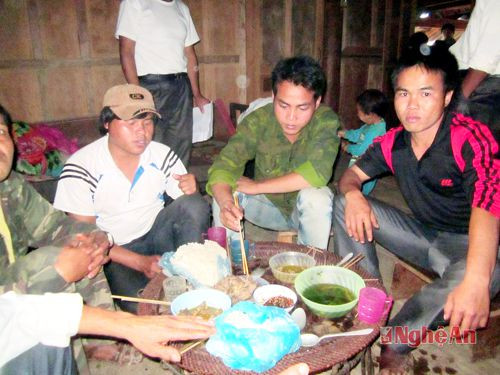 |
| A meal at a Khmu wedding. |
Having attended weddings in the Don Phuc communes, the author of this article is quite familiar with the custom of the son-in-law living with his wife's family. This custom is also practiced in these Thai and Khmu communities in Keng Du (Ky Son), and it's a rather interesting aspect of their wedding traditions. The highlanders believe that when a daughter is born and raised, her parents have endured many hardships to nurture her. This effort cannot be repaid with silver ingots, buffaloes, cows, or paper money. Therefore, the son-in-law, regardless of the amount, must live with his wife's family for a period of time to help with farming, raising pigs and chickens; and when the village has house-building events, the new groom must also participate. Furthermore, by living with the wife's family, the parents can assess the son-in-law's character before entrusting their daughter to him. Ms. Lu Thi Xuyen stated that any man in Xop Pu village, upon marrying, must live with his wife's family for at least one year, and sometimes up to three years. This has become a custom, and people call it living with the wife's parents as a way of repaying their kindness.
Another resident of Xop Pu village, Mr. Oc Dinh Tan, has unforgettable memories of his time living with his wife's family. The 58-year-old veteran recounted that he joined the army in 1979. Before heading to the northern border to fight the Chinese invaders, he had already asked for his wife's hand in marriage and prepared to fulfill his "duty" of living with his wife's family. However, he had to leave due to the demands of the country at that time. After three years in the army, Mr. Tan returned to his village and began living with his wife's family for the same amount of time he had served.
Mr. Tan said that during those three years, he became part of his wife's family. He was only allowed to go home to help his wife's parents when his wife's family had free time. During that time, the son-in-law had to do whatever was requested, including the daily chores of his wife's parents. Furthermore, to please his wife's family, the groom had to work even harder than usual. He also helped other families in the extended family with tasks such as building houses, clearing land, or assisting with weddings, roofing, and funerals.
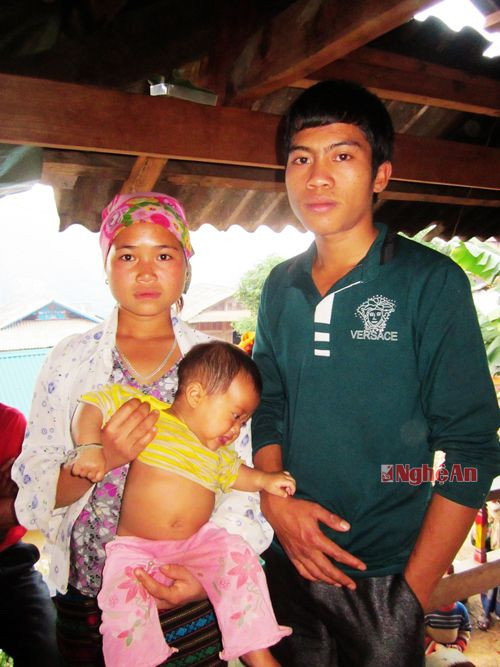 |
| The family of the young couple in Keng Du - Ky Son. |
“To please my wife's parents, I had to wake up before everyone else in the morning to cook sticky rice and feed the chickens and pigs. After breakfast, I had to take my machete and go clear the fields before the rest of the family,” Mr. Tan recalled. Back then, his wife's family was also very large. She was the eldest, only 17 years old when she married him. After her, there were eight more younger siblings, all tiny and fussy. Seeing their brother-in-law, they all vied to sleep with him, demanding he serve them rice, and whining about all sorts of things. One wanted a basket woven for him, another wanted a spinning top carved, and one even wanted to be carried in his arms, because his mother-in-law had given birth to three more children when he came to live with them. So Mr. Tan had to take care of his siblings and also look after his mother-in-law during her childbirth. During those three years, he helped his father-in-law cut wood and build a stilt house, which was normal for sons-in-law in the village in the 1980s.
Mr. Tan himself had to live with his wife's family for so long because his family didn't have buffaloes or silver ingots to pay the bride's family. In the past, the dowry demands were very heavy, often requiring buffaloes and silver ingots to marry. This forced many poor young men in the village to make the sacrifice of living with their wife's family for many years. Some, from more difficult circumstances, had to live with their wife's family for up to five years, and the wife's family would even build a separate house for them. In families with enough money to pay the dowry demands and mutual understanding between the two families, the grooms usually only had to fulfill their "obligations" with the wife's family for six months to a year. After that, a formal wedding was held, and the groom took his wife to his home.
Another resident of Xop Pu village, Mr. Oc Van Loi (31 years old), said that nowadays, the custom of a man living with his wife's family for three years is almost nonexistent. The longest is only one year. According to Mr. Loi, this custom is reasonable because "if you take someone's daughter and don't repay the favor, it's too unfair to them." Meanwhile, in Khmu communities along National Highway 7A such as Pa, Na Luong, and Huoi Tho villages (Huu Kiem - Ky Son), the custom of a man living with his wife's family to repay the favor has almost disappeared. Mr. Kha Van Quyen, Chairman of the People's Committee of Huu Kiem commune, said: "Now, in the Khmu villages, you don't see anyone living with their wife's family anymore; they have followed modern trends."
However, the Thai community in the Cam Lam and Don Phuc areas still maintains this custom. Mr. Lo Van Hung, residing in Bach Son village (Cam Lam - Con Cuong), got married two years ago. Before the official wedding, Mr. Hung had to live with his wife's family in Hong Dien village, Don Phuc commune, for nine months. Mr. Hung said that living with his wife's family was quite easygoing, mainly for the bride's family and the groom to get to know each other. Nowadays, no one nitpicks about whether the son-in-law is diligent or lazy anymore.
The Xieng Nua village, also a Thai community in Yen Na commune (Tuong Duong district), still maintains the custom of the groom living with the bride's family. In about two weeks, Luong Thien Dinh will be getting married to a girl from Vang Cuom village (Yen Tinh commune - Tuong Duong district). Dinh will only have to live with his bride's family for three months as a formality. "It's just to follow the custom," the 21-year-old said. Meanwhile, Lo Van Pan, from Na Pu village (Yen Na district), who got married in 2013, said he didn't have to live with his bride's family for a single day because the bride's family didn't require it. Nowadays, young men in the village rarely have to live with their bride's family because people no longer hold onto old customs. "These days, young men in the village, when they get married, are working in companies, studying, or working as officials; they don't have time to live with their bride's family," Pan explained. Perhaps it is precisely because of such changes in the highland communities that the custom of the groom living with the bride's family is gradually fading away?
Huu Vi