

Rural transportation is waiting for... cement.
(Baonghean) - Implementing the National Target Program on New Rural Development, localities prioritize allocating significant resources to infrastructure development, with rural road construction being the strongest movement and receiving widespread support from the people. However, for various reasons, the construction of rural roads (criterion number 2) in many communes is currently stalled, waiting for cement.
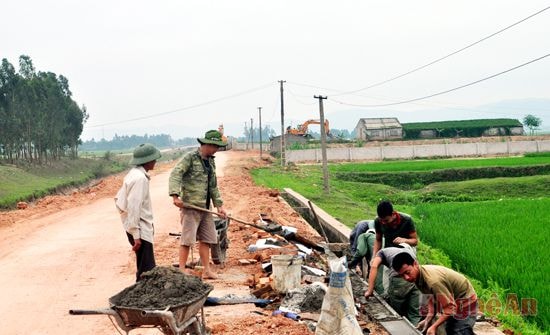 |
| Rural road construction in Nam Anh, Nam Dan |
Implementing the province's policy on supporting cement for rural road construction in the New Rural Development program, through three phases of implementation from 2012 to 2014, the total amount of cement for rural road construction that the Provincial People's Committee decided to support for districts, cities, and towns by the end of 2014 was over 334,600 tons. Of this amount, localities have received nearly 267,000 tons of cement, totaling over 372 billion VND, of which 272 billion VND has been paid, including advances from the provincial budget for 2015. Currently, the province still owes cement factories over 100 billion VND, while cement production enterprises in the area are also lacking investment capital for production and business, leading to delays in cement supply. Mr. Nguyen Ho Lam, Deputy Head of the Standing Office of the Provincial New Rural Development Program Coordination Office, stated: Although 33 out of 431 communes have met the new rural development standards (accounting for 7.65%), this is still slow compared to the target of 87 communes meeting the standards by the end of 2015. There are many difficulties, including criterion number 2 regarding rural road construction. Due to the very limited supply of cement from cement factories compared to the local plan, the progress of rural road construction is currently slow. Therefore, to date, only 64 out of 431 communes have met criterion number 2, representing a very low rate of 14.8%.
Nam Dan is a model district for new rural development nationwide, with four communes achieving the new rural development standards in 2014. In 2015, the district aimed to have six more communes meet the standards, including Van Dien, Xuan Hoa, Nam Anh, Nam Xuan, Nam Thuong, and Nam Nghia, bringing the total number of communes meeting the standards to 10. In implementing the new rural development program, many localities have mobilized the people to effectively carry out land clearance, donate land to expand local roads, and contribute money to purchase raw materials such as sand and stone for road construction. However, a current difficulty is that many communes have unfinished roads due to the lack of cement, affecting the progress of the new rural development program. According to Mr. Nguyen Huu Nhuan, Head of the Agriculture Department of Nam Dan District: “In 2014, Nam Dan was allocated 51 km of roads, corresponding to 9,450 tons of PC40 cement, but so far only nearly 50% (4,700 tons) has been supplied. In 2015, the communes have not yet received the provincial cement support plan. Due to several reasons, including the slow delivery of cement, in 2014, only 5 out of 23 communes met the transportation criterion. This is partly due to some communes being slow in preparing their dossiers and budgets, leading to a lack of proactive cement reception and delays in cement supply, which has affected the implementation process in the communes.”
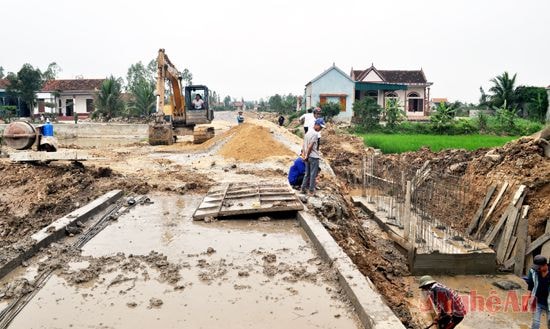 |
| Constructing rural roads in Quynh Bang commune (Quynh Luu district). |
Similarly, several communes in Quynh Luu district are also struggling with criterion number 2. In Quynh Bang commune, along a more than 1km long inter-village road, contractors, workers, and residents are concentrating on compacting and installing culverts. Sand and gravel have been stockpiled on both sides of the road, awaiting concrete pouring. Mr. Duong, a land management official of the commune, said that in 2015, Quynh Bang commune was allocated 200 tons of cement, but has not yet received it. Therefore, the contractor is providing advance cement to ensure the road is completed during the agricultural off-season. Quynh Bang commune is striving to achieve its goals this year, but currently has 4 unmet criteria, all related to infrastructure: market, health station, school facilities, and cultural center. Regarding the transportation criterion, while the roads are basically paved, many sections have not yet been concreted. Many roads have been left unfinished because residents have donated land to open them up and transported materials, such as those in Tan Xuan, Mai Giang 2, and Quyet Tam hamlets. However, cement is unavailable. Mr. Tien, a resident of Tan Xuan hamlet, shared: "Currently, the dry weather is ideal for road construction during the agricultural off-season. If we don't start now, we won't be able to complete the work during the harvest season or during the rainy season, and even if we do, the quality will be poor."
To implement the national target program for building new rural areas in the 2015-2020 period, the Provincial People's Committee has developed a policy to encourage and support this. This policy was approved by the Provincial Party Committee's Standing Committee at its regular meeting in March 2015, and includes provisions for supporting the provision of cement for rural road construction in communes registered to achieve the target in 2015. To complete the 2015 plan and help communes meet the transportation criteria in the new rural area construction plan as scheduled, districts and communes need to make efforts to find suitable solutions to accelerate progress. Currently, the Provincial People's Council allows districts and communes to retain 30% of the land use bidding revenue; this policy helps localities mobilize resources to support new rural area construction. Therefore, after the province approves this mechanism, the district and commune budgets must also allocate the remaining 40% of the cement needs. Mr. Nguyen Ho Lam, Deputy Head of the Standing Office of the Provincial New Rural Development Program Coordination Office, added: "To create conditions for communes to continue fulfilling the transportation criteria, relevant departments and localities need to work with cement factories to ensure timely supply to communes, especially those registered to achieve the target in 2015."
| According to calculations, the total length of rural roads requiring cement support is currently 508 km (an average of 6 km per commune in the plains and 8 km per commune in mountainous areas). The demand for PC40 cement is 88,900 tons, with a total cost of nearly 138 billion VND. The program applies to communes that register to achieve New Rural Area standards annually, as approved by the Provincial People's Committee. The roads must be within the commune's planning approved by the District People's Committee and designed according to the regulations of the Ministry of Transport. According to the 2015-2020 roadmap, the drafting agency proposes a maximum support amount of no more than 60% of the actual needs per commune, and no more than 1,200 tons per year per commune, because the number of communes eligible for support is relatively large, while the provincial budget is facing difficulties. |
Thu Huyen