

World in the past week: The world at the negotiating table.
(Baonghean) - Chosen as the most common (though not necessarily the most effective) method for resolving disputes or discussing issues, interests, and common goals, the negotiating table has become a place that reflects the face and dynamics of the world every day, every hour. The world last week witnessed a warming of the political "atmosphere," evidenced by the historic and topical rounds of negotiations that the entire planet watched…
Negotiations on Iran's nuclear program resume.
On Wednesday, April 22nd, negotiations on Iran's nuclear program resumed in Vienna, Austria – three weeks after the negotiating parties reached a provisional agreement in Lausanne, Switzerland. This round of talks sets out more specific goals and issues, preparing for the final agreement scheduled for signing at the end of June.
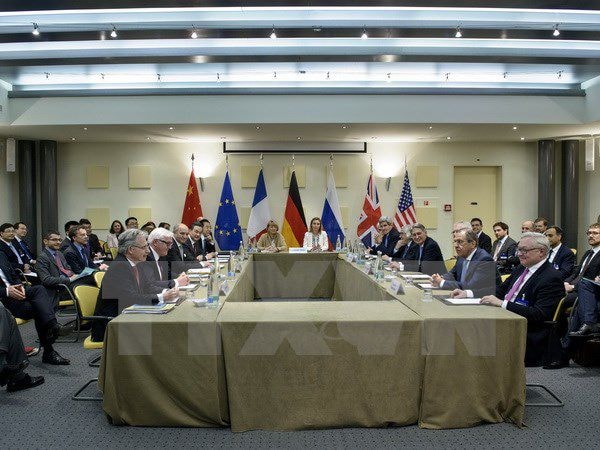 |
| Representatives of the P5+1 group and European Union officials at a meeting ahead of negotiations with Iran in Lausanne. Source: AFP/VNA. |
Thus, the "marathon race" on the diplomatic table has begun once again, starting a process that will last two months to definitively resolve the remaining questions in the agreement reached in Lausanne on April 2nd. The pressure and tension of this round of negotiations seem to have increased exponentially. The West wants to "lock" Iran into a position of constraint to prevent it from developing nuclear weapons. For the Iranians, their biggest goal is to obtain assurances of a swift lifting of international sanctions that are paralyzing their economy.
With such more specific goals than the previous round of negotiations, it's not surprising that tensions have surged dramatically in recent days, not only on the international political stage but also within each country. In the US, President Obama had to make concessions, accepting Congress's approval of the final agreement. For the group of countries imposing sanctions, Russia's lifting of sanctions and its preparation to deliver S-300 anti-aircraft missiles to Iran came as a surprise, almost like a "bolt of lightning." In Tehran, Supreme Leader Ali Khamenei declared that his view of the Lausanne agreement differed from that of the US. Before the resumption of negotiations in Vienna, Iranian Foreign Minister Mohammad Javad Zarif gave a speech published in the New York Times, in which he said: "It is time for the US and its Western allies to choose between cooperation or confrontation."
To briefly recap the Lausanne agreement, despite many unresolved issues, it marked an undeniable step forward in Iran's nuclear program after more than a decade of failed negotiations. The three key points of the agreement were: Iran's nuclear activities would be severely restricted for at least 10 years; controls would be strengthened to ensure Tehran adheres to its commitments; and the international community would lift sanctions against Iran. However, delving deeper into each issue, there were specific provisions regarding implementation methods that needed further discussion. This is where clear disagreements began to emerge among the parties involved.
Regarding the reduction of Iran's nuclear activities, the Lausanne agreement stipulated that Iran would have to minimize uranium enrichment and plutonium production – two primary methods for manufacturing nuclear weapons. Accordingly, the number of nuclear centrifuges used for uranium enrichment would be reduced from 19,000 to 5,060. However, the Iranian text did not specify a reduction in existing enriched uranium stocks, while the Americans quantified this reduction to 300 kg within 15 years. Furthermore, Tehran did not mention dismantling the Arak reactor – used for plutonium production – while Washington insisted that the reactor core would be destroyed.
Besides the aforementioned technical issues, there are also "political points" that need clarification. These include the pace of lifting sanctions and access to military sites that the West suspects are linked to Iran's nuclear research program. General Hossein Salami, a senior leader of the Revolutionary Guard, bluntly declared: "Iran will never become a haven for spies." At the same time, Iran demanded that the West lift sanctions immediately upon the signing of a final agreement. This demand was rejected, replaced by a proposal for a gradual lifting of sanctions starting after confirmation by the IAEA – the organization tasked with monitoring Iran's nuclear activities – that the country is complying with the treaty's commitments.
According to US Secretary of State John Kerry's estimate, it would take about a year to completely lift sanctions on Iran. Of course, making such a statement on the eve of the second historic round of negotiations was probably not the wisest thing for the "big brother" of world politics to do. Therefore, on April 17th, the US President left the door wide open for negotiations by declaring that "breakthrough rounds" of talks could potentially remove this obstacle. However, he also did not forget to warn Iran that a procedure would be implemented to reinstate the sanctions program if Iran showed signs of violating the terms of the agreement.
Europe is grappling with the immigration problem.
On Thursday, April 23rd, leaders of European Union countries held an extraordinary meeting in Brussels to find a definitive solution to the tragedies in the Mediterranean Sea. Most recently, on April 18th, a boat carrying 850 illegal migrants capsized south of Lampedusa, Italy – a wake-up call about the increasing number of illegal migrants crossing continents, with Europe being a frequent destination.
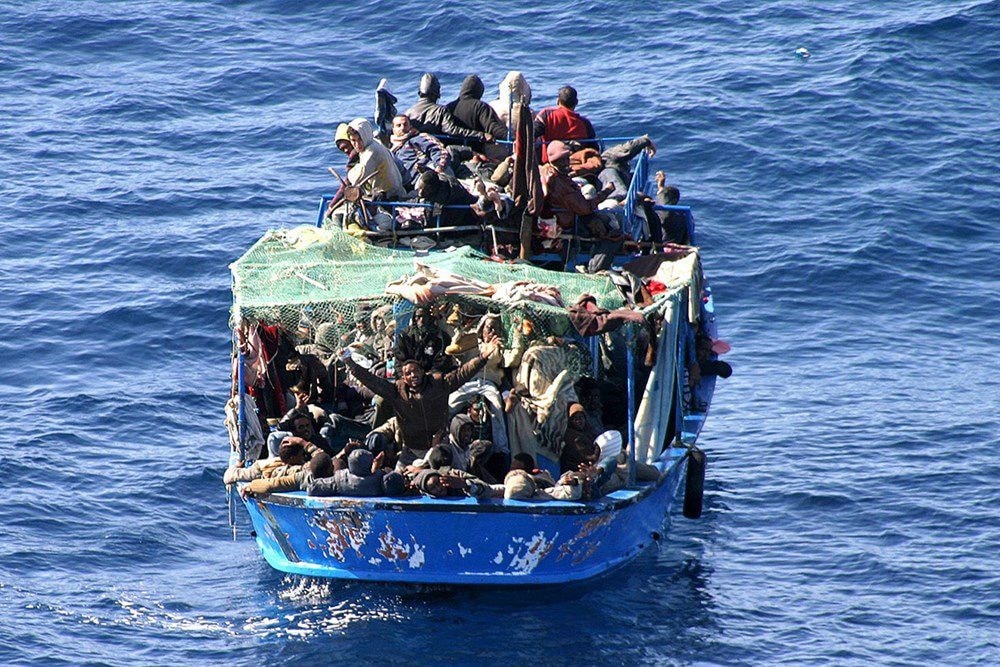 |
| Approximately 111 migrants await rescue on a boat after enduring a grueling 48-nautical-mile journey off the coast of Malta. (Source: Reuters) |
However, this meeting still failed to produce long-term solutions to the immigration problem, only reaching a relatively specific conclusion: the "Triton" border protection operation, launched by the European Union in 2014 and implemented by Frontex, will be intensified. Many countries, including France, Germany, Belgium, Latvia, etc., have decided to provide Frontex with new equipment. French President Francois Hollande announced that he would send a patrol vessel, a deep-sea tugboat, surveillance aircraft, and double the number of expert personnel participating in the program. Previously, France had deployed two ships and an aircraft to participate in the Triton operation.
Although not participating in the operation, the United Kingdom pledged to send two patrol boats and three radar-equipped helicopters. Notably, HMS Bulwark, one of the key warships of the Royal Fleet, would also be deployed. British Prime Minister David Cameron declared that if any of these ships encountered illegal immigrants, they would be allowed to dock in the nearest country – which, of course, could only be Italy. This statement demonstrated the British Prime Minister's firm stance on immigration, despite his tense election campaign. Italian Prime Minister Matteo Renzi agreed with Cameron's approach, and it was the general conclusion of the meeting: after all the tragedies in the Mediterranean Sea caused by illegal immigration, it was time to find a truly humane solution that also ensured safety.
Thus, the cost of Operation Triton is expected to increase from 2.9 to 9 million euros per month. There were also suggestions to reintroduce the “Mare Nostrum” program – an independent rescue program launched by Italy and discontinued in 2004. While the program was controversial from a humanitarian standpoint, its effectiveness is undeniable: since “Triton” replaced “Mare Nostrum,” the number of people attempting illegal border crossings has increased by 160%. Ultimately, the meeting concluded that the operating terms of Triton would remain unchanged, and the operational area would be limited to approximately 55km from the European coast.
However, the European Commission insists that Frontex vessels will still be allowed to operate in “nearby areas” and even in deep waters. Another goal set by the Commission—the seizure and destruction of small boats used by the illegal immigration network—is also controversial, as it runs counter to international law. The EU is seeking approval from the UN Security Council. French President Francois Hollande said he would raise the issue with Russian President Vladimir Putin during his visit to Armenia.
He hopes to persuade Russia not to veto the Security Council – something Russia has done before regarding proposals to intervene in Libya. Regardless of Russia's position on the matter, it will certainly take a long time to gain UN approval, and the EU will have to quickly find temporary alternatives.
It seems even that is a thorny question for the EU, as member states have yet to find common ground. Programs like “Dublin II”—which mandates that receiving countries handle immigration applications themselves—or the “Project Pilot”—allowing 5,000 Syrian refugees in detention camps to enter an EU member state—are stalled. While the British Prime Minister argues for voluntary allocation, Germany and Conservative members of the European Parliament support mandatory quotas. The only certainty is that the longer this drags on, the greater the public backlash and pressure on the EU will become, with the upcoming April 29th talks awaiting an explanation from European Council President Donald Tusk.
Thuc Anh
According to Le Monde
| RELATED NEWS |
|---|