

Russia supplies S-300 missiles to Iran: A difficult choice for Israel.
(Baonghean) - “That is the choice of the Israeli leadership; they have the right to do what they consider beneficial” - this was the response of Russian President Vladimir Putin in a recent television interview regarding the possibility of Israel supplying weapons to Ukraine in retaliation for Russia's decision to lift the ban on supplying S-300 air defense missile systems to Iran. With this statement, Israel can understand that it cannot pressure Putin to change his decision, and Israel's only remaining choice is how to behave in its relationship with Russia.
| RELATED NEWS |
|---|
After expressing his stance that Israel "can do whatever it wants," Russian President Vladimir Putin did not forget to warn of the consequences of this action, stating that the weapons Israel is transferring to Ukraine will only increase tensions and the number of casualties, and "the result will remain the same." Vladimir Putin also emphasized that Israel's actions will undermine efforts to bring peace to eastern Ukraine.
Of course, the Kremlin leader understood perfectly well that the threat to Israeli Prime Minister Benjamin Netanyahu was in retaliation for Russia lifting its ban on supplying S-300 air defense missile systems to Iran. Therefore, Putin dismissed Israel's concerns, asserting that the S-300 is merely a defensive weapon and therefore poses no threat to the security of Israel or other countries in the Middle East.
Earlier, on April 18, Russian Deputy Defense Minister Anatoly also emphasized that Russia does not face any international obstacles in supplying Iran with the S-300 air defense missile system, because the S-300 is not an offensive weapon.
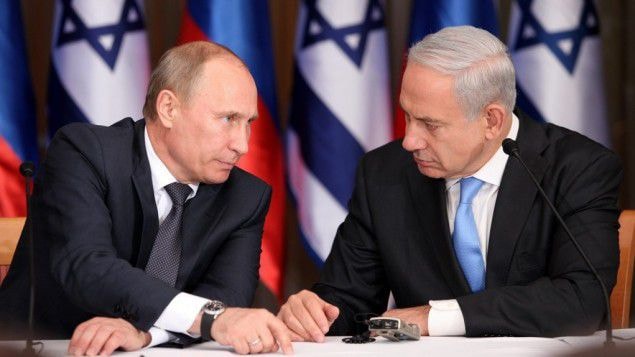 |
| Russian President Vladimir Putin and Israeli Prime Minister Benjamin Netanyahu. |
Iran is currently hoping to receive Russian S-300 air defense missiles by the end of this year. However, Russia has not promised a specific timeframe, citing that this depends on the capabilities of its manufacturing plants. Nevertheless, one thing is certain: Israel has not been able to influence Russia's decision in this deal. The remaining question is whether Israel will act on its threat to supply weapons to Ukraine. In fact, the connection between Russia's supply of S-300s to Iran and Israel's supply of weapons to Ukraine dates back to the past.
In 2007, Russia signed a contract to sell Iran the S-300 missile system, worth up to $800 million. However, this contract was frozen after the UN Security Council adopted a resolution imposing sanctions on Iran over its controversial nuclear program. Although not publicly stated, Israel's subsequent refusal to supply weapons to Ukraine and Georgia is believed to be a "retaliatory" move against Russia. Therefore, theoretically, once Russia resumes the S-300 supply contract with Iran, Israel would have the right to supply weapons to Ukraine.
Vladimir Putin himself acknowledges this "right" of Israel, but whether Israel will exercise its "right" is another matter, and Israel will certainly have to carefully consider its options if it intends to take this reckless step. Israel's opposition to Russia is based on concerns about the threat that the S-300 missile defense system poses to its security. With the ability to track up to 100 targets and simultaneously engage 12 to 36 targets, and the capability to effectively destroy all airborne targets such as aircraft and ballistic missiles, the S-300 system that Russia will supply to Iran is understandably causing Israel considerable unease.
However, the difference between the two arms deals between Russia and Israel is that Russia is supplying defensive weapons to Iran, while Israel has not clarified whether it will supply Ukraine with offensive or defensive weapons. Of course, behind every arms deal are many strategic calculations from the parties involved, and the story will not just be about offense or defense, but there is one factor that puts Russia in a more advantageous position than Israel. That is, Russia is supplying S-300 missiles to Iran under conditions where there is no conflict or fighting in Iran, and the likelihood of countries taking military action over Iran's nuclear program is low, given that the parties reached a framework agreement in early April.
Conversely, Ukraine remains a persistent "hot spot" that the international community has had to expend considerable effort to de-escalate. Despite numerous difficulties, the Normandy Four reached the Misk-2 agreement – a deal that temporarily defused the conflict in eastern Ukraine – but its maintenance remains very fragile. In this context, supplying weapons to Ukraine would undoubtedly cause Israel to lose significant credibility in the eyes of the international community – an outcome that even the US was previously unwilling to accept when considering doing the same.
Furthermore, Israel's carrying out its threat would mean pushing Russia-Israel relations into a serious confrontation. Previously, both Russia and Israel always tried to maintain friendly relations, especially in economic and trade cooperation. Although Russia is an ally of Iran, in Middle Eastern affairs, Russia has always acted as a mediator, never directly confronting Israel.
Israel has also acted similarly by maintaining neutrality in confrontations between Russia and the West, even though Israel is a close ally of the United States. Once Israel sides with Ukraine by supplying weapons, this relationship will certainly be lost, as the whole world is well aware of Vladimir Putin's hardline stance on the Ukraine issue.
This is a consequence that Israel will have to weigh the pros and cons of, especially given the recent growing impatience of the West with Israel's approach to the Iranian nuclear issue and the conflict with Palestine. Therefore, deciding how to respond to Russia's supply of S-300 missile defense systems to Iran is a truly difficult problem for Israeli Prime Minister Benjamin Netanyahu.
Thuy Ngoc