

Victory of April 30th: "Let's not forget the 300,000 martyrs who have yet to return home."
Chairman Nguyen Thien Nhan: "On April 30, 2015, let us all pray for the souls of the martyrs to return and witness the development of our country."
"On April 30, 2015, let us all pray for the souls of the martyrs to return and witness the development of the country, to see that the sacrifices of the heroic martyrs have been rewarded. Let us also not forget that there are still more than 300,000 martyrs whose remains have not yet been found." Mr. Nguyen Thien Nhan, Member of the Politburo and Chairman of the Central Committee of the Vietnam Fatherland Front, shared this with the press on the occasion of the 40th anniversary of the complete liberation of the South and the reunification of the country (April 30), to further clarify the significance of this momentous historical event and the Front's role in mobilizing the strength of national unity.
3 memorable lessons from the historic victory of April 30th.
PV:Mr. Chairman, the whole country is celebrating a glorious historical milestone, the 40th anniversary of the liberation of the South and the reunification of the country. As the head of the Central Committee of the Vietnam Fatherland Front, how do you assess the significance of the victory of April 30th in the current context?
Chairman Nguyen Thien Nhan:When the country was at war, it was normal for young men to go to the front lines, while women stayed home to do all the work. In those days, when bombs fell on houses and streets, people sought shelter and then continued to work and continue fighting.
But over the past 40 years, we have all seen that survival in war is not the rule of humankind. The general rule is survival in peace.
Our victory in that war held immense significance, serving as a historical lesson. It was a victory for a people (95% illiterate) and over 95% barefoot, fighting against one of the most modern empires in the world at that time. But why did we win?
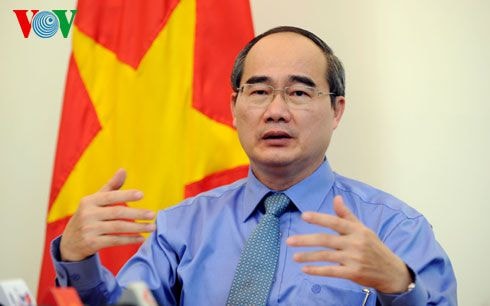 |
| Mr. Nguyen Thien Nhan, Member of the Political Bureau, Chairman of the Central Committee of the Vietnam Fatherland Front (photo: Hoang Long) |
We know that our nation has a tradition of fighting invaders, but fighting a modern enemy with guns, ammunition, and overwhelming power is an enormous challenge. At that time, we had the most advanced tool in terms of revolutionary philosophy: the intellectual superiority of the Party combined with the traditions of the Vietnamese nation, which created extraordinary strength. Without this dialectical strength, we could not have liberated the country. In my opinion, the first lesson is that a country may be weak materially, but it must not be intellectually backward.
Secondly, why can barefooted soldiers defeat soldiers in shoes? Why can bamboo sticks defeat cannons and airplanes? It is thanks to the spirit of national unity. In 1960, President Ho Chi Minh taught, "Thanks to national unity, for centuries the Vietnamese people have protected their independence and freedom. Thanks to national unity, the Vietnamese people defeated colonialism, achieving the success of the August Revolution and the victorious resistance war. Thanks to national unity, Vietnam will certainly be unified."
Thirdly, relying solely on our own strength, we cannot defeat the invaders. Besides the intellectual strength of humanity, which is Marxism-Leninism, we can also utilize the power of the times. This includes the assistance of developed countries in Eastern Europe. Without the help of countries like the Soviet Union, how could we have had the cars, tanks, and airplanes to fight the Americans?
The lesson is that if a nation has the right path, follows the righteous way, and knows how to utilize the strengths of the times, it can defeat very powerful enemies. In other words, to overcome challenges, one must know how to utilize the strengths of the times. But internal factors must remain the core to unleash external advantages.
The question is, what is the strength of the modern era? During wartime, the strength of the era was the consensus on the goal of regaining peace and national independence. Now, the strength of the era is the ability to reach consensus with other nations. Each nation must look after its own interests, its independence, sovereignty, and the happiness of its people, but without infringing on the interests and rights of others. If we can do that, we can unite politically and ideologically.
Secondly, in today's era of globalization, we must know how to take advantage of the opportunities offered by globalization in terms of markets, technology, capital, human resources, and regional integration. This is a very special opportunity that opens up possibilities for a country, even one that may start from a much lower base than many others, to rise rapidly.
The third lesson is national unity. Even now, with a GDP per capita of over $2,000, this lesson remains extremely important and needs to be promoted in the current circumstances.
PV:How does the Chairman assess the contributions of the National Liberation Front of South Vietnam to the victory of April 30, 1975, especially during the period 1954-1975?
Chairman Nguyen Thien NhanDuring the uprising of the people of South Vietnam, the National Liberation Front of South Vietnam was established (December 20, 1960).
From December 20, 1960, just one year after the political struggle movement developed, the people initiated a political struggle combined with military mobilization, leading to localized armed struggle and the creation of the Đồng Khởi (General Uprising) movement. The masses themselves proved that from political struggle and military mobilization, small armed forces could be formed to fight the enemy, reclaim parts of the land, and gradually create a combined force of politics, military mobilization, and armed struggle. By the end of 1964, we had essentially dismantled the strategic hamlet strategy of the US and its puppet regime.
With the establishment of the National Liberation Front of South Vietnam, the struggle created a new situation: liberated zones. This was particularly significant, as liberated zones began to exist in 1965. Thus, after five years of the National Liberation Front of South Vietnam, with the combined struggle in the South and support from the North, we transformed from fighting within enemy territory into having our own independent zones. This was a revolutionary transitional period, but it also marked the creation of liberated zones. The Front was responsible for managing the government in these liberated areas.
It can be said that the Front's role shifted from directly supporting political and armed warfare to managing liberated areas, while simultaneously receiving support from the North to form a state management system to carry out operations.
The establishment of the National Liberation Front of South Vietnam was the result of a correct revolutionary line. The Front harnessed the initiative of the people and developed step by step, making a worthy contribution to the victory of liberating the South and unifying the country.
Let's not forget that 300,000 martyrs have yet to be brought home.
PV:Building upon the spirit of the April 30th victory in the current process of national construction and defense, what important goals and tasks are the Vietnam Fatherland Front and other socio-political organizations focusing on, Mr. Chairman?
Chairman Nguyen Thien Nhan:In 2014, the Vietnam Fatherland Front held its 8th National Congress, outlining five key areas of activity. Alongside its fundamental and traditional role of mobilizing the people to understand the Party's policies and fostering consensus and initiative, the Front's communication efforts emphasized reflecting the people's voice to the Party and government at all levels. The guiding principle was to inform the people about the Party's policies and the country's situation, but also to listen to the people and convey their voices to the government at all levels, including the crucial task of listening to the voices of Vietnamese people living abroad.
The second task is that, in the face of international and domestic challenges, if we want to accelerate sustainable development with greater efficiency, we must promote the initiatives of the people, organize campaigns and emulation movements to encourage people to contribute their ideas to building the country and improving people's lives.
The third task is to promote democracy, with the Vietnam Fatherland Front and other political organizations playing a core role in supervising and providing social feedback on the country's development, as required by the 2013 Constitution. This is a sacred responsibility, and anyone working for the Fatherland Front, youth organizations, women's organizations, veterans' associations, or the Vietnam General Confederation of Labor has the honor and mission to fulfill the supervisory and critical responsibility required by the Constitution.
Another task is for the Front to build a truly strong organization from the grassroots level to meet the aspirations of the people as well as the Party and the State. In the current context, I believe it is necessary to strengthen propaganda about the achievements of our country over the past 40 years.
I recently attended the 40th anniversary celebration of the victory in Tra Vinh, and it was very clear that, even without comparing it to 1975, just compared to 1997, the year Tra Vinh province was re-established, by 2014, the province's economic growth had increased fivefold, and the face of the countryside had changed rapidly. Previously, in the Southwest region, meeting anyone required crossing by ferry, but now magnificent bridges are everywhere – a centuries-old dream of the people has finally come true.
Previously, who would have thought that Ca Mau and Bac Lieu would have wind power? Now, 20 wind turbines are operational, and more are being added. Thus, a country emerging from war with an average income of only 78 USD has seen a dramatic transformation in 40 years. The task set by the Front is to mobilize the strength of national unity to propel the country forward, making its development faster and more sustainable.
PV:On the occasion of the 30th anniversary of the reunification of the country, what message does the Chairman of the Central Committee of the Vietnam Fatherland Front want to convey to the Vietnamese people both at home and abroad?
Chairman Nguyen Thien Nhan:On April 30, 2015, let us all pray that the souls of the martyrs may return to witness the development of the country and see that the sacrifices of these heroic martyrs have been rewarded.
We pray that the heroic Vietnamese mothers who have passed away will know, when their descendants light incense, that their names are inscribed throughout this country. For the heroic Vietnamese mothers who are still alive, let us strive to care for them so that they may all be happy.
Let us not forget that the remains of over 300,000 martyrs have yet to be found. Let us light an incense stick at the martyrs' cemetery, at the memorial, and even at our ancestral altars, hoping that the martyrs will understand our situation. Forty years have passed, and although our government, army, and our friends in Laos and Cambodia have made efforts to bring tens of thousands of martyrs' sons and daughters home, over 300,000 martyrs are still missing.
We also want our international friends who contributed to the victory of April 30th to know that Vietnam will always remember their support during the war against the United States.
PV:Thank you very much, sir.
According to VOV