
The new growth of Nam Giang
(Baonghean) - In recent years, Nam Giang commune has actively collaborated with investors in the implementation of investment projects according to the industrial cluster plan. Thanks to this, from a purely agricultural commune, Nam Giang has made a strong breakthrough in economic restructuring.
(Baonghean) - In recent years, Nam Giang commune has actively collaborated with investors in the implementation of investment projects according to the industrial cluster plan. Thanks to this, from a purely agricultural commune, Nam Giang has made a strong breakthrough in economic restructuring.
Companiontogether with investors
Visiting Nam Giang today, the first impression is the bustling activity of factories and enterprises in the commune. From a purely agricultural area, lacking services just a few years ago, it has now become truly vibrant with a full range of services: food and beverage services, guesthouses, souvenir shops, general stores, etc. The commune always accompanies investors throughout the project implementation process, such as: clearing and handing over land on schedule, ensuring consensus, and coordinating to ensure security, order, and environmental protection when the projects are operational. Chairman of the Commune People's Committee Tran Huu Van informed: Nam Giang has a total of 480 hectares of agricultural land, but 120 hectares, equivalent to 1/4 of the land, have been allocated for the construction of industrial clusters. There are 14 agencies and factories located in the area. Despite the large number of businesses and the large area of land reclaimed, no complaints or hotspots have occurred during the project implementation.
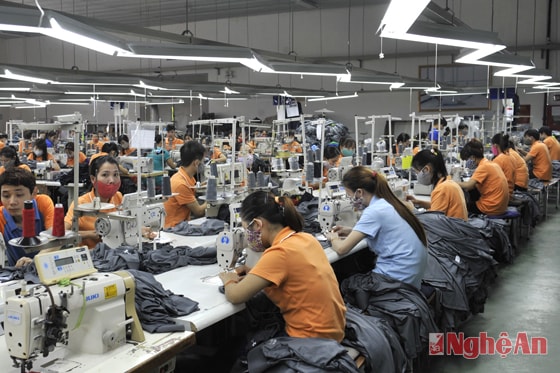 |
| Children from Nam Giang commune work at Havina Kim Lien garment factory. Photo: SM |
Thanks to the commune's proactive efforts in attracting investment, the Nam Giang industrial cluster is now basically full with 3 fairly large projects, including 2 projects that have entered stable operation: Havina Kim Lien Garment Factory and Hanosimex Nghe An branch. These two factories have created jobs for more than 3,500 workers. Also here, another project is being implemented on an area of 25 hectares in the Vung Dung high-tech industrial cluster, with a total investment of nearly 2,000 billion VND by VN Nam Dan Van An Company in the field of processing precious stones and metals. Currently, the enterprise has entered phase 1 production and is implementing all aspects of the project. Mr. Kim Chul Ho, CEO of Havina Kim Lien Garment Factory, said: “Although we are a foreign-invested enterprise in Nam Giang commune, we feel very close and friendly with the local authorities. We regularly coordinate to ensure security and order, and manage labor effectively. Thanks to this good cooperation, the more than 2,800 workers at the factory are now truly confident and diligently follow the industrial garment production line process…”
It can be said that few communes have such a close relationship between investors and local authorities as Nam Giang. The commune and the companies/units have signed agreements on coordination to ensure security, order, and environmental hygiene in the area. Twice a year, the commune and investors meet to jointly evaluate and review the coordination process and identify areas for improvement. Mr. Tran Tien Dung, Director of the Hanoi Textile and Garment Corporation branch, said: “The factory cooperates very closely with the commune, especially in ensuring security and order. The factory's security force and the commune's security personnel regularly monitor the situation to coordinate and protect assets and workers. We are truly reassured when investing in building the factory in the area.” Currently, the branch employs 840 workers, and this number will increase to over 3,000 when it invests in two more yarn spinning and weaving lines. Thanks to the investment attraction results, Nam Giang has made a significant shift in its local labor structure, effectively addressing employment and income issues for people after land conversion. Currently, the Nam Giang industrial cluster employs nearly 5,000 workers, of which over 900 are local residents.
Redirectin agricultural production
Guided by the Chairman of the People's Committee of Tran Huu Van commune, we visited models of commercial production after land conversion. At Chua Chuyen field, there is a highly effective model of growing green squash on double-cropped rice land belonging to Mr. Phan Trong Ba's family in Hamlet 2. On nearly 5 sao (approximately 0.3 hectares) of concentrated land, Mr. Ba planted 3 sao of green squash and the remaining 2 sao with green beans, kohlrabi, cabbage, carrots, etc. Previously, this area only cultivated two rice crops a year, leaving the land fallow during the winter. Now, green squash, green beans, cabbage, and kohlrabi are growing lushly throughout the area. Mr. Ba said: "In about 10 days, we can harvest the first squash fruits to sell to workers. With high yields and current squash prices, growing squash on double-cropped rice land is three times more profitable than growing rice. Next season, my family will expand cultivation to the entire existing area to increase the value after land conversion and crop conversion."
Besides Mr. Ba's family, the families of Mr. Nguyen Dinh Cuong and Mr. Le Quang Dung also participated in growing commercial vegetables and crops during the winter season, achieving high economic efficiency. In the Dong Vo area, the 2 hectares of commercial glutinous corn grown by Mr. Nguyen Van Thanh's family in Hamlet 5 demonstrated the effectiveness of growing glutinous corn in the winter season on land previously used for two rice crops. To encourage households to boldly grow commercial vegetables and crops during the 2014 winter season, Nam Giang commune implemented a mechanism to support the provision of seeds, fertilizers, pesticides, and guidance on planting, caring for, and harvesting on an area of 6 hectares. Thanks to this support, nearly 30 households participated, creating a new momentum for production in the fields. Chairman of the People's Committee of Nam Giang commune, Tran Huu Van, stated: "The commune will gradually encourage households to become familiar with the production of commercial vegetables and food crops."
Initially, the focus is on selling to factory workers. In the long term, the plan is to develop a production process for vegetables and food according to standards and quality, ensuring food safety and hygiene to provide a stable food supply for factories to serve workers' meals and potentially expand the model to other markets. To prepare for entering the commodity production sector, the commune directs agricultural cooperatives to provide excellent "two-way" services (input and output) to ensure farmers can produce with peace of mind. The commune has also established 40 hectares of large-scale specialized rice fields for high-quality rice varieties, such as the Cua Ngan area in Hamlet 11, the Lang Ru area, the Dap Nen area, and the Cua Khe area in Hamlet 10. Areas suitable for specialized crop cultivation include the Chua Chuyen and Nha Ray areas, and areas specializing in aquaculture. There are currently 29 efficient farms in the commune. Simultaneously, the application of technology and the introduction of mechanization into the fields to replace manual labor and increase land use efficiency are being emphasized by the people. The entire commune currently has 26 plows for land preparation and 16... Rice threshing machines, 5 hand-held harvesting machines... free up labor and increase production value in agriculture.
Lessons learned from attracting investment and restructuring the agricultural labor force are giving Nam Giang a new impetus, especially after achieving national standards for new rural areas. The success of the agricultural production model transformation, combined with industrial clusters in the area, provides a solid foundation for Nam Giang to continue successfully implementing the model commune construction project.
Huu Nghia