

Massive capital will continue to be poured into transportation.
Not stopping at the figure of approximately 160 trillion VND, it is expected that in the coming years, the transportation sector will attract even more huge amounts of capital from sources outside the state budget for investment in the construction of transportation infrastructure.
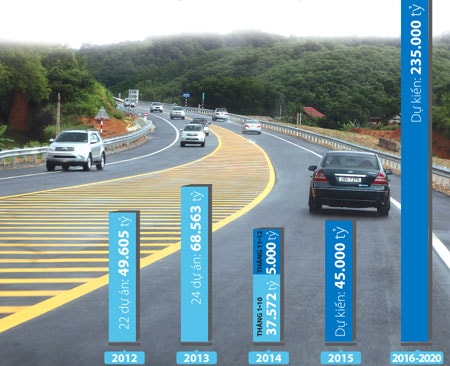 |
| Results of mobilizing social capital for transportation projects from 2012 - 2014 and projections for the years 2015 - 2020. |
One year is equivalent to several decades combined.
According to Mr. Nguyen Viet Huy, Deputy Head of the Public-Private Partnership (PPP) Project Investment Management Board, the Ministry of Transport has so far mobilized 65 investment projects under the public-private partnership model with a total investment of approximately 160 trillion VND.
“Starting in 2013, the mobilization of capital from socialized investment in the transport sector has seen a major breakthrough. In 2013 alone, 24 projects were mobilized with a total investment of approximately 68,563 billion VND. In 2014, up to the end of October, there were 19 projects with a total investment of 37,572 billion VND. It is expected that by the end of 2014, there will be five more projects, raising the total capital attracted this year to 42,572 billion VND,” Mr. Huy said.
Speaking with a reporter from Giao Thong Newspaper, Mr. Tran Xuan Sanh, Director of the Department of Construction Management and Quality of Transport Works, said that investing in transport projects using socialized capital will lessen the burden on the budget and reduce public debt. At the recent National Assembly session, the Ministry of Finance reported that in 2014, only about 200 trillion VND was issued for investment. The 160 trillion VND mobilized by the Ministry of Transport is incredibly significant. According to calculations, this amount accounts for approximately 64% of other capital sources from the budget and ODA allocated to transport.
This is even more significant considering that over the years, the combined annual budget and government bond funding allocated to the transport sector has only amounted to just over 20 trillion VND, half of the required amount. The lack of matching funds has significantly impacted land clearance and project construction. The situation of having to borrow funds from the following year to "make ends meet" has persisted for decades. Due to this capital shortage, the average annual disbursement for the transport sector has been modest, at around 50 trillion VND. However, thanks to the effective attraction of socialized capital, this year's disbursement is expected to reach a record high of 100 trillion VND.
“This achievement is the result of the decisive involvement of the entire transport sector. The leaders of the Ministry of Transport and relevant agencies consider attracting non-budgetary capital as a unique opportunity and have sought every way to remove as many obstacles as possible in terms of mechanisms and policies for investors. To facilitate investors, many projects even commenced construction before receiving investment licenses,” Mr. Sanh said.
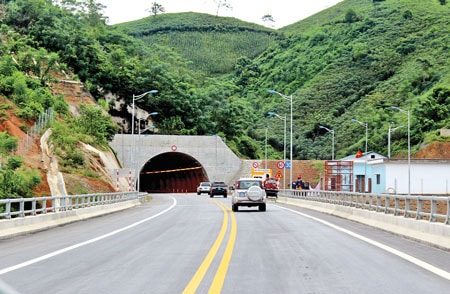 |
| Transferring the operating rights of completed highway projects will help generate additional funds for investment in other transportation projects. |
Attracting more and more investors
Mr. Pham Van Khoi, General Director of Phuong Thanh Tranconsin, one of the three investors in the project to upgrade the Phap Van - Cau Gie expressway to expressway standards, said that the Ministry of Transport's policy of socializing investment has created great efficiency and a new impetus for investors. Previously, very few investors were interested in transportation projects because of the large capital requirements and the long payback period. However, nowadays, each project usually attracts many investors (both domestic and foreign), leading to intense competition. To be selected, investors must have real capacity and financial resources to ensure the project is implemented on schedule and with quality.
“For example, in the Phap Van - Cau Gie project, as soon as they were selected as investors, the consortium of Minh Phat Construction Investment Company - Construction Corporation No. 1 (Cienco 1) and Phuong Thanh Tranconsin quickly mobilized sufficient equity capital to contribute to the project. Because this is a gateway project to the South of the Capital, with a large volume of traffic, the investors also had to deploy a large workforce and machinery to accelerate progress and ensure that the project was opened to traffic by June 2015 as required by the Ministry of Transport,” Mr. Khoi shared.
Sharing the same view, Mr. Nguyen Tuan Huynh, General Director of Construction Corporation No. 4 (Cienco 4), said that investing in socialized transportation projects is a strategic choice for Cienco 4 in the coming years.
Proof that the policy of privatizing transportation infrastructure is increasingly attracting investors is the fact that many transportation projects that had been "unsuccessful" for a long time, unable to find investors, are now in high demand. The Ninh Binh - Thanh Hoa - Bai Vot expressway, despite being on a national arterial road, struggled for years to find funding. Now, with the privatization policy, many investors are interested, and construction could begin in a short time. Similarly, the Trung Luong - My Thuan section has also attracted many investors. The Thai Nguyen - Cho Moi expressway, passing through one of the poorest localities in the country with low traffic volume, has successfully attracted investment and has begun construction.
A huge amount of capital will be invested in transportation.
With increasing investor interest in transportation projects, it is expected that the amount of socialized capital flowing into this sector will be much larger in the future. According to Mr. Nguyen Viet Huy, the amount of non-budgetary capital mobilized in 2015 will be even higher than in 2014, at approximately 45 trillion VND. It is projected that from 2016 to 2020, a massive amount of non-budgetary capital, up to about 235 trillion VND, will be invested in transportation.
"The flow of socialized capital into transportation will certainly increase in the coming period, due to increasingly open capital attraction policies and a more favorable legal framework. Credit institutions are also very interested and ready to support investors with the capacity and experience to invest in transportation projects," said Mr. Pham Van Khoi.
Mr. Le Duc Tho, General Director of VietinBank, also stated that investing in transportation infrastructure projects is one of VietinBank's strategic goals. Currently, VietinBank is financing many socialized projects in the transportation sector, not only in road transport but also in other areas such as aviation, railways, inland waterways, and maritime transport.
To attract more capital from private sector investment, the Ministry of Transport will continue to create the most favorable conditions in terms of policies and legal frameworks. According to Mr. Tran Xuan Sanh, the management regulations of state agencies are currently governed by Decree 108. However, this Decree still reveals some shortcomings, and the Ministry of Transport will diligently work with relevant agencies to supplement and amend it accordingly.
The Ministry of Transport is also studying the transfer of infrastructure operation rights and toll collection. In response to questions from National Assembly deputies at the recent session, Minister Dinh La Thang affirmed that this is a breakthrough solution to attract more private investment capital for transportation in the future. “524 km of expressways have already been completed. If we transfer these rights to domestic and foreign investors, we will have the funds to complete another 500 km in a phased manner, which is particularly significant,” Minister Thang said.
According to the Ministry of Transport