

A time of "fire and glory"
(Baonghean) - Forty years have passed since the war ended, and the country continues to overcome difficult challenges to achieve sustainable development. The lessons of unity learned during the resistance war against the US are being upheld, creating the strength of the nation... These days, memories of the "time of fire and flowers" inspire generations of Vietnamese people to move forward, with the active support of the military and people of Nghe An always accompanying them.
Crossing the sea to the South
Dien Ngoc commune (Dien Chau district), one afternoon in April 2015. Recalling the nameless ship that sailed south that year, Mr. Ngo Tri Ban's face became pensive. A time of heroic youth, overcoming countless hardships and sacrifices, remains etched in the heart of this former naval veteran.
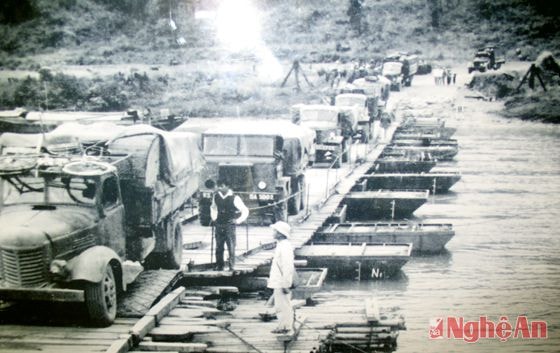 |
| The Nghe An Public Security Force guides trucks carrying goods and weapons into the Southern battlefield via the Cam Bridge - Nghi Loc (1965). Photo: St |
In 1969, Ngo Tri Ban, a young man from the coastal region, was recruited into the navy. After training, he was assigned to the iron ship Nhat Le, numbered 69B, part of the "No Number" fleet specializing in transporting weapons to the Southern battlefield via the Ho Chi Minh Trail at sea. The young man from the coastal region eagerly accepted the position of chief engineer and second-in-command of the 12.7mm machine gun.
One day in early November 1970, after a "living memorial service" organized by his unit, Ban and 22 sailors from Ha Long Bay, carrying 200 tons of weapons and equipment, sailed across the sea to support the South in fighting the Americans. Sometimes disguised as a fishing boat, other times as a merchant ship, and flying the flags of various countries in the region, the vessel maneuvered the seas to evade enemy detection. The unmarked ship drifted at sea for nearly four months to avoid enemy attention. Then, one night in April 1971, after reaching the required location, the ship headed towards Ca Mau Cape.
 |
| Mr. Ngo Tri Ban (right) (from Dien Ngoc, Dien Chau) recalls his comrades who died on the "No Number" ship during the battle against enemy ships and aircraft in the Ca Mau sea area (April 1971). |
When about 20 nautical miles from Cape Ca Mau, they unexpectedly encountered an enemy warship. Under the command of Captain Phan Xa, the crew fiercely fought back, suffering nearly half casualties. With no other choice, the captain fired a flare towards the mainland to report the news, and simultaneously ordered the remaining soldiers to evacuate the wounded and dead from the ship and detonate the explosives planted in the ship's hold. Ngo Tri Ban was the last to leave the ship. After swimming about 50 meters, he was thrown high into the air by the ship, which was carrying 200 tons of weapons and goods, when it exploded violently and sank into the sea... Overcoming the waves, Ban and 15 other comrades were gradually found by local guerrillas and continued fighting until the complete liberation of South Vietnam.
Mr. Nguyen Dinh Sin, Head of the Liaison Committee of the Veterans of the "No Number" Naval Fleet of Nghe Tinh (currently residing in Hung Loc commune, Vinh City), stated that according to data from the Naval Command, from 1961 to 1975, the "Ho Chi Minh Trail on the Sea" saw 1,789 voyages of "No Number" ships transporting 150,000 tons of weapons, equipment of all kinds, and 80,000 personnel. Generations of officers and soldiers of Unit 125 fought more than 30 battles against enemy ships, repelled 1,200 enemy air raids, shot down 5 aircraft, and destroyed many enemy boats and vessels; successfully completing their assigned tasks. In this glorious victory, 54 sons of Nghe An province made a worthy contribution.
The Opening Song
During the years of the war against the US to save the country, tens of thousands of young men and women volunteered to fill bomb craters and open roads to the South, regardless of sun, rain, bombs, and bullets. For Heroine of the People's Armed Forces Ho Thi Thu Hien, the memories of that "time of fire and flowers" remain vivid.
In a quiet house in Le Mao ward (Vinh City), Ms. Hien recounted to us the heroic period of her youth. In 1969, at the age of 22, while serving as the Youth Union Secretary of Hung Phu commune (Hung Nguyen district), she volunteered to join the Youth Volunteer Force and was appointed company commander. Her unit was deployed to serve on the fierce Tri-Thien front and Route 9 in Southern Laos. Her hands, along with those of her comrades, became calloused from carrying supplies, transporting the wounded, filling bomb craters, and building roads. Bombs, hunger, lack of sleep, and terrible malaria did not deter these young men and women from Nghe An province in their twenties.
...Once, the company discovered three magnetic bombs lying in the middle of the road. Hien calculated that using explosives would be safe but would severely damage the road, while pushing the bombs down into the ravine would certainly cause less damage. Company commander Ho Thi Thu Hien made a bold decision. With a spirit of volunteerism, she formed a suicide squad, directly commanding them, using bamboo poles to dislodge the magnetic bombs. After a memorial service, the suicide squad approached the three bombs, digging them up with their hands and using bamboo poles to push them. From afar, the entire Youth Volunteer Company and the drivers held their breath watching, then all froze when all three bombs exploded with a deafening bang. But then they burst into tears when they saw the women of the suicide squad carrying the bombs running out onto the road. For her exceptionally outstanding achievements, in 2009, Ho Thi Thu Hien was awarded the title of "Hero of the People's Armed Forces" by the State.
Mr. Mai Ất, Chairman of the Nghe An Former Youth Volunteers Association and former Chairman of the Vinh City People's Committee, said: In late May 1965, during the first week of the "Three Ready" movement, nearly 10,000 young men and women from all over the province, of all backgrounds and religions, volunteered to join. Many wrote their applications in blood. While Nghe An province had 11,800 young people participating in the Youth Volunteers force during the resistance against the French, this number increased to nearly 30,000 during the resistance against the Americans. The Nghe An Youth Volunteer Force joined forces to ensure traffic flow on 52 routes, covering over 2,300 km of provincial and national roads, 200 km of roads in neighboring Laos, 200 km in Quang Binh and Quang Tri provinces, 3,500 km of district roads, 250 km of rivers, seas, and the Nha Le canal, and 60 km of railway lines passing through key areas... All contributed their strength and intelligence alongside the army and people of the whole country to liberate the South and unify the nation.
Battle spirit
In early 1975, the people of North Vietnam in general, and Nghe An province in particular, lived in an indescribable atmosphere of jubilation. Victories from various regions resounded throughout the area. However, a great deal of manpower and resources were still needed for the battlefield. Mr. Dau Ngon (90 years old), residing in Dien Thanh commune (Dien Chau district), still remembers the "Dien Hong Conference" organized by the district on a day in early 1975. There, many elderly people in the district expressed their determination to encourage their children and grandchildren to enlist, participate in the civilian labor force on the front lines, and volunteer to contribute rice, pigs, and chickens to feed the troops. During that period, the district exceeded its troop recruitment target by 12%.
The people of Minh Thanh commune (Yen Thanh district) still remember the image of Mr. Tran Van Trang from Yen Thinh parish happily bidding farewell to his youngest son as he joined the army. This was the sixth time he had entrusted his sons to the military, to the front lines against the Americans. Meanwhile, in Dien Ky commune (Dien Chau district), Mrs. Dang Thi Tiep, a Catholic and mother of a fallen soldier, also came to the troop deployment site to encourage the new recruits. In the March 1975 enlistment, the number of Catholic youths enlisting alone increased 4.1 times compared to the whole of 1974.
Mr. Ha Van Tai (residing in Hung Loc commune, Vinh City), former Deputy Secretary of the Vinh City Party Committee, recalled: In just one day at the beginning of 1975, Vinh City sent 1,023 young men to join the army, exceeding the assigned target by 20%, equaling the combined recruitment targets of 1975 and 1976. This was the highest result since 1959 - the first year of implementing compulsory military service. From 1959 to 1975, Nghe An had over 163,000 young men and women joining the army, nearly 30,000 participating in the Youth Volunteer Force, and tens of thousands participating in civilian labor to support the battlefields. It is a source of pride that, regardless of their position, the children of Nghe An upheld the traditions of their homeland, achieving outstanding accomplishments and making worthy contributions to the great victory of the nation, allowing the country to harmonize in the epic of national unity throughout the country.
Viet Long