
Ky Son: Spreading the "key figures in poverty alleviation"
(Baonghean) - Ky Son district, a remote border area, has developed and implemented 282 effective economic models in its villages. Besides helping people overcome difficulties and become wealthy, these models have become sustainable "poverty alleviation nuclei," spreading widely and gaining the trust of the Mong, Thai, and Khmu ethnic groups.
(Baonghean) - Ky Son district, a remote border area, has developed and implemented 282 effective economic models in its villages. Besides helping people overcome difficulties and become wealthy, these models have become sustainable "poverty alleviation nuclei," spreading widely and gaining the trust of the Mong, Thai, and Khmu ethnic groups.
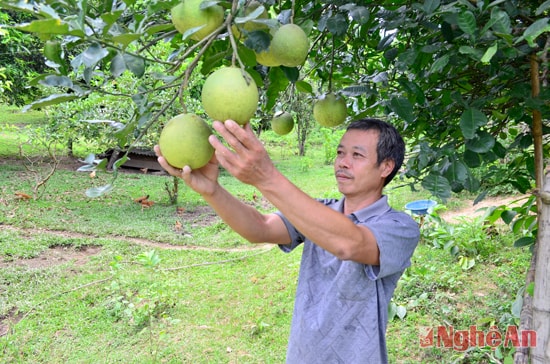 |
| Effective farming and livestock models in Ky Son district. |
Over the years, Ky Son district has identified a sustainable poverty alleviation strategy for the Mong, Thai, and Kho Mu ethnic groups: developing economic models that leverage the local strengths of land, climate, and soil in each microclimate, and then replicating these models for others to learn from and follow. In the outlying communes, where there is a small amount of flat land, the district has piloted integrated models combining upland corn cultivation with terraced rice farming. Regarding poultry farming, in the high mountainous areas with cold climates, especially where the Mong people live, successful models of Mong cattle farming are emerging.
From the center of Hoa Son village, Ta Ca commune, it's nearly a 2km walk to reach the foot of Pu Na Cao mountain. It was midday, the sun blazing. Vi Van Dung's makeshift house at the foot of the mountain was deserted. In front of the house, two brand-new motorbikes were neatly parked along with a tractor and farming tools. After waiting nearly 30 minutes, Mr. Dung finally walked from the stream to his house to greet us; he explained that he and his wife were busy weeding the rice paddies and were taking the weeds to the stream to wash them for their cows. Mr. Dung said that 10 years ago, the Pu Na Cao area was still wild and undeveloped, with dense forests above and overgrown bushes below, along with the Huoi Giang stream which flooded several times a year. At that time, Ky Son district had a policy encouraging people to develop farm-based businesses. During a village meeting, he asked the management board for permission to clear land on Pu Na Cao mountain, much to the surprise of the villagers present. Everyone thought that Dung and his father were just "talking big, but they couldn't even make a living farming in the open fields, let alone go into the mountains."
To prove to the villagers that they weren't just "joking," and to ensure their children stayed in the village to attend school, Mr. and Mrs. Dung went into the forest, cut bamboo and reeds to build shelters and reclaim land. They cleared bushes in the mornings, cut reeds to make pipes to bring water to the fields at noon, and used hoes to break up patches of barren land, building terraced fields... Nearly three years later, their family reaped their first rewards: the newly built terraced fields were thriving with glutinous rice, and their free-range chickens were growing rapidly and selling very well. These initial successes strengthened Mr. and Mrs. Vi Van Dung's resolve and belief in the right direction. With the support of the district's agricultural extension officers, they replanned their hillside garden according to the VACR model (Vegetable, Animal, and Crop). In the hillside areas, they planted longan, lychee, pomelo, guava, and mango trees.
In the higher areas, they cultivate acacia and bamboo shoots. Under the canopy of longan and lychee trees are chicken and cow sheds. Dung also dug a pond and invested in plastic pipes to bring stream water to his fish pond in a "one in, one out" system. The water in the pond is constantly replaced, allowing the fish to grow quickly and preventing disease... The diligence, hard work, and perseverance of Dung and his wife have transformed the once wild forest area daily. Currently, in addition to a herd of 20 cows with 7 breeding cows, Dung has over 300 chickens, a fish pond, a timber forest, an orchard, and rice paddies; his family earns over 150 million VND annually from the farm. Thanks to the VACR model (integrated farming system), Dung's family has escaped poverty sustainably and become one of the well-off households in Ta Ca commune.
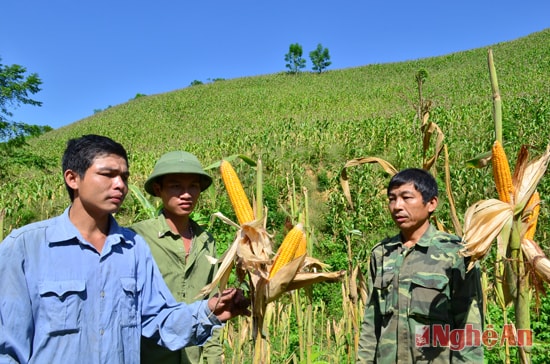 |
| A bumper corn harvest in Hoa Son village, Ta Ca commune (Ky Son district). |
Leaving Son Hoa village, we crossed the suspension bridge, the Nam Mo River, and arrived at Xop Nhi village, Huu Lap commune. Late in the afternoon, Ms. Kha Thi Hien, carrying her child, was checking her hybrid corn field to prepare for hiring harvesters. This is the second year Ms. Hien has grown hybrid corn on her farmland. The first year, she planted a small amount as a trial, but the results were very good. This year, with the district's subsidy on corn seeds, her family boldly planted 5 kg of seeds. Thanks to the good soil and favorable climate, all the corn fields yielded a bountiful harvest. Looking at the large, evenly sized, and firm kernels of the corn, she felt incredibly satisfied. With the current selling price at the farm of around 2,800-3,000 VND/kg, Ms. Hien estimates that her family's corn field will generate an income of about 50 million VND, many times more than growing rice. Ms. Hien confided that thanks to the hybrid corn crop, the households in the village now have enough to eat and save, and many have sold their corn and invested capital in various economic models. As she spoke, Ms. Hien pointed down to Mr. Lo Khac Loi's farm. Beneath the canopy of bamboo trees, Mr. Loi's family was busy selling their second batch of chickens for the year. Mr. Loi is a prime example of the innovative, proactive, and eager-to-learn households in Huu Lap commune. From being a perpetually impoverished farmer, this man of the Thai ethnic group has boldly built a model of raising chickens combined with fruit tree cultivation and fish farming. Notably, he was the first person in Ky Son to independently research and learn how to breed turtles. Currently, his family has a flock of nearly 1,000 chickens and ducks, two turtle ponds, and one fish pond. His model was visited and praised by the Provincial Party Secretary Ho Duc Phoc during his working visit to Ky Son district...
After passing through several "gateways," we arrived in Huoi Tu and Muong Long communes. Here, fattening cattle has become a "specialty" livestock product of the Mong people, along with black chickens, taro, and small pigs. Mr. Ly Co Va, from Tham Hoc village, said that for the past two years, he and some other households in the village have built cattle sheds near their homes and bought cattle to raise. Each shed is about 12 square meters and houses one cow. The villagers grow grass and grind corn to fatten the cows for about 1-2 months before selling the beef to traders from the lowlands; each cow sells for 8-12 million VND, yielding a profit of 5-6 million VND per cow after two months. During peak periods, Mr. Va's family fattens up to 12 beef cows at a time.
While the Hmong people in Muong Long and Huoi Tu are building a brand for their "fattened cattle," the Hmong people in the border areas of Dooc May, Na Loi, Tay Son, and Nam Can are utilizing natural conditions to raise large herds of cattle in the forest. In a recent survey, the Ky Son District Agricultural Extension Center noted that some households are worth billions of dong and are considered "kings of cattle farming" by the locals, such as Mr. Xong Chua Tua in Ai Khe village, Muong Ai commune, who owns a herd of 100 cattle, including 30 breeding cows; Mr. Gia Giong Chua in Huoi Poc village, Nam Can commune, who owns a herd of 90 cattle; Mr. Lau Xia Nenh, who has a farm raising 75 cattle; and Mr. Lau Chong Tua in Truong Son village, Nam Can commune, who raises 49 cattle…
Mr. Mua No Xu, Vice Chairman of the Ky Son District People's Committee, said that for the 282 effective economic models in the district, the district is simultaneously developing the models and expanding them by sending people to learn how to produce the products, and focusing on opening roads for traders to come and purchase directly from the farms. The district's experience is to select truly effective models for replication, building absolute trust with the people. For models using native plants and animals, once successful, the district directs their expansion immediately. As for models applying many high-tech scientific and technical methods, they are repeatedly tested and proven "sure" before being expanded. Similarly, for new models introduced from other areas, they must be implemented on a small scale many times, and only if consistently successful should they be scaled up and expanded. Thanks to this approach, all 282 economic models developed by the district are demonstrating sustainable development, gaining the trust and adoption of the local people.
The economic models in Ky Son district not only help ethnic minority households escape poverty and become wealthy, but each model has become a prime example with a wide-ranging impact, creating a new impetus for production and business development within the community. These are the compelling "nuclei for poverty alleviation" in the villages and communities of the Mong, Thai, and Khmu ethnic groups in the high-altitude border region of Ky Son. “Building on initial success, with local economic models as the core, Ky Son district is aiming to replicate 200-300 high-income economic models annually, striving to ensure that by 2020, the majority of households in the district will have established such effective models, bringing the poverty rate down to 20-25%. This goal has been carefully considered and decided upon based on the practical implementation of specific models and the district's overall orientation and determination in implementing the Resolutions of the Party Congress at all levels and Resolution 26 of the Politburo,” affirmed Mr. Bui Tram, Chairman of the People's Committee of Ky Son district.
Text and photos:Nguyen Khoa