

Stagnant ponds and wastewater – The consequences are significant.
(Baonghean) - Stagnant wastewater in ditches and ponds within residential areas causes pollution and severely impacts the lives of many rural villages in Nghe An province. Properly and appropriately treating wastewater from production facilities, households, and livestock farms in rural residential areas, craft villages, and cities is a complex issue.
Ponds and lakes in residential areas, especially in rural regions, play a crucial role in daily life and production, creating landscapes, regulating climate, and maintaining ecological balance and the environment. However, due to uneven development across residential areas and the lack of rational planning for filling in pond and lake systems, many problems have arisen. The current practice of directly discharging household waste, agricultural waste, and especially waste from small-scale family livestock farming into ponds, lakes, and canals is quite common. This leads to the gradual pollution of pond and lake water, becoming a potential source of disease outbreaks within residential areas, especially during hot or rainy seasons.
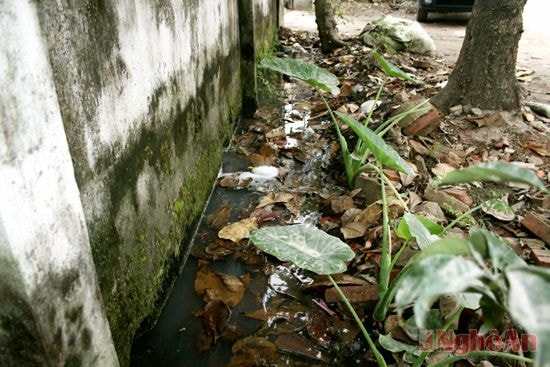 |
| Wastewater is stagnating on Nguyen Quoc Tri Street (Block 20, Hung Binh Ward, Vinh City). |
Thinh Thanh commune (Yen Thanh district) has quite a few ponds and lakes. On average, each hamlet has around 10 ponds of various sizes. However, only over 50% of these ponds are used for aquaculture, while the rest are completely unused. The stagnant water, left untreated for a long time, has become a breeding ground for flies, mosquitoes, and countless disease-causing parasites. Furthermore, some households even use the ponds to soak wood, causing a strong, unpleasant odor that affects many surrounding households.
Regarding the above situation, Mr. Duong Trong Phuong, Vice Chairman of the commune, shared: “Currently, the entire commune has nearly 150 ponds and lakes of various types; however, most of them are not being exploited or used effectively, affecting the surrounding environment. Since 2013, the commune government has encouraged people to fill in these ponds and lakes to convert them into agricultural land. After nearly two years of implementation, the number of stagnant ponds and lakes has been significantly reduced, thus improving the living environment of the people. For areas with fish ponds, household owners must also comply with certain principles in embankment construction, weed clearing, and ensuring proper water inflow and outflow to avoid environmental pollution.”
However, not all localities have solved the problem of stagnant water pools like Thinh Thanh. In Ngoc Van hamlet (Dien Ngoc commune, Dien Chau district), located along the coast with a long tradition of seafood processing, environmental pollution remains unresolved; especially since the establishment of the Ngoc Van seafood processing village, the pollution caused by accumulated waste in residential areas has become even more complex. The foul odor from fishmeal and frozen food processing businesses, along with untreated or inadequately treated wastewater, is discharged directly into holding tanks, creating stagnant water pools that pollute the environment day after day.
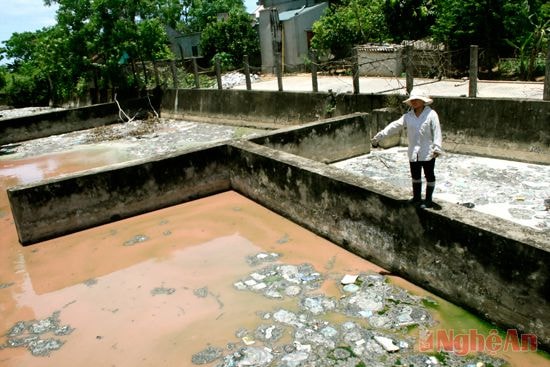 |
| A pond containing thick, black, foul-smelling wastewater in Ngoc Van hamlet (Dien Ngoc commune, Dien Chau district). |
Ms. Tran Thi Tam, a resident living near the wastewater tank, shared: “The tank has been stagnant for a long time, bubbling and emitting an unpleasant odor. Day and night, the area constantly smells foul, causing immense suffering for those of us living nearby, and we don't know what to do. Previously, children used to swim in the rivers in the commune, but since wastewater from the ponds started leaking into the rivers, no one dares to swim anymore. We only feel safe using water supplied by the water treatment plant; households in the neighborhood rarely use well water.”
Pollution from traditional craft villages is quite common, especially those producing vermicelli, cakes, fish sauce, and shrimp paste. Besides the lack of funding for wastewater treatment systems, the awareness of the local people regarding environmental protection is also limited. Passing through Blocks 8 and 12 of Cau Giat Town, one is shocked to see that this section of the river has become a "garbage dumping ground," with both banks overflowing with blankets, plastic bags, and animal carcasses. During the dry season, when the water level is low, it's insufficient to carry away the garbage, inadvertently creating dark, foul-smelling pools of water mixed with waste. Because it's close to residential areas, many residents have to keep their doors and windows closed all day to try and reduce the stench, but even that is ineffective. It's not just Block 8; the section of the river flowing through Block 12 now resembles dead ponds. The river, which used to drain floodwaters, has now become a series of shallow, polluted pools.
In many communes of Hung Nguyen and Nam Dan districts, stagnant ponds are quite common. This is because these areas were once used for freshwater aquaculture, but many households have stopped farming and lack the funds for renovation, inadvertently turning them into rural ponds.
Stagnant ponds and wastewater accumulation are not unique to rural areas. Currently, due to rapid urban development, wastewater treatment is also a major problem. The section of Nguyen Quoc Tri Street in Block 20, Hung Binh Ward (Vinh City) frequently experiences stagnant wastewater, causing unsanitary conditions and environmental pollution. Despite being located within the city, there is currently no drainage system, so household wastewater is discharged directly onto the street. For households further inside the city, they often have to dig trenches to channel the water to their gardens.
Ms. Nguyen Thi Khai, a resident in the neighborhood, shared: “Every time we wash clothes or dishes, the water doesn't drain quickly enough, and the whole garden is covered in soap suds. If it rains, not only are the sides of the road flooded, but the inside of the houses also become waterlogged in many areas.” It is known that, given this situation, residents in the neighborhood have repeatedly requested the construction of a drainage system to eliminate the water stagnation that causes public sanitation problems, but the issue remains unresolved.
Stagnant ponds primarily affect the health and quality of life of the people; in addition to actions and solutions from authorities to address the problem, raising awareness and implementing environmental protection measures to safeguard the lives of each individual is essential.
Thanh Quynh