

Australian students make breakthrough in space exploration.
A student in Australia has used a radio telescope for the first time to pinpoint the location of giant plasma tubes in the sky.
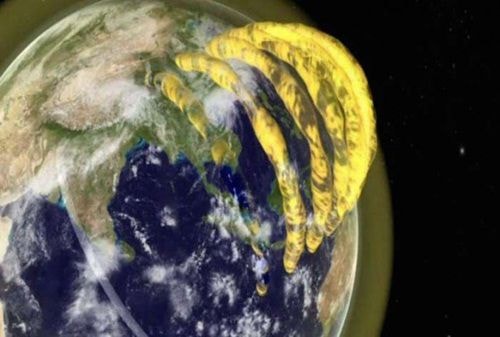 |
| Tubular plasma structures in the Earth's ionosphere. Photo: CAASTRO/Mats Bjorkland |
Scientists have long believed that the interaction between Earth's magnetic field and solar energy creates giant plasma tubes in the sky. These could impact astronomical observations and affect military and civilian navigation systems.
Cleo Loi, a 23-year-old student at the University of Sydney, Australia, used the Murchison Widefield Array (MWA) radio telescope located in the western Australian desert to pinpoint the location of plasma tubes in the atmosphere. This is the first time we have directly observed and determined their shape. The research results were published in the journal Geophysical Research Letters.
MWA is a network of 128 antennas, covering an area of 7 square kilometers. Loi divided the system into two parts, the western half resembling the right eye and the eastern half resembling the left eye. Similar to how humans use vision, she used triangulation to construct a three-dimensional map of the plasma tubes' images.
"Cleo Loi has convinced the rest of the scientific community. Although she is only an undergraduate student and has no prior knowledge of the subject, this is an impressive achievement," said Tara Murphy, University of Sydney student manager.
The ionosphere consists mostly of ionized oxygen atoms. Here, photons from sunlight knock out atomic electrons, creating a plasma state of charged particles. This plasma interacts with the Earth's magnetic field, creating plasma tubes in the sky. Additionally, free electrons in the ionosphere interfere with astronomical observations and can potentially affect satellite navigation systems.
"For over 60 years, scientists believed this structure existed. With these first images, we provide visual evidence that it is indeed there," Loi said.
Many weak electromagnetic signals travel millions or billions of light-years to reach the Solar System, and they must pass through Earth's atmosphere before being recorded by radio telescopes. Therefore, understanding the structure of plasma tubes is crucial for studying astronomical entities (quasars, galaxies, black holes) using radio telescopes.
According to VnExpress