

The world and the pandemic
(Baonghean) - Epidemics have never been absent from human history. However, with the development of human society, the concept of epidemic not only refers to a type of natural disaster but also to diseases originating from the human self. And, these chronic diseases, understood in this broader sense, are threatening the stability of the world.
MERS outbreak: Fear is spreading.
2015 seemed to be a year of infectious diseases. Just as Ebola was showing signs of being contained in West Africa, another potentially deadly disease emerged from the Middle East, then spread to South Korea and China, sowing fears of a large-scale epidemic.
The coronavirus that causes Middle East Respiratory Syndrome – abbreviated as MERS – has symptoms similar to the common cold but has claimed the lives of approximately 40% of the more than 1,100 people who have contracted the disease since the first case appeared in Jordan in 2012.
To date, the mechanism of human-to-human transmission of the virus has not been determined. However, most patients have had direct contact with camels, consumed products from this animal such as raw meat, unpasteurized milk, etc., or contracted the virus at a healthcare facility while treating another MERS patient.
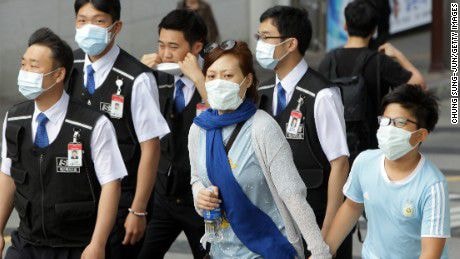 |
| People in South Korea wear face masks to protect themselves from the MERS virus. (Image: Internet) |
In theory, it's easy to prevent person-to-person transmission by wearing masks and washing hands thoroughly. But MERS spread at a clinic in Saudi Arabia last year and more recently at a clinic and hospital in South Korea, where a man who had returned from Saudi Arabia two weeks prior spread the virus to 34 other people.
One of the people exposed in South Korea traveled to China, flying and driving a bus while potentially infectious. It remains unclear whether this man spread the MERS virus.
On June 6th, the South Korean Ministry of Health confirmed nine more cases of MERS, bringing the total number of MERS infections in the country to 50. Since the first case was reported on May 20th, there have been four deaths in South Korea. The government has been making efforts to implement emergency measures to control the outbreak. Many schools have closed, public places are unusually deserted, and the number of tourists has suddenly decreased… it seems South Korea is facing its biggest challenge in years.
The worrying thing is that there is currently no vaccine or specific treatment for this disease that daily sows fear and anxiety among the population. However, as the world saw with the Ebola epidemic last year, it is optimistic that most epidemics can be contained if people implement appropriate infection control measures. The challenge is how to ensure everyone knows, understands, and strictly adheres to those measures.
Of course, this first requires the role of authorities in controlling and preventing the disease, providing sufficient information to raise public awareness. Prevention is better than cure – controlling the spread of the disease is crucial in countries experiencing outbreaks, avoiding an increase in the number of infections domestically or even spreading to other countries.
Furthermore, cooperation between governments, and between governments and international organizations, is also a necessary effort to prevent the MERS epidemic. MERS is now not only a concern for countries like Saudi Arabia, South Korea, or China, but a focal point and a common worry for all of humanity. The whole world working together to combat the epidemic, as was the case with SARS and Ebola previously, is the right approach to eradicate this disease.
Corruption: FIFA's Chronic Illness
While the MERS outbreak is a daily hot topic, the scandal at the World Football Federation, which began with the arrest of several high-ranking officials on May 27th on corruption charges, shows no signs of cooling down.
To date, 18 high-ranking officials of this federation have been arrested, with alleged corruption totaling $150 million over the past 24 years. In addition, these individuals are also accused by investigators of fraud, bribery, money laundering, related to World Cup hosting bids, as well as marketing activities and football television broadcasting rights deals.
Despite the dark cloud hanging over the club, Sepp Blatter won the FIFA presidency for the fifth consecutive time in the May 29th election, overwhelmingly defeating his formidable opponent, Prince Ali Bin al-Hussein of Jordan. In this re-election, Blatter promised to bring about new reforms in a "revitalization" of the world football governing body.
However, just days later, Sepp Blatter abruptly announced his resignation as FIFA President, ending his 17-year tenure at the helm of the organization and raising many unanswered questions and criticisms among football fans.
The impact of the scandal engulfing FIFA is considerable, evidenced by the fact that it has even garnered attention from top politicians and may be included on the agenda of the G7 summit taking place in Germany today (June 7).
On June 5th, White House spokesman Josh Earmest stated that he would "not be surprised" if the FIFA "dark power" scandal were brought up for discussion among heads of state at the G7 summit. The global interest in the issue will likely motivate US President Barack Obama to raise it at the meeting in order to quickly find a solution to the current situation.
Shortly afterwards, according to The Guardian's report on June 6th, British Prime Minister David Cameron was expected to urge world leaders attending the conference to take international action against corruption following the FIFA bribery scandal. He remarked that the FIFA bribery scandal would be the opening shot in an international anti-corruption campaign.
Cameron asserted: “Corruption is a malignant tumor at the core of many of the problems we face today. It threatens not only our prosperity but also our security. Football is embarking on a long journey to eradicate corruption and it will take time, courage, and determination to see through the reforms that FIFA needs. I believe that leaders must demonstrate that same courage and determination to openly discuss corruption globally.”
Thus, FIFA's corruption problem, which has persisted for nearly a quarter of a century, is finally entering a phase of "diagnosis" and decisive "treatment." Many football fans have been waiting and hoping for the return of a completely new FIFA after the recent shocking events.
Thu Giang
| RELATED NEWS |
|---|