

The bitter taste of the automotive industry
In a recent press conference, the General Director of Toyota Vietnam (TMV) released information that, while not new, is quite sensitive and has caused disruption in the automotive market.
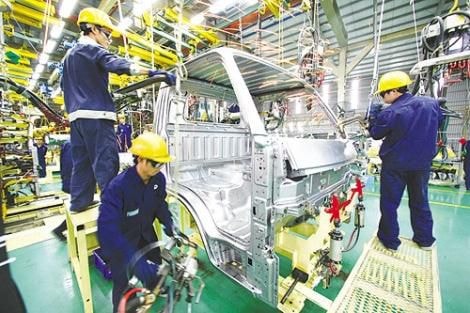 |
| Illustrative image. Image from the internet. |
Currently, Vietnam's largest automotive joint venture is still grappling with the dilemma of whether to continue investing in domestic car production or switch to importing completely built vehicles. The leader also acknowledged that, given the current situation, with the roadmap to reduce import taxes on completely built vehicles from the region to 0% by 2018, domestic production will be uncompetitive, making importing vehicles the more advantageous option.
Known for his cautious statements, the head of TMV seems to have made no slip of the tongue. This information is no longer a warning, but rather a very honest confession about the "unfinished" situation in the investment in the automotive manufacturing industry in Vietnam, not only for TMV but also for many other automotive companies.
It should be noted that companies that have invested significantly in automobile manufacturing and assembly, such as TMV, Mercedes-Benz, Ford Vietnam, GM Vietnam, Truong Hai, etc., prefer to manufacture their own vehicles rather than import complete units.
First, there was the 15-20 years of "pursuit" in Vietnam, and the large sums of money invested (TMV invested $154 million; Ford Vietnam $125 million, Mercedes-Benz approximately $80 million...).
Secondly, and more importantly, assembling a car domestically is far more profitable than importing a completely built vehicle. Furthermore, importing a complete car would lead to intense competition, fragmenting the market, and joint ventures like TMV (currently holding 31% market share), Mercedes-Benz, and Ford Vietnam would no longer have the advantage of dominating the market as they do now. Sales volume and profits would also be significantly lower.
However, with the high import tax reduction schedule, the weak state of the supporting industries, and the low localization rate, domestic production and assembly will naturally not be able to compete with imported products from countries in the region, especially from automotive "powerhouses" like Thailand, Malaysia, and Indonesia.
Therefore, the message being conveyed by automotive businesses is "we are waiting"—waiting for specific government policies to support the development of domestic production following the recently approved Strategy for the Development of Vietnam's Automotive Industry until 2025, with a vision to 2035.
But what are we waiting for? The first half of 2015 is almost over, and 2018 is fast approaching. Time for businesses to react seems to be running out. If we only import complete vehicles, and production shrinks or stops, this would truly be a bitter outcome for the decades-long history of the automotive industry.
According to VnMedia