

Will Modi's arrows hit their target?
(Baonghean.vn) - Narendra Modi, a visionary new leader, recently came to power in India. He seeks to realize India's enormous growth potential and transform it into a major global player. This has generated widespread optimism, both domestically and internationally, about India's resurgence. So what challenges must India overcome to achieve this?
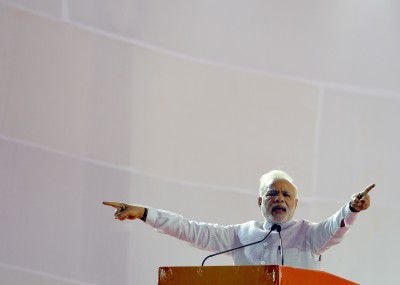 |
| Narendra Modi is seeking to realize India's enormous growth potential and transform it into a major global player. Photo: Internet. |
There is a broad consensus that structural reforms should focus on three key economic policy arrows, and the new government appears committed to pursuing these goals. The first arrow is agriculture, a sector where major market failures have fueled widespread consumer price inflation. The second arrow encompasses reforms aimed at facilitating labor-intensive manufacturing to realize the government's "Make in India" campaign. The third arrow is fiscal restructuring to free up tax revenue for large-scale investment in physical and social infrastructure.
Besides these three major structural reforms, it is believed that there are three fundamental factors hindering India's progress. These factors exist in three different but closely related areas: economic, cultural, and social.
From an economic perspective, the main constraint lies in the failure to strike the right balance between the market and the state. Market fear has long permeated economic policy and civil society in India, tipping the scales toward the state, undermining economic efficiency and productivity growth. Crony capitalism is a direct consequence of this imbalance.
The state clearly plays a key role in managing markets and providing public goods. However, failures of both the state and the market can also occur due to excessive state intervention. The agricultural trade in India, which prevents farmers from selling their produce directly to the market, is a relevant example. Like other monopolies, state monopolies risk becoming inefficient due to a lack of competition and are also highly susceptible to bribery.
But even as the Indian state expanded its role in regulating, controlling, and replacing the market excessively, it failed to invest sufficiently in crucial physical and social infrastructure, leading to stifled productivity and income growth.
While market anxieties have tended to limit gains in efficiency and output, India's prominent inward-looking cultural front has restrained competitiveness in a rapidly integrating global economy. India is now an outsider among emerging market economies in managing its structural current account deficits.
Despite sweeping trade reforms in the early 1990s, India remains one of the most protectionist of the world's major economies. While East Asia engages with the world to learn from and adopt global best practices in an effort to quickly catch up, India seems to believe it is different, having little to learn from the experiences of others and instead pursuing its own unique policies. Of course, it doesn't need to follow everything the West does, but if India is to realize its potential, and avoid falling behind, it needs to engage more with the outside world – both the West and the East.
Socially, India must address the social inequalities that restrict equal access to opportunities. The caste system has long been a defining characteristic of India, dividing society into small communities with limited social interaction and allowing disproportionate, hierarchical access to opportunities. The lingering effects of the caste system continue to divide access to opportunities and undermine the dignity of the workforce in civil societies.
A notable consequence of these lingering influences is India's poor human development indicators. This cannot be attributed to a scarcity of resources, as the state has propped up a large middle class at the expense of investing in social infrastructure for the marginalized. A large segment of the population is deprived of opportunities for education and skills development. The full potential of the country's talented individuals remains untapped.
India could be the new engine of global growth. Unlike other emerging markets that rely on external levers to return to high growth, India's economy is well-balanced. The necessary reforms are primarily domestic, making now the opportune time for India's resurgence.
To realize its enormous potential, India needs radical policy and structural reforms in the short to medium term. In particular, it needs to shoot three arrows – agriculture, labor-intensive manufacturing, and financial restructuring – from the bow of good governance.
Pulling these strings taut is the immediate challenge facing the Modi administration. But if India is to sustain high growth for an extended period, beat the middle-income trap, and become a major global player, it also needs to change its mindset. Civil society needs to overcome its fears of the market, engage more fully with the outside world, and provide equal opportunities for its people. The true wealth of nations lies within their people.
Thu Giang
(According to East Asia Forum)
| RELATED NEWS |
|---|