
The people "on duty" to save the summer-autumn rice crop.
(Baonghean) - During the peak of the hot season, in the fields of Hung Nguyen, people witnessed images of officials working in the fields, wading through rice paddies to regulate water for the parched rice seedlings, striving to the utmost so that farmers could have seedlings to sow for the summer-autumn crop.
(Baonghean) - During the peak of the hot season, in the fields of Hung Nguyen, people witnessed images of officials working in the fields, wading through rice paddies to regulate water for the parched rice seedlings, striving to the utmost so that farmers could have seedlings to sow for the summer-autumn crop.
Quickly putting on his sweat-soaked work shirt, Mr. Phan Anh Tuc, the Party Secretary of Dong hamlet, Hung Thang commune, looked out at the fields and enthusiastically said, "So, this morning, another 2 hectares of rice seedlings in the Cham field received water. Our hard work at the pumps since yesterday has paid off." For more than 10 days, Mr. Tuc and his colleagues in the Dong hamlet Party Committee have been taking turns manning the pumping stations, hoping to secure water to combat the drought affecting the wilting rice seedlings. They have worked alongside the villagers in the fields to regulate the water supply, prioritizing water distribution to seedlings far from the source, lacking water, and at risk of dying from drought. Ms. Tran Thi Van from Dong hamlet said, "It's at times like these that we see the responsibility of the officials. Their own seedlings might lack water, but when they have water, they readily let other households irrigate first..."
To get water for the rice seedlings, the mobile pumping team in Dong hamlet had to "run" to the 9B canal pumping station in Hung My. However, the water supply at this station was unstable because the upstream water from Ba to Nam Dan had dried up. Therefore, the Hung My pumping station, which supplies water to the entire Hung Thang, Hung My, and Hung Xuan areas, only had a capacity of 2,000-3,000 m3/h, while a pump with a capacity of 15-17,000 m3/h was needed to ensure sufficient water for the entire region. Consequently, to secure water, the Party committee and the village leadership of Dong hamlet had to be on duty until the tide rose on the Hoang Can River, immediately damming the river to retain the water, because after that, the water had to be diverted to other rice paddies. This water monitoring was very difficult; in reality, many households in low-lying areas, unable to receive water in time, tried to claim the pumping for themselves. However, if they received water first, other households would not have access to water in time.
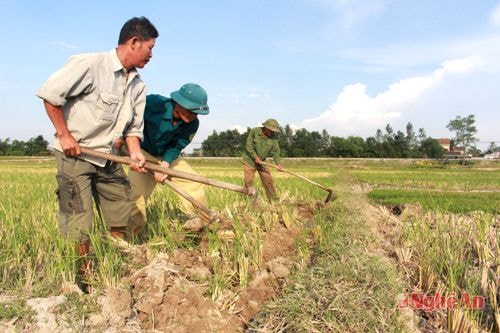 |
| People in Hung Thang commune (Hung Nguyen district) are heading to the fields to fight drought and save summer-autumn rice seedlings. |
In Ao hamlet, 44 hectares of rice paddies in the Cham rice-growing area are also drying up, with two-thirds of the seedlings already withered. Mr. Tran Van Kieu, the head of Ao hamlet in Hung Thang commune, who is constantly on duty in the Cham rice fields, shared: “We don’t know when the water will come and how much it will flow, so we’re all on standby here. As soon as water comes, we’ll focus on clearing the ditches to get the water into the rice paddies. We’ve also agreed with the villagers that those who have just received irrigation should reserve it for others.” By June 2nd, 5 hectares of rice paddies in Hung Thang commune were at risk of dying from drought, so they urgently needed local water sources from the villagers’ fish ponds. Given the situation of water arriving in trickles, and even areas with water not having enough to keep the seedlings moist, and many areas far from the source not receiving water at all, by the afternoon of June 2nd, Phan Anh Tuc, the Party Secretary of Dong hamlet (Hung Thang), decided to sacrifice his more than 1-hectare fish pond, which was almost ready for harvest, to provide water for households at risk of rice paddies dying.
Hung Thang commune currently has 666 households participating in summer-autumn rice production with 253 hectares of double-cropped rice land in two fields: Cham and Len. Due to the drought, most households here are currently unable to secure irrigation water for their summer-autumn rice seedlings. In response, the commune's Party committee and government have assigned personnel to work together to proactively secure irrigation water for the farmers. Mr. Phan Quang Mao, Deputy Secretary of the Party Committee and Chairman of the People's Committee of Hung Thang commune, said: “Facing the risk of rice seedlings dying from drought, we held an emergency meeting and established a drought prevention committee, requiring Party committee members to closely monitor the production teams to count the area of rice seedlings at risk of dying from drought.”
In addition, the Party Committee members also instructed the Party branch secretaries of each hamlet to directly lead and guide their respective hamlet committees, staying close to the fields and operating the pumps to ensure that water is distributed to the rice paddies that need it immediately. This avoids situations where people compete for water, causing disunity and wasting water resources.” As the person primarily responsible for coordinating with officials from the Department of Agriculture and the irrigation enterprise, Mr. Phan Văn Hiền, Head of the Agriculture Committee of Hưng Thắng commune, said: “Anticipating that the heatwave will reach its peak since 1971, we have coordinated with Hưng Xuân commune to regulate water for the people. The water from the Hoàng Cần River via Pumping Station 9B can still supply several neighboring communes, including Hưng Thắng, so coordinating water regulation will eliminate the risk of rice seedling damage.”
To regulate water for all communes in the central and outer regions, agricultural officials in Hung Nguyen district have been working day and night in the fields, directing the damming and water retention. Mr. Hoang Duc An, Deputy Head of the District Agricultural Department, said: “Now, it’s not just the outer communes that are in urgent need of water; the central and upper communes are also experiencing water shortages. However, there are a few places, like the Hung Xuan low canal, that still have water, so we have to be on standby to regulate water for neighboring communes.” Besides regulating water from the Hung Xuan low canal, they also regulate water from mobile pumping stations on the Rum River to supply water to the outer communes of Hung Loi, Hung Chau, and Hung Phuc. For 10 days under the scorching sun, agricultural officials, wearing helmets, rolling up their trousers, and working with muddy hands and feet, along with officials from the Hung Nguyen Irrigation Enterprise, inspected water sources. On one hand, they stored water from the Hung Chau pumping station for Hung Loi and Hung Phuc, saving rice seedlings in the outer areas. On the other hand, they regulated water locally for the communes of Hung Chau, Hung Nhan, etc.
The water management process in Hung Chau commune, thanks to the smooth coordination between the local government and the irrigation enterprise's staff, has yielded positive results. Mr. Nguyen Ngoc Quyen, Deputy Secretary of the Party Committee and Chairman of the People's Committee of Hung Chau commune, said: “For more than 10 days now, we have practically been eating and sleeping in the fields to direct the people in irrigating the rice seedlings, conserving and storing water for the already planted areas.” Mr. Quyen also added that all the village secretaries and heads are on duty in the fields; they are the “conductors” distributing water to the drought-stricken fields. However, it is the staff of the Hung Nguyen Irrigation Enterprise who are working the hardest to ensure water supply.
According to our findings, when the water level at the Hung Chau pumping station reached the dead water level, the Hung Nguyen Irrigation Enterprise proposed reinforcing the water supply with 3 mobile pumps on the Rum River to increase local water supply for 4 outlying communes. Because the water source here is frequently affected by salinity, irrigation officials have to monitor the pumps to check the salinity after each hour of pumping. Furthermore, the water supply depends on the tides, so irrigation officials have to work until morning almost every night, as that is when the water is abundant and salinity is low. Mr. Pham The Linh, Head of the Hung Chau pumping station, said: “If the situation continues to be this tense, we will propose that Nam Irrigation Company Limited install another pump to pump water from the Rum River into the discharge tank of the Hung Chau pumping station, to achieve a capacity of 3000 m3/h, promptly serving nearly 500 hectares of rice fields in 3 communes: Hung Chau, Hung Loi, and Hung Phuc.”
With the tireless efforts of cadres and Party members who work day and night in the fields, finding every way to bring water to the thirsty rice paddies, everyone is striving to support farmers in their production during this difficult time…
Thanh Nga