

New hope on Huoi Xai
(Baonghean) - On the first day of June, we traveled up the dusty red road to Na Ngoi commune (Ky Son district). From Pu Kha 1 village, we turned through Na Cang and Pu Quac 2 villages along a narrow path only about three handspans wide, with a deep ravine below... The motorbike revved in first gear for a long time, and then Huoi Xai village, with its cluster of a few dozen houses, appeared in the early morning sun...
Upon arriving at the village, we were surprised to find it deserted, with only a few dirt-covered children playing. On the windowsills, a few elderly Hmong women were basking in the sun... It turned out that all the men in the village had gone to the fields since the wild roosters crowed at dawn.
While hesitating about turning back, we met a group of men from the village returning from gathering grass for their buffaloes, including the village chief, Gia Ba Bi. Welcoming us into his thatched house, Gia Ba Bi cheerfully said, "It's been a long time since anyone from the lowlands came to our village!" Although only 24 years old, Gia Ba Bi had already been the village chief of Huoi Xai for two years. When asked where his wife was and why he was home alone, Bi replied, "She went to the fields; I have to stay home to cut grass for the buffaloes and cook meals for my children." Bi's three children, the oldest four and the youngest two, were all covered in dirt.
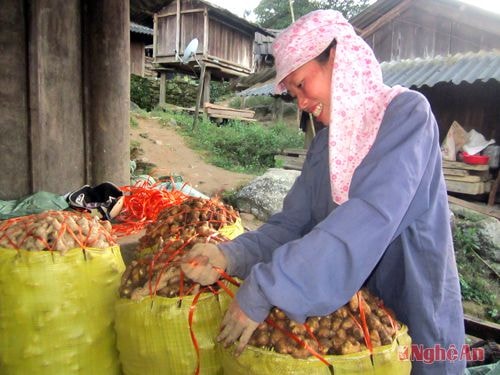 |
| People in Na Ngoi commune (Kỳ Sơn district) package ginger products. Photo: Hữu Vi |
Leading us on a tour of the village, Elder Ba Bi explained: Huoi Xai is the poorest village in Na Ngoi commune. The village has 25 households with 140 inhabitants, but as many as 22 households are poor and 3 have only recently escaped poverty. This number surprised us. While the people of Na Ngoi commune are focusing on boosting economic development with key crops like ginger, cassava, and fattening cattle, this remote village still has people living day by day, seemingly isolated from the "outside world." This is truly remarkable...
When we asked why Huồi Xài still has so many poor households, Già Bá Bì explained: "Because the village is isolated and has no roads, the villagers mainly rely on self-sufficiency for their livelihood. Selling is difficult due to the poor road conditions, which means traders force down prices. A kilogram of ginger costs 20,000 dong in Pù Khả village, but traders only pay 10-12,000 dong when they come to buy it in Huồi Xài. The roads are narrow and difficult to navigate, so we have no choice but to accept that."
Following Bi's directions, we visited the home of Mr. Xai Phia, considered the wealthiest household in the village. Indeed, Mr. Xai Phia's house seemed better off than the surrounding houses. His new house, roofed with corrugated iron, was bought with the money from selling his buffaloes, but the interior was still pretty much the same. He said, "We still raise 14 buffaloes and only escaped poverty this year. We just have enough to eat; we work hard but don't know how to sell anything to anyone. There isn't a single shop in the whole village; if you want to buy anything, you have to walk for hours..." Even if he were short of money, Mr. Xai Phia wouldn't dare sell his buffaloes because he still has several unmarried children, and he wants to keep one for each of them as capital when they start their own families. Despite being the wealthiest in the village, Mr. Xai Phia's lunch was similar to that of a typical Hmong family in this small, remote village: a basket of rice and a bowl of soup – that was it.
We visited the family of Mr. Gia Nhia Bi, who, according to the village head, is the largest ginger grower in Huoi Xai. Quickly putting on his long robes to greet guests, Mr. Gia Nhia Bi said: “The village head says so, but although we grow a lot of ginger in our village, the harvest isn't as good as in other villages. We harvest 4-5 tons of ginger each year, but we don't sell it for much. We can't transport it to the main road. When people come to buy it, the price is too low, sometimes only half of what it is in Pu Kha.” Even the income from his large ginger plantation isn't enough to lift Mr. Gia Nhia Bi's family out of poverty. Day after day, he, his wife, and children toil in the fields from morning till night, barely making enough to eat. But luckily, this year's ginger price has increased significantly compared to previous years, so Nhia Bi's family has been able to buy some corrugated iron roofing sheets to prepare for rebuilding their house.
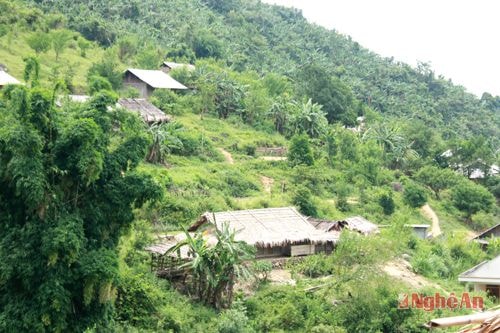 |
| Huoi Xai village, Na Ngoi commune (Ky Son district). |
We asked the village chief, Già Bá Bì, if we could visit the poorest family in Huồi Xài, and he immediately took us there. It was the home of Già Nhìa Phổng. Nhìa Phổng and his wife weren't home. Their young children, seeing strangers, hid behind a wall and peeked out. After a few exchanges in the Hmong language, Bá Bì explained that Nhìa Phổng and his wife had been working in the fields for several days and hadn't returned. Looking at Già Nhìa Phổng's house, it was only slightly larger than a small storage shed for Hmong rice. The four sides were made of flimsy bamboo and thatch, and the only possessions were a few bamboo beds for the family to sleep on. Village chief Bì said, "It's understandable that they're poor. He's only a little over 40 years old and already has eight children. How will he ever be able to feed and care for eight more when they grow up?"
On our way back to the village of Già Bá Bì, we passed the Na Ngoi 2 Primary School. The village chief pointed and said, "Look, gentlemen, the lives of the villagers are hard, but the teachers living here aren't any better off than we are." The primary school is located on a hillside, with five classrooms thatched with bamboo, and on the other side is a row of similar teacher dormitories. Village chief Bì said, "Every year, the villagers mobilize to go into the forest to get bamboo to repair the classrooms for the students and the teachers' quarters to ensure teaching continues. But the school is so makeshift that it sometimes needs repairs several times a year. Like this year, during the recent tornado, these thatched roofs were all blown away." Children in Huồi Xài of school age are sent to school by their families, but currently only a few people in the village have completed high school; no one has a vocational diploma.
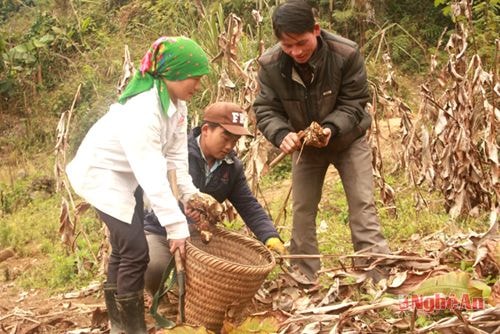 |
| Harvesting cassava in Na Ngoi. |
When we asked if there were any drug addicts in Huoi Xai, the village head, Gia Ba Bi, said in a subdued voice: “This is the most shameful thing about Huoi Xai; every meeting in the commune talks about it. Currently, the village has six addicts, mostly 50 years old and above. Some of the younger ones have already gone to rehabilitation... Some addicts are difficult to get to rehabilitation because of their age.” Discussing this with us, Xong Ba Denh, Secretary of the Na Ngoi Commune Youth Union, said: “Currently, the commune is focusing on investing in economic development for Huoi Xai village with the goal of reducing the number of poor households to 15 in 2015. Only through strong economic development can we raise the awareness of the villagers and completely eliminate the problem of drug addiction.” Hearing this, the village head, Bi, seemed thoughtful, yet nodded in agreement.
...As we left Huồi Xài, the village chief Già Bá Bì smiled brightly and promised: "Next time you come back, you'll see Huồi Xài has changed." Whether it was a promise or an invitation was unclear, but in the depths of the young chief's eyes, we saw a new and great glimmer of hope for Huồi Xài.
Dao Tho