

Thuan Hau, a traditional village
(Baonghean) - Following the lines of poetry by Vuong Trong: "At Cung Wharf, I arrived in the evening / Meeting the river, but there were no oars or ferryboats crossing / The sky and water were vast and boundless…" we visited Thuan Hau village, Trung Son commune (Do Luong district) – a peaceful and beautiful rural area on the left bank of the Lam River.
According to the genealogy of the Nguyen Cong family, the village was founded in the 17th century; several hundred years ago, the fertile land along the river was settled and cultivated by the ancestors of the Nguyen Cong, Nguyen The, Phan Ba, Tran Van families, and others. In the past, the village had four hamlets: Thuan, Nghia, My, and Tu, centered around the village communal house; behind it were rice fields; and in front was the winding Lam River.
According to the elders, in the past, on a spacious plot of land in the middle of the village, nearly 2 acres in size, there existed three ancient structures situated side-by-side, enclosed by a common wall built from laterite stone from Rú Cuồi. The Thuần Hậu communal house was a massive five-bay structure, with the outer bay containing two sets of wooden platforms and a kneeling-legged platform. In front of the communal house was an ancient well, constructed from mountain stone, from which water was often drawn for religious ceremonies. At the communal house, in the sixth lunar month, the village held a ceremony to worship the village guardian deity, and before the harvest season, they would perform the Thượng Tân ceremony, praying for a bountiful harvest. During the revolution, the communal house was where villagers gathered for rallies and seized power, and immediately afterwards, opened literacy classes for the people. During the resistance war, the communal house served as the headquarters for Southern army units relocating to the North; it was also where villagers bid farewell to their sons going to fight.
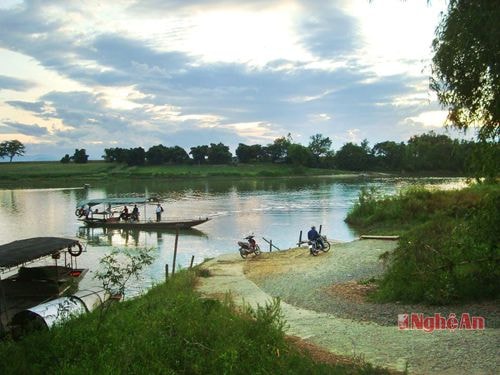 |
| Cung ferry terminal, Thuan Hau village (Trung Son commune, Do Luong district). |
The Bản Cảnh Temple, located nearby, has two buildings, an upper and a lower one. In the past, the temple housed a genealogical record, which was later lost; it is a place where villagers often come to offer incense and pray for peace. The three-bay Võ Ancestral Temple, situated near the temple, commemorates and honors the villagers who served in the Nguyễn Dynasty army (those honored had to be at least "lieutenant or officer" rank). Every year, at the beginning of spring, the village holds a ceremony here. During the war against the Americans, the Võ Ancestral Temple was dismantled, and the two rows of ancestral tablets were moved by the villagers to their respective family temples.
From the village communal house, looking out towards the riverbank, one can see Cay Pagoda and Diem Market. The pagoda is built on a 5-sao (approximately 1000 square meters) plot of land, with a village scholar in charge of its upkeep and Buddhist rituals. Diem Market is an ancient market, named as such because there is a guard post near it. Located on an alluvial plain along the river, near the main road, it features a large communal house and an ancient rice tree; it was the center of trade and commerce for the region, with people from Thanh Chuong, Do Luong, and Yen Thanh often gathering here by land and river. During the resistance war, to ensure safety, the market had to be moved to several locations (closer to the riverbank, up Den Mountain, etc.), and then merged with a market in a neighboring commune (now Diem Market - Da Son). After many changes and upheavals, the ancient structures of the village have faded, and the image of the old homeland with its familiar temples, communal houses, wells, and markets now only remains in memory.
The Lam River flows in front of the village, curving in an arc shape, embracing the alluvial plain, hence the village's riverbank is called Cung Wharf (Arch Wharf). Since ancient times, Cung Wharf has been the gateway to the village, district, and county, connecting to neighboring districts. It was once closely associated with Diem Market, a bustling hub of buying and selling on both boats and in the market. During the Soviet era, Cung Wharf was where people crossed from Cat Ngan to the other side of the river to participate in anti-French demonstrations at the Cho Rang outpost. During the war against the Americans, Thuan Hau village served as a transit station for wounded and sick soldiers returning from the battlefields; within the village, people both fought and participated in caring for and transporting the wounded. For nearly eight years, Cung Wharf became the place for transporting wounded and sick soldiers from the village to Military Hospital IV (located in Cat Van – Thanh Chuong) and was also one of the most heavily bombed areas by the American forces in Do Luong. Today, the old riverbank remains, the only difference being that it has been transformed into a "model ferry terminal" with motorboats, waiting areas, and a concrete path leading down to the dock amidst green cornfields. For the people of Thuan Hau, the Cung ferry terminal is not just a place to ferry passengers across the river, but also a place that bears the imprint and carries the weight of both painful and glorious years.
According to Mr. Nguyen The Trung (85 years old), the people here have always been as kind and honest as the name of the village suggests; besides being hardworking, they are also passionate about sports and arts. In the past, the village was famous in the region for its wrestling team, with many strong young men who won every competition. The village also established a theatrical troupe, bringing together talented singers and actors like Mr. Nguyen Dau Cam, who worked during the day and practiced at night, performing throughout the village during festivals and holidays. Through classic plays such as Trung Trac – Trung Nhi, Pham Tai – Ngoc Hoa… they conveyed, propagated, and instilled in the people a love for their homeland and an undying spirit of resistance against foreign invaders.
It has become a long-standing tradition in Thuan Hau for people to invite each other to drink green tea, a beautiful custom preserved for generations. Although life in the countryside has changed considerably, with high walls and fences, the hearts of the people remain open and warm, reflecting the close-knit community spirit expressed through a cup of green tea. Night after night, after the invitation, villagers gather around steaming pots of tea, chatting about current events and setting aside the worries of daily life. A cup of green tea, simple and unpretentious like the people of the countryside themselves, is the glue that connects the community and preserves the soul of the rural village.
Descending from Cung ferry landing, leaving Thuan Hau village, the boat cut through the waves across the river, my heart still filled with longing for the land and people of Trung Son. "The boat rows out into the middle of the river / My hat's strap is tied so it doesn't overlap." That countryside by the Lam River, though no longer possessing its ancient charm, will forever retain its humane traditions for generations to come.
Huy Thu