
Nghi Loc scenic area, come and reflect…
(Baonghean) - Blessed with numerous scenic spots and historical relics, and situated close to Vinh City and Cua Lo coastal town, Nghi Loc district is expected to attract investment and develop its inherent potential...
(Baonghean) - Blessed with numerous scenic spots and historical relics, and situated close to Vinh City and Cua Lo coastal town, Nghi Loc district is expected to attract investment and develop its inherent potential...
Visiting Nghi Loc one day at the end of May, hoping to see a glimpse of the development of the "non-polluting industry," a colleague of mine recommended Bai Lu - Cua Hien. That was also the opinion of many people when thinking about Nghi Loc.
Bai Lu - Cua Hien is located in the northeastern part of the district, within the territory of Nghi Yen and Nghi Tien communes, in the southeastern coastal arc of Lach Van - Cua Hien - Cua Xa. Looking down from the top of Lu Mountain, the harmonious blend of mountains and sea, enhanced by human development, has made this an attractive ecotourism destination. Many domestic and international tourist groups come here to enjoy the scenery and relax, and according to reports, since the beginning of summer, anyone wishing to book accommodation needs to reserve rooms weeks in advance...
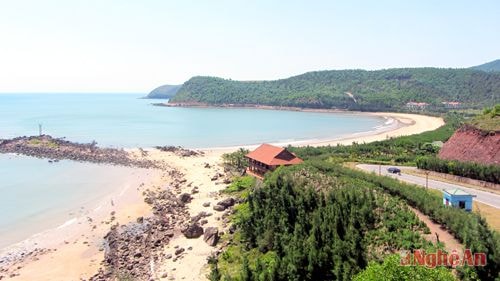 |
| Bai Lu tourist area is located in Nghi Loc district. |
However, in this area, there are a few kiosks selling souvenirs and refreshments, but the items are monotonous, mostly imported from Da Nang, Nha Trang, etc., and there are no local products at all. Even in the lobby of the large hotel in the Bai Lu area, there is a display area, but it doesn't have any cultural products or souvenir pictures introducing the land where they operate. At most, there are only a few pebbles taken from the beaches of Nghi Tien and Nghi Thiet, shaped and inscribed with a couple of lines of poetry about Bai Lu in calligraphy. According to hotel staff, some tourists do want to buy local products. Each time, they will call to place an order for the guests.
We wondered why the unit didn't create souvenir display areas at the tourist site to give visitors more choices and, at the same time, help introduce this region? Upon investigation, we learned that Nghi Loc has many local products, but they are unprocessed and unpackaged, making preservation difficult. For example, dried shrimp, fish, and squid from Nghi Loc are of very high quality, but without packaging to preserve their aroma, how can they be displayed? Regarding cultural products, the Department of Culture and Tourism has brought in some CDs, DVDs, and pictures, but these items are available in many places such as Vinh City, Kim Lien (Nam Dan), and other locations, so visitors are not very interested…
Our next destination was the temple and tomb of Duke Nguyen Xi, a National Historical and Cultural Architectural Relic site located in Nghi Hop commune, close to National Highway 46, only about five kilometers from Cua Lo beach. This relic site, with its magnificent architecture and beautiful setting, is truly a scenic spot worth visiting. According to Mr. Nguyen Ba Dam and Mr. Nguyen Dinh Tung, members of the Nguyen Dinh clan's management board, every year on the 29th and 30th of January, the ancestral festival, thousands of descendants from all over the country and visitors flock to the temple. On regular days and during the summer, many visitors also come to the temple, but most are descendants of the clan. However, there are no solutions yet to create new ways to make the relic site more attractive to tourists; currently, only electric car drivers in Cua Lo town introduce and invite visitors for tours...
As for Mr. Le Minh Thuong – the owner of five ancient persimmon trees in Nghi Thinh commune, a group of precious 600-year-old trees recognized as heritage trees – he also believes that the local government lacks effective methods to create unique attractions for Nghi Loc. Mr. Thuong owns five ancient persimmon trees worthy of admiration. The bumps, lumps, and cavities on their large, dark green trunks form fascinating shapes. The "father" persimmon tree has a circumference of over 14 meters; its trunk and base resemble a small rocky mountain supporting dozens of sturdy branches spreading throughout the garden. The "mother" persimmon tree has a trunk circumference of nearly 10 meters. Not as majestic as the "father" persimmon tree, the "mother" persimmon tree possesses a perfect, natural beauty. Its trunk and base are round, with regular fleshy segments, swirling bumps, and root mounds, as if arranged by a bonsai artist. The three "daughter" persimmon trees have slightly smaller trunks and bases, but they are no less beautiful.
The trees are also rough, covered with bumps, hollows, and swirling ridges, creating unusual shapes. Furthermore, their trunks and branches are adorned with a variety of green foliage created by parasitic ferns. The "history" of these five ancient persimmon trees is also fascinating. During the reign of King Le Loi, there was an official named Le Van Hoan (from Thanh Hoa province) who was entrusted by the court to govern the central coastal region. He chose this land to gather his descendants and establish a village because he noticed that after a great storm, all the trees in the area were destroyed, but the persimmon trees remained. During his military campaigns to the North and South, he always visited these persimmon trees, and subsequently achieved victory. Therefore, he had a temple built here to honor the five persimmon trees... Official Le Van Hoan is the ancestor of the Le family in Nghi Thinh commune today.
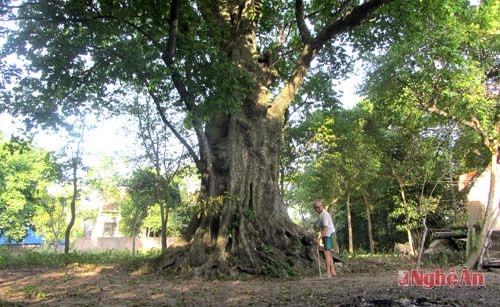 |
| One of the five ancient persimmon trees recognized as heritage trees in Nghi Loc district. |
According to Mr. Le Minh Thuong, after the trees were officially designated as heritage trees, he received many visitors, both domestic and international. Most honorably, on September 6, 2011, President Truong Tan Sang and his wife visited. "This year, on the occasion of President Ho Chi Minh's birthday, many delegations from outside the province were also brought to visit the ancient persimmon tree. Everyone loved it. Each time a delegation came, I also took on the role of explaining the history of the five persimmon trees to them. It was enjoyable, but I felt the need to review the promotion and tour route planning to make it more reasonable. I've attended several seminars on heritage trees and heard discussions about various approaches, but nothing has changed yet. Sometimes, when guests arrive unexpectedly, we're not prepared, resulting in less than proper reception. Even the installation of directional signs, which I've been proposing for almost two years, hasn't received any support from the commune or district..." Mr. Thuong confided.
Visiting the three aforementioned historical and scenic sites is not enough to fully appreciate the tourism development potential of Nghi Loc district. However, it is clear that Nghi Loc has not yet paid much attention to building its image and brand; moreover, tourism products and related services are still very poor and limited. To develop tourism, it is necessary to invest in infrastructure that meets international standards; develop cuisine, create new tourism products; create a healthy and friendly environment and care for tourists... and focus on promoting its image. With its strengths in numerous historical and scenic sites; abundant local products such as Xa Doai oranges, agricultural products like peanuts, corn, and tomatoes, and many seafood products harvested daily from the sea. Particularly given its proximity to Vinh City, Cua Lo coastal town and Nghi Loc district need to focus on promoting their image and learn from others to create attractive, locally-oriented products that can generate widespread appeal and exploit existing potential…
Nhat Lan