

Investing in irrigation for dryland crops: Highly effective, but difficult to replicate?
(Baonghean) - Nghe An is experiencing intense heatwaves. The drought is causing significant damage to agricultural production. In this situation, many localities in the province have implemented effective irrigation models for dryland crops, protecting them from drought while maintaining high economic efficiency.
Effective model
We visited Mr. Nguyen Huu Binh's orange orchard in Hamlet 15, Dong Thanh Commune (Yen Thanh District). The sun was blazing, and while the grass and trees along the hillsides were withering, Mr. Binh's orchard remained lush and green. While supervising his workers watering the orange trees, Mr. Binh explained: "This year the heat has been 'beyond expectations,' and all the natural ponds have dried up. I had to search for water sources and urgently drilled four wells. However, because the orange orchard is so large, the well water isn't enough. So I went to find water sources around the mountains and dug three ponds 5-7 meters deep. Then I installed large-capacity gasoline-powered pumps connected to 70mm diameter pipes to irrigate the 3-4 year old orange trees. Smaller (electric) pumps draw water from the wells to irrigate the newly planted orange trees; we only water them for 3-4 hours in the morning, with each irrigation cycle lasting 10 days to maintain soil moisture."
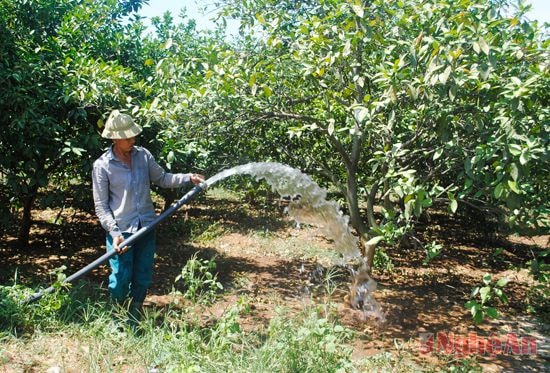 |
| Watering orange trees at Mr. Nguyen Huu Binh's farm, Hamlet 15, Dong Thanh Commune (Yen Thanh District). Photo: VT |
Mr. Binh also said that the pumping costs are quite expensive, requiring the purchase of generators, electric pumps, and a system of large and small pipes over 3,000 meters long, worth over 200 million VND; each pumping session requires about 10 laborers, and the cost of fuel, electricity, and labor... amounts to about 40-45 million VND per session. Due to the hot weather and the hot, dry winds from Laos, Mr. Binh has had to pump three times already, and may need 4-5 more sessions to cope with the drought. His method of "cooling" the orange trees is quite creative: he uses straw and rice husks spread around the base of 1-2 year old orange trees and newly planted areas, then waters them, which helps retain moisture for longer and reduces the number of watering sessions. Mr. Binh added: In Dong Thanh commune alone, there are over 60 hectares of orange trees belonging to 6 households. The investment cost for planting oranges is quite high, over 300 million VND/hectare. If there is a drought and no irrigation system, orange growers could easily go bankrupt. Therefore, it is essential for the government to provide financial support to orange growers so they can drill underground wells and invest in pumping systems, hoses, etc.
In Quy Hop district, many models applying drip irrigation technology to orange trees have proven effective during droughts. Visiting Mr. Bui Ngoc Anh's orange orchard in Minh Ho hamlet, Minh Hop commune, we see that the trees are still thriving. Mr. Anh's drip irrigation model is quite modern. Water from two boreholes is pumped directly into a 200 m³ water tank, which has a main water pipe system including an air release valve, filter, and pressure gauge connected to the water source and permanently installed. Irrigation branches are arranged along the rows of trees using plastic pipes. The pipes have small holes, 1, 2, 3, or 4 holes depending on the spacing of the trees. The drip irrigation system focuses mainly on the root system of the trees, thus maintaining moisture around the base of the orange trees; even in hot weather like this year, irrigation is done for more than 4 hours a day.
Mr. Anh said: “In 2012, my family invested over 120 million VND in applying drip irrigation technology from Israel to 2 hectares of orange trees. Drip irrigation technology has the advantage of controlling moisture levels and proactively timing irrigation for orange trees, saving 30% of water, 80% of labor compared to direct irrigation as before, 90% of fertilization labor, and 50% of inorganic fertilizer needed for orange trees. Orange yield is significantly higher, reaching 20-25 tons/ha/year.” Seeing the effectiveness of drip irrigation technology, from the beginning of 2015, Mr. Anh's family continued to invest over 150 million VND to irrigate another 2 hectares of orange trees.
The drip irrigation system for sugarcane used by Mr. Duong Dinh Tan's family in Nghia Xuan - Quy Hop is also very effective. Mr. Tan's lush green sugarcane field is located on a hillside. He said: “Water pipes run along each row of sugarcane, and water flows out through small holes drilled in the pipes, seeping deep into each sugarcane root. Just starting the engine activates the entire system, providing drip irrigation across the entire area. Since applying this system, sugarcane yield has increased dramatically. Previously, sugarcane yield only reached a maximum of 55-60 tons/ha, but now, thanks to drip irrigation, it reaches 100-110 tons of sugarcane per year.” Each sugarcane root receives 1 liter of water per hour, and irrigation is done every 5 days during hot weather. Importantly, this system can deliver water and fertilizer directly to the active root zone in small, sufficient doses for the plants to absorb completely, through a system of pumps, valves, water pipes, and drip irrigation lines. Mr. Tan installed a drip irrigation system in 2013 at a cost of over 250 million VND to irrigate 4 hectares of sugarcane, and the irrigation efficiency during the hot season was very high. In 2014, Mr. Tan continued to invest 270 million VND to install an additional drip irrigation system to serve over 4 hectares of oranges.
Mr. Hoang Van Thai, Head of the Agriculture Department of Quy Hop District, said: Quy Hop has over 6,500 hectares of sugarcane, but to date, only 4 drip irrigation models for oranges and sugarcane have been implemented. Orange and sugarcane production in Quy Hop lacks stability and sustainability due to water scarcity. Meanwhile, farmers are still wasting water, not investing in or applying water-saving irrigation techniques, and not using fertilizers rationally, which are the main reasons leading to increased costs, increased risks, and reduced profits. Therefore, drip irrigation will help sustainable crop production, saving 30-40% of irrigation water compared to traditional methods, saving 30-40% of fertilizer compared to manual fertilization, and reducing labor costs for irrigation and fertilization by over 90%.
Currently, in Quynh Vinh commune (Quynh Luu district), some households have joined together and utilized additional state investment to build a scientific irrigation system; in some communes of Nghia Dan district such as Nghia Binh, Nghia Hoi, Nghia My, etc., after having a canal system from Song Sao reservoir, people use pumps or utilize multi-functional plows equipped with pumping systems to irrigate rice below and sugarcane above.
Overcoming difficulties
The application of irrigation for crops, especially high-value crops, has shown great benefits for investors, particularly during hot weather like this summer. The irrigation system is suitable for the gently sloping hills in the Phu Quy region, is easy to install, operate, and maintain. The investment cost is approximately 60 million VND/hectare, with a minimum lifespan of 10 years, making it accessible to many farmers. However, the issue of irrigation for dryland crops in our province remains a challenging problem.
Thanh An commune (Thanh Chuong district) has 440 hectares of tea plantations. In recent years, almost every year, a significant area of tea plants has withered due to drought. This year, the drought is more severe, and the lack of irrigation water has put many tea plantations at risk of not recovering. According to Ms. Tran Thi Kim Ngan, Head of the Agriculture Committee of the commune, "Most of Thanh An's tea plantations are located on high, steep hills, so irrigation is very difficult, even if we consider it. Besides, water sources are very scarce." Therefore, most of Thanh An's tea plantations rely solely on rainwater.
Thanh Chuong district currently has approximately 4,400 hectares of tea plantations, distributed across 14 communes, mainly located in hilly and mountainous areas with steep slopes, and many areas far from residential areas and water sources such as lakes, dams, and streams; people do not yet have the means to invest in irrigation systems (approximately 50 million VND/hectare). In recent years, some sprinkler irrigation models have been introduced in Thanh Duc and Thanh Mai communes, but they have largely failed to be effective due to water scarcity. Mr. Nguyen Ba Son, Vice Chairman of the People's Committee of Thanh Duc commune, said: At the end of 2014, the commune received support from the National Agricultural Extension Center in the form of two sprinkler irrigation machines for tea plants, each worth 50 million VND. Water can be sourced from the Giang River, and during droughts, water can be pumped from the river or wells into plastic tanks for irrigation. However, since its introduction, the machine has mainly been used by households for spraying pesticides due to its inconvenient design. Even when used, it can only be applied to an area of about 20 hectares in flat-topped villages.
Nghe An province has a relatively large area dedicated to dryland crops, and in recent years, concentrated growing areas have been established, such as tea in Thanh Chuong and Anh Son districts, sugarcane in Quy Hop, Nghia Dan, and Anh Son districts, and oranges in Quy Hop and Yen Thanh districts. Verification has shown that tea yields increase by 30-35% with initial irrigation, and sugarcane yields also increase significantly, potentially reaching 160-170 tons/ha, while the province's average yield is currently only slightly over 60 tons/ha. Currently, despite the province's best efforts in implementing irrigation policies for dryland crops, the irrigated area remains very modest. According to Decision No. 87 of the province dated November 17, 2014, the province will support 40% of the cost of irrigation projects for industrial crops (tea, coffee, sugarcane), fruit trees (oranges, pineapples), and concentrated grass cultivation on a scale of 1 hectare or more, including dug wells, drilled wells, small portable pumps, and irrigation pipes, as determined by competent authorities. Additionally, it will support 40% of the project value (but not exceeding 20 million VND) for a small reservoir to create an irrigation water source. However, in reality, this policy has not been well-received by the people. The reasons include unsuitable terrain in some areas, lack of water in others, and the fact that sugarcane and tea plantations are mostly spread out, requiring large investments that the people lack the capacity to undertake.
Mr. Nguyen Huu Van, Deputy Head of the Nghe An Irrigation Department, said: “Previously, almost only agricultural and forestry farms and businesses ‘requested’ support policies from the province, but in the last few years, more and more households have participated in this program. However, another difficulty is that the provincial budget allocated to this program only meets about 1/3 of the needs.” According to many agricultural experts, the most effective irrigation solution for dryland crops currently is to promote the movement of water-saving and scientific irrigation. First, the area for planting crops must be re-planned in a concentrated manner starting from the household level, so that people have the conditions and enthusiasm to invest. This irrigation system requires a fairly large investment, but usually the State supports 40% of it, and in the long run, it yields very high efficiency. In addition to watering, it is possible to combine the spraying of fertilizers, pesticides, and growth stimulants without causing harm to the sprayers; Water consumption is also 20-30% less than with conventional irrigation, and yields are significantly higher after irrigation.
V. Trường - P. Hương