
Highland products
(Baonghean) - In the highland districts of Tuong Duong, Ky Son, and Que Phong, we often get to enjoy delicious traditional products from the mountains, such as Mong melons, mac tet fruit, sweet eggplant, bitter bamboo shoots, etc. However, these clean products are produced spontaneously by the local people, so the productivity and economic efficiency are not high.
(Baonghean) - In the highland districts of Tuong Duong, Ky Son, and Que Phong, we often get to enjoy delicious traditional products from the mountains, such as Mong melons, mac tet fruit, sweet eggplant, bitter bamboo shoots, etc. However, these clean products are produced spontaneously by the local people, so the productivity and economic efficiency are not high.
Along National Highway 7A, passing through Tuong Duong and Ky Son districts, and along the roads leading to the villages, we easily encountered ethnic minority people carrying produce on their backs to sell at the central markets. At Hoa Binh Town Market (Tuong Duong), people were selling many "mac tet" fruits (Thai gourds). Mac tet resembles a cucumber but has long stripes, and when boiled, it is very fragrant and delicious. Ms. Vi Thi Lan, from Chan village, Thach Giam commune, who was selling a basket of mac tet harvested from her garden, said: "This 'product' is a staple in the meals of the ethnic minority people, so mac tet is quite easy to sell. We sell them in bundles of 4-5 fruits tied together for 10,000 dong. Each market day brings in 150,000-200,000 dong."
According to Ms. Lan, the Thai people grow the mac tet fruit to replace vegetables in their meals. In Chan village, for about 5 years now, mac tet has been grown commercially to supply the Hoa Binh town market, although the quantity is not large. Each family only earns between 1.2 and 1.5 million VND per harvest. Ms. Luong Thi Nguyet, also from Chan village, who grows about 150 square meters of mac tet trees, said: "Growing mac tet is very effective. Planting from March to May yields harvests until the end of October, with fruit available daily. A whole harvest brings in nearly 2 million VND. However, expanding the area for growing mac tet is difficult due to the investment required for trellises and irrigation difficulties, so people mainly grow it in their home gardens." It is known that Chan village has over 100 households, but about 50 households grow mac tet, and the income from this fruit helps improve the lives of the people.
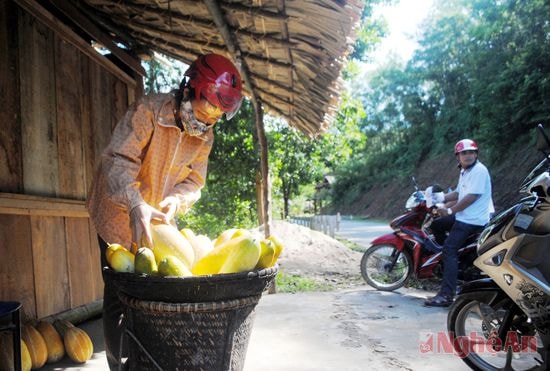 |
| Melons grown in the fields of Xop Chang, Yen Hoa (Tuong Duong). |
Tuong Duong is also famous for its sweet eggplant, which is larger than the common eggplant, green with a white border, and eaten raw with soy sauce or shrimp paste for a sweet taste. Almost everyone who visits Tuong Duong tries to find this special product to take home as a gift. Sweet eggplant is sold quite a lot at Hoa Binh town market and in the communes of Tam Thai, Tam Dinh, and Xa Luong… Sweet eggplant is grown in many communes, but Khe Ngau village in Xa Luong commune is considered the "capital" of sweet eggplant. According to Ms. Luong Thi May in Khe Ngau village, her family harvests 3 tons of sweet eggplant annually, mainly grown along Khe Ngau stream, completely naturally without the use of any pesticides. With a price of 8,000 - 10,000 VND/kg, her family earns 27 - 30 million VND per year from growing sweet eggplant. In Xa Luong commune, 45 out of 120 households grow sweet eggplant, yielding 35-40 tons per crop and generating over 300 million VND in revenue annually. Mr. Luong Van Phan, Chairman of the Xa Luong Commune People's Committee, stated: Sweet eggplant thrives in the Khe Ngau area, with two harvests per year. This summer's sweet eggplant crop was expected to yield 45 tons, but due to drought, the yield is lower.
Mr. Lo Kham Kha, Head of the Agriculture Department of Tuong Duong District, added: The district is focusing on specific areas with agricultural products such as pumpkins, Con Phen bitter bamboo shoots, taro, etc. However, the cultivated areas are still fragmented and not planned into concentrated zones due to the disjointed terrain. For example, there are about 25 hectares of green pumpkins concentrated in the communes of Tam Hop, Thach Giam, and Tam Dinh; taro is 10 hectares in Tam Hop and Luu Kien... Developing these into marketable products is difficult because the market is not stable, mainly consumed within the district and by visitors from afar. The district is gradually building brands for highland products, and has initially established sweet eggplant in Khe Ngau, fragrant gourd in Xa Luong, mac tet in Chan village (Thach Giam), taro, and mustard greens in Luu Kien... The district encourages farmers to cultivate using traditional methods without pesticides. However, for highland products to bring high economic value, they need to be promoted and introduced in restaurants and hotels in the city. This program needs mechanisms and policies to support ethnic minorities in their bold development.
The mountainous district of Kỳ Sơn is also famous for its local produce such as upland melons, taro, and wild yams. Upland melons are a distinctive product, often called "Mông melons" by the highlanders. These melons are 3-4 times larger than cucumbers, crunchy and sweet, with a unique flavor. They are grown by the Mông people in the communes of Huồi Tụ, Mường Lống, and Nậm Cắn on high mountain slopes covered in mist. In Nậm Cắn commune, the Mông melon harvest is underway. Mr. Lầu Tổng Chúa from Trường Sơn village said: "These melons are very easy to grow. After clearing the land and sowing the seeds in February (lunar calendar), they can be harvested around May-June (lunar calendar). Due to Nậm Cắn's year-round cool climate, the melons don't need watering and still bear fruit consistently. My family planted about 500 square meters and harvested about 200 kg, selling them at 10,000 VND/kg, earning 2 million VND per harvest." The entire Nậm Cắn commune currently has about 3-4 hectares of upland melons, concentrated in the villages of Ba Ca, Trường Sơn, etc. Mr. Hờ Chống Nhìa, Chairman of the People's Committee of Nậm Cắn commune, added: Upland melons are a high-value specialty but it is difficult to expand the area because the planting sites are far from residential areas, so they are frequently damaged by rats. Not to mention the need to properly preserve the seeds; some households sow quite a lot but the germination rate is not high.
Nam Can is also famous for its taro, a specialty grown on hillside fields. Locals say that taro is easy to eat and quite popular during the winter months because it helps retain body heat. In recent years, the villagers have received government relief rice during the lean season, but no one has abandoned taro cultivation; instead, they have expanded the area to grow it for sale and increase their income. Mr. Ho Chong Nhia, Chairman of the People's Committee of Nam Can commune, shared: "Seeing the value of taro, the commune has encouraged and motivated the people to expand the area. From just over 3-4 hectares, this year there are over 8 hectares of taro. Expanding the taro area and increasing income is easy because taro is a finicky crop. It requires good, unspoiled soil to grow well. High-quality taro has large, starchy tubers with a distinctive, delicious flavor. If chemical fertilizers are used, the taro will not taste good."
Besides, taro is also grown intensively in the communes of Huoi Tu, Muong Long, Dooc May, Na Ngoi, and Tay Son. With its potential and advantages, Ky Son also has many other valuable products such as Shan Tuyet tea, concentrated in Huoi Tu and Muong Long, covering over 500 hectares. Mr. Nguyen Dinh Tri, Head of the Agriculture Department of Ky Son, said: The potential of Shan Tuyet tea is enormous, but Ky Son has not fully exploited it. The reason Shan Tuyet tea has not reached its full potential is due to the outdated processing technology at the Youth Volunteer Brigade 8, the lack of emphasis on promotion, and the lack of production capital.
The products of the highland districts are being preserved and produced by the local people. However, to become marketable goods and widely introduced to the market, it requires active involvement and many positive solutions from all levels and sectors in the areas of product consumption, promotion, and production linkages.
Van Truong