
Preserving the historical relics of Cho Xam communal house.
(Baonghean) - During the two wars of national liberation, Xam Market communal house was not only a meeting place for the independent Party branch of Kim Khe Trung village, but also a place to bid farewell to the sons and daughters of Nghi Hoa (Nghi Loc) who were enlisting in the army; and a venue for local festivals. Currently, the people of Nghi Hoa are striving to preserve and restore Xam Market communal house and the folk games associated with traditional festivals... meeting the spiritual and cultural needs of the people.
(Baonghean) - During the two wars of national liberation, Xam Market communal house was not only a meeting place for the independent Party branch of Kim Khe Trung village, but also a place to bid farewell to the sons and daughters of Nghi Hoa (Nghi Loc) who were enlisting in the army; and a venue for local festivals. Currently, the people of Nghi Hoa are striving to preserve and restore Xam Market communal house and the folk games associated with traditional festivals... meeting the spiritual and cultural needs of the people.
Memories of the old temple
According to the recollections of Mr. Dang Van Dien (75 years old) from Hoa Trung hamlet, the Cho Xam communal house was very large back then, situated on a high, flat mound of land to the east of the village. The communal house had two buildings: the upper and lower halls. The upper hall consisted of a single bay with two gables, a four-pillar structure, supported by four lim wood columns 2.78m high and 0.70m in diameter. The roof was covered with yin-yang tiles, topped with a relief of two dragons facing the moon, and a gate in front. A wall surrounded the communal house; on it were sculpted figures of animals such as horses, elephants, and soldiers holding swords standing guard. On either side of the gate were two 3.5m high pillars, topped with reliefs of lotus flowers. In the middle of the courtyard stood an ancient banyan tree, further enhancing the majestic and ancient appearance of the communal house.
To the south of the communal house is the Pagoda Well – a well built during the French colonial period, its water is incredibly clear, cool, and sweet. On hot summer days, people returning from working in the fields would stop by the communal house to cool off under the banyan tree, and would not forget to scoop up water from the well to quench their thirst. The Pagoda Well supplied water to the entire Kim Khe Trung area at that time (comprising the three communes of Nghi Hoa, Nghi Thuan, and Nghi Long). Along with the communal house and the Pagoda Well, there is also a Buddhist temple to the west – a place of worship for Confucius and Mencius, and a celestial altar dedicated to the God of Agriculture erected in the open air. Not only is it a spiritual place for people in the region to visit on the 15th and 1st of each lunar month, and on days of fasting, but the communal house also hosts many traditional village festivals annually, such as the Thuong Nguyen Festival on the 7th of January, the Trung Nguyen Festival on the 15th of July, and the Ha Nguyen Festival on the 15th of December, along with many traditional games like chess, wrestling, spinning tops, theatrical performances, and traditional opera... attracting a large number of people from the region and the surrounding area.
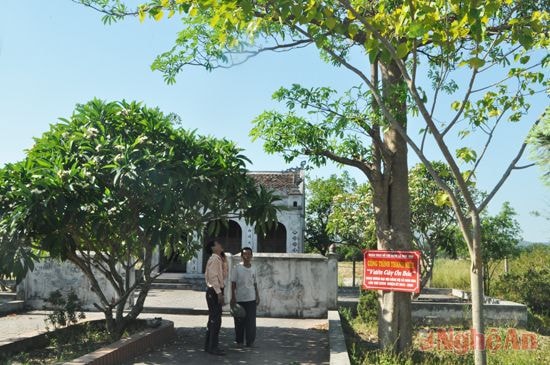 |
| A view of the Chợ Xâm communal house historical site. |
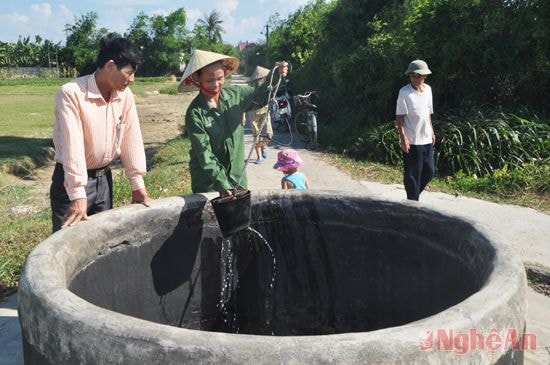 |
| The temple well is located within the Chợ Xâm communal house complex. |
What the people of Kim Khe Trung were most proud of back then was that Cho Xam communal house was chosen by revolutionary patriots as a center for communication, meetings, printing, and hiding Party documents during the revolutionary movement of 1930-1931. It was the place where the Kim Nguyen commune Party branch was established, where 300 farmers gathered to coordinate with the Dang Xa, Van Trinh, and Thuong Xa communes to go to the district town to demand a reduction in taxes and the distribution of communal land to poor farmers, and where the ancient banyan tree stood where the French executed 19 revolutionary fighters… It was also here, night after night, under the dim light of peanut oil lamps and with rudimentary printing tools, hundreds of leaflets containing news of the struggle and Party directives and resolutions were distributed. When the documents could not be transported, they were hidden in the altar and ceremonial objects. Cho Xam communal house has been associated with many events in the history of the heroic struggle of the people of Nghi Hoa, especially during the Nghe Tinh Soviet period of 1930-1931. Because of this significance, Cho Xam communal house was recognized as a National Historical Monument by the Ministry of Culture and Information in 1998.
Conservation efforts
On a June afternoon, I followed Mr. Dang Van Tam, a cultural officer of the commune, to revisit the old communal house. The communal house is now located in the center of Hoa Dong village, next to the village cultural center, so many people pass by daily. Thankfully, in 1994, in accordance with the wishes of the people, the commune restored the main hall – the place of worship and religious practice for the villagers during festivals, holidays, and on the 15th and 1st days of the lunar month. Not far away, the temple well remains intact, its water still clear and cool, and every day the people of Hoa Trung village still come here to fetch water for their use. Especially during severe droughts like this, the temple well is the main water source for hundreds of households in the surrounding area. Even more encouraging is that around the communal house, rows of green trees of various species are carefully tended and protected by the local people. Mr. Tam said: "To restore the greenery to the temple, every year, on the 'Forever Grateful to Uncle Ho' tree-planting festival, organizations and people in the commune come together to plant more trees, providing shade and beautifying the temple's landscape."
After being recognized as a National Historical Monument, the temple has been restored and renovated by the State, partially meeting the cultural and spiritual needs of the people. Mr. Nguyen Quoc Van (the caretaker of the monument) said: "On the 15th and 1st of each lunar month, many people come to offer incense. Every year on July 27th, young people come to learn about the history of the temple. The Soviet Nghe Tinh Museum has also organized exhibitions showcasing images related to the Soviet Nghe Tinh uprising to help people better understand the value of the monument."
What worries the people of Nghi Hoa is that the shrine dedicated to Confucius and Mencius has not yet been restored. Only the upper hall remains; the traditional cultural and spiritual activities of the region, such as festivals, traditional games, and traditional opera, have not been revived. Ms. Tran Thi Ty (56 years old, Hoa Dong hamlet) said: "The people are very eager because Nghi Hoa only has this one complex of historical relics at Cho Xam communal house. Everywhere, people are restoring, renovating, and beautifying relics to remember their roots and to help the younger generation understand the traditions of the village and commune. The people hope that the commune government will get involved more decisively and thoughtfully. How can we restore the lower hall, the temple, the banyan tree, etc., so that this place becomes a cultural and spiritual center for the people? A place for extracurricular activities about history for teenagers and children?"
Mrs. Ty's wish is also the wish of many people in Nghi Hoa. However, the Nghi Hoa commune government has been pondering how to appropriately promote the value of the Cho Xam communal house relic with long-term directions. These include, in the future, strengthening propaganda to encourage people and organizations to participate more actively in the tree planting movement at the relic site, especially replanting the banyan tree – an important historical witness during the Nghe Tinh Soviet Uprising in the Kim Khe Trung region. They will choose a day – perhaps the day the 19 revolutionary soldiers were executed by the French – as the main commemorative day for the Cho Xam communal house complex to hold a memorial and tribute… Gradually restoring the various parts of the communal house such as the sanctuary, the lower hall, the main courtyard… Assigning the commune's cultural officials, the Youth Union, the Women's Association, the Veterans' Association, and other organizations to restore folk games and traditional festivals… so that this place becomes a cultural and spiritual center for the people of Nghi Hoa in particular, and the people of Kim Khe Trung in general.
Thanh Thuy