

Growing tea using clean farming practices: A sustainable path forward.
(Baonghean) - The recent rejection of substandard tea exports in several localities across the country has caused a sharp drop in tea prices, from 4,700 VND/kg to 3,600 VND/kg (in June). Tea growers in Nghe An are also facing many difficulties, while drought is threatening yields. In this context, the model of producing high-yield, clean tea according to VietGAP standards in Hung Son commune has proven effective and is worth studying and replicating in other localities to enhance the competitiveness of tea.
Visiting Hung Son commune (Anh Son district), one can witness the vast green tea hills and truly appreciate the efforts of the local people in developing the tea-growing region. In particular, the support of the VietGAP-certified tea cultivation project has opened up a new direction for tea growers in this area, creating an economic turning point. From 10 hectares of experimental tea cultivation following the "clean" tea method, stretching along Khe Giat and Con Tit, the thriving tea plants have yielded significant economic benefits, prompting Hung Son commune to seek a new market direction for its tea industry. After 12 years, Hung Son now boasts 304 hectares of tea produced according to VietGAP standards, with a large consumer market.
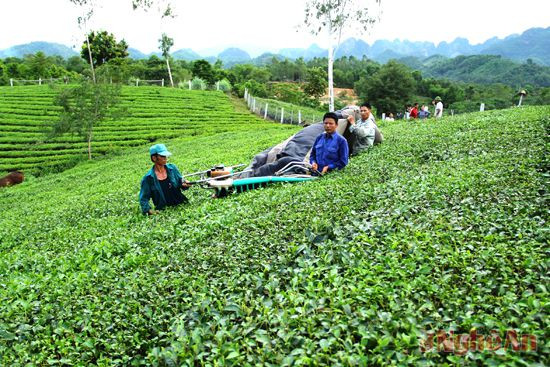 |
| Farmers in Hamlet 5, Hung Son Commune (Anh Son District) are harvesting tea. |
At Quang Tien tea hill (Hamlet 5), Mr. Vo Van Dong's 1.5-hectare tea plantation is considered the oldest in Hung Son region. Taking advantage of the mild weather, his family is harvesting tea, the first harvest after the historic heatwave. He shared: “Every year, tea growers harvest six times, with an average income of approximately 80 million VND per hectare per year. This time, due to the drought, the yield decreased by about 30%, reaching only 6 tons of fresh tea buds, while previous harvests yielded over 9 tons. Previously, when applying traditional tea cultivation methods, our family's tea yield was not high, and the investment costs were also much higher. Since applying VietGAP production methods, tea yields have been much higher than in neighboring localities. Thanks to proper technical care, the tea plants are healthy and highly resistant to weather changes.”
To produce tea according to VietGAP standards, farmers must adhere to "unwavering" principles to ensure that the tea plants are disease-free and do not contain chemical residues. Previously, disease control for tea plants was only carried out when pests appeared. Now, farmers have changed their perception; the key to preventing diseases in tea plants is to address the plant's inherent characteristics. If done well from seed selection, fertilization, and care to ensure optimal plant growth, the tea plant can become immune to environmental changes. During the recent heatwave, many tea plantations withered, but many households only suffered losses of about 30-40%. Fertilization is also no longer haphazard; farmers now follow a specific procedure.
Over the years, tea cultivation in Anh Son district has gradually established a stable position. The lives of tea-growing households are improving, with many families becoming wealthy thanks to tea. A family with 5 sao (approximately 0.5 hectares) of tea plants can harvest 2 tons of tea buds per crop. With at least 6 harvests per year, yielding 12 tons, and a price of 3,600 VND/kg, this brings in approximately 43 million VND, a very stable income. When tea prices are higher, the income increases even further. In Hung Son, a favorable factor is the presence of a tea processing factory located within the tea growing area, which ensures a market for 100% of the farmers' tea buds.
Mr. Nguyen Huu Quy, Deputy Director of the tea processing enterprise, shared: “In some areas, tea products are not properly fertilized and pesticides are used indiscriminately. Therefore, tea yields are low and do not meet food safety standards. To overcome these limitations, the synchronized application of tea production processes according to VietGAP standards is essential. This requires households to keep detailed production logs, which serves as proof that farmers follow the correct procedures and that the tea products are of guaranteed quality. Currently, tea products from this area are widely consumed in many provinces and cities nationwide, and are even exported to some neighboring countries such as China and Thailand… Currently, Hung Son Tea Enterprise is aiming to expand the area of tea production according to VietGAP standards to Duc Son and Cam Son communes with an area of 300 hectares.”
Regarding the production of tea according to VietGAP standards, Mr. Nguyen Cong The, Head of the Agriculture and Rural Development Department of Anh Son district, said: “In 2011, the Department of Science and Technology provided funding to implement the project “Supporting the model of tea production and processing according to VietGAP standards in Anh Son district”. The goal of the project was to successfully build a model of raw tea production according to VietGAP standards on a scale of 10 hectares. To date, the model has been expanded to over 300 hectares out of a total of nearly 600 hectares of specialized tea-growing areas and has achieved certain progress. The model has created conditions for farmers to access and apply scientific and technical advancements in tea production to increase productivity, minimize the use of pesticides, create clean products, ensure food safety and hygiene, meet market demands, contribute to increasing income, improve the lives of producers, and at the same time reduce environmental pollution. To support the farmers, the Anh Son District Agriculture Department has taken the initiative.” "Advising, organizing, and guiding farmers in applying science and technology in production, cultivation, and market research... The goal is to affirm the quality of local agricultural products, and on that basis expand the market for product consumption."
Thanh Quynh