

Bright colors of Huoi Poc
(Baonghean) - Huoi Poc, once a sacred and dangerous forest, is now a picture of prosperity with the green of rice paddies and the flourishing of livestock. Contributing to this joyful picture today are the diligent hands, the dynamic mind, and the persistent patience of Youth Union Secretary Luong Van Kieng.
Refusing to accept poverty
“From Muong Xen town to Noong De village in Nam Can commune, turn right, follow the small dirt road, and at the end of Huoi Poc ravine is my camp,” Luong Van Kieng, the Youth Union Secretary of Noong De, instructed me over the phone. Sitting on my motorbike, we traveled nearly 4 kilometers through the forest, occasionally encountering steep slopes and rocky terrain. Some sections required a steady hand to maneuver around large boulders protruding from the road. After about 30 minutes, I met a child standing by the roadside. I stopped and asked about Kieng's camp, and the child nodded: “Follow me, Uncle Kieng asked me to meet you at the road.”
Climbing up the hillside, past small terraced rice paddies that had just been filled with rice, I came to a small house built on the hillside. Luong Van Kieng greeted me in his work clothes stained with tree sap, a bright smile on his thin, dark face. If I hadn't been introduced by the District Youth Union Secretary, I wouldn't have known he was a Youth Union "leader," because he looked older than his age. Climbing the makeshift staircase constructed from tree trunks with their bark still intact, in the corner of the house, a dark-skinned woman sat by a loom weaving cloth. Kieng introduced her to his wife, Vi Thi Nang. Through conversation, I learned that Nang was from Na Loi village, Na Loi commune, several tens of kilometers away, and had married Kieng in 2001.
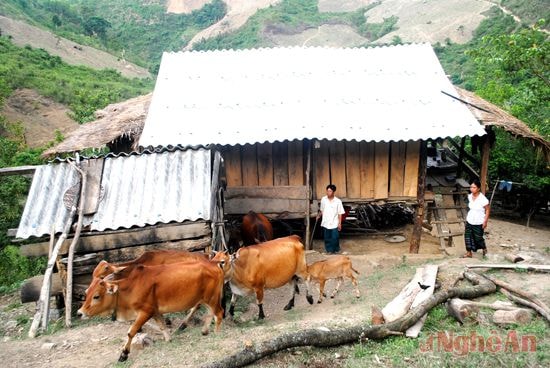 |
| The small house of Mr. and Mrs. Luong Van Kieng in Huoi Poc. |
Sitting by the side of the house, Kieng cheerfully chatted. His father died early, and his mother raised nine children alone; Kieng was the eighth. After finishing 11th grade, Kieng had to drop out of school due to the family's difficult circumstances. At 19, Kieng got married and, with the help of his siblings, built a small house in the village. They started their own family with nothing of value. Their life depended entirely on the nearly one hectare of farmland his mother had given them, so they were constantly struggling. Many nights, Kieng couldn't sleep, his hand on his forehead, pondering that if he didn't break free from his youth, he would remain poor forever, while Ky Son was a sparsely populated area. Khe Huoi Poc, though far from home, had vast land, and he could establish a long-term livestock farming area there.
Without hesitation, Kieng discussed the matter with his wife, leaving their house with his mother and moving to the area to start a new life. With mutual agreement, the young couple brought their belongings to the Huoi Poc ravine and built a small house to live in. After observing the area, Kieng concluded that raising cattle, goats, and chickens was the most suitable option, given the vast hills and abundant food sources. However, he wondered where they would get the money to buy livestock, as his mother and siblings were all poor. Hearing on the radio and television that the local people could borrow money from the Social Policy Bank to start businesses, the couple traveled to Muong Xen town and sought out the district's Social Policy Bank to inquire about the loan process. After being guided by bank officials on how to prepare the loan application, they soon had 15 million dong as capital. With that money, he bought a cow, a breeding goat, and 10 chicks. In addition to livestock farming, the couple actively cleared land for cultivation, planting rice and cassava to ensure food security.
Ms. Nang confided: "We can't measure the exact area in hectares, but each year my husband and I sow 35 kg of rice seeds and harvest 40 bags of rice. After harvesting the cassava, we diligently chop it into small pieces, dry it, and store it as feed for the chickens. Although the chickens are free-range on the hills, we have to stockpile feed for them. When it rains heavily and we can't let them out, we scatter it for them to eat. After more than 10 years of living in the Huồi Pốc ravine, my husband and I now have a large herd of cows, goats, pigs, and chickens. We revealed that every year we sell one or two cows, a few goats, and raise pigs for meat from the sows to cover living expenses and repay bank loans. My wife is very capable, taking care of everything at home and raising the children, creating opportunities for my husband to participate in social work. Currently, Mr. Kiềng is the Deputy Secretary of the Party branch and the Secretary of the Youth Union in Noọng Dẻ." In this remote and isolated place, despite the lack of resources, the young couple encouraged each other to work hard, produce, and stabilize their lives, proving themselves worthy role models for many youth union members to emulate.
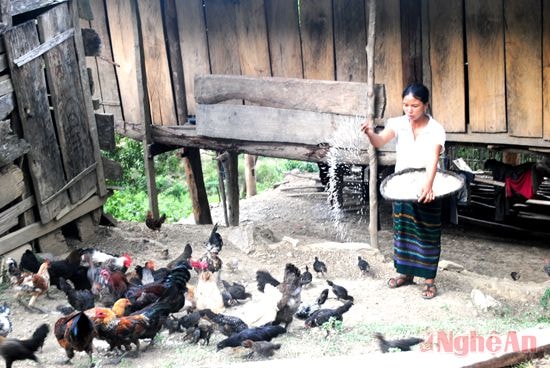 |
| Ms. Vi Thi Nang (Mr. Kieng's wife) takes care of the chickens. |
Follow Kieng's instructions.
Like many other villages in the high mountainous region, the lives of the people in Noọng Dẻ are still difficult, and the poverty rate remains high. The main reason is that the villagers lack business acumen, and many are even lazy. On several occasions, Mr. Kiềng discussed with village officials and encouraged the people to develop their economy through pig and chicken farming. The idea was agreed upon by the officials, but making the farming efficient was not easy, as the villagers had previously raised pigs with low returns. After reading newspapers, listening to the radio, and watching television, he learned about many places where people helped each other raise pigs in groups very effectively. After several village meetings, Kiềng proposed the idea, and it was supported by the officials and the villagers.
However, there were still some villagers who didn't want to work, waiting for government support policies. Refusing to give up, Mr. Kieng personally met with and encouraged each person, telling them that they had to be self-reliant to escape poverty. He explained that their lives were their own, that they had hands, feet, and brains, only lacking perseverance and diligence. He spoke little, then much, and gradually the villagers understood. Thus, the most difficult problem was fundamentally solved. Mr. Kieng calculated that the village had 120 households and needed to be divided into several groups of 3-4 households each to support pig farming. The first group received breeding pigs from the government's livestock support project. After the pigs gave birth, each household was responsible for supporting another group with two sows. Through this method, Noọng Dẻ village now has four pig farming groups, bringing practical economic benefits to each household and gradually stabilizing their lives.
When they first arrived in Huồi Pốc to build their homes and start a new life, this mountainous area was deserted, with few people passing through. Yet now there are six households, all young couples. Luong May Thien, one of the six families who followed Kieng here to settle four years ago, confided: "Following Kieng and his wife's way of doing business, we built our house here and diligently cleared eight terraced rice paddies around our home. In addition, we've raised many cows and goats… so our family life is no longer lacking food and work like before. Now, in Huồi Pốc, not only are there herds of cows, goats, and chickens… but also terraced rice fields on the hillsides, presenting a picture of prosperity for these people who refused to accept poverty."
As a Party member and Youth Union Secretary, Luong Van Kieng always adheres closely to his duties, regularly visiting the village to encourage Youth Union members and young people to actively participate in the activities and movements launched by the Youth Union. A regular focus of the Youth Union Secretary is mobilizing Youth Union members and young people to help families in particularly difficult circumstances repair their houses and prepare land for production; clearing trees along the village roads, cleaning public areas, dredging canals, and managing and repairing community water supply facilities… Thanks to the active contributions of the Youth Union, Noong De village is becoming cleaner and more beautiful.
According to Ms. Xa Thi Xi, Secretary of the District Youth Union, Ky Son currently has 105 young people with successful economic models, earning between 40 and 150 million VND per year. A commendable aspect of Ky Son's youth is that most of these models started with small bank loans. Thanks to their diligence, hard work, and ability to utilize local advantages, they have built stable family lives, both mentally and materially. Luong Van Kieng, Secretary of the Youth Union branch, is one of the 105 exemplary young people in Ky Son's economic development models. Not only has he strived to become self-reliant, but Mr. Kieng is also a skilled youth union member in community outreach, recognized by the people of Noong De village and the Nam Can commune Youth Union.
Xuan Hoang