

The truth behind the fake soy milk powder
With a few spoonfuls of powder, some flavoring, and boiling water, you can have a cup of soy milk… that looks just like the real thing. This powder can be bought in many places at a very cheap price. Many of them come in bags with no brand name or label.
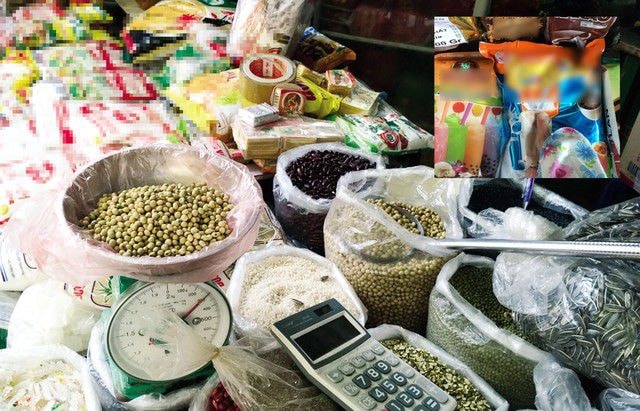 |
The soybeans, advertised as "local soybeans," were purchased by the reporter at Thanh Xuan market. Cream powder used to make soy milk on Hang Buom Street (small photo). |
Cream powder + essential oil = soy milk
Following reports that soy milk is made from powdered creamer and flavoring, we went to Hang Buom Street in Hanoi to verify the information. “There’s no soy powder here. I see people buying creamer powder, adding a few drops of soy oil, and it becomes soy milk,” said a grocery store owner on Hang Buom Street – considered Hanoi’s “food chemical warehouse.” She then pointed to a row of powder packets on a shelf. The cheapest ones cost 35-40,000 VND per half kilogram. Larger packets cost 80,000 VND per kilogram. Touching the packaging, the white granules inside felt gritty like sugar. According to our observations, these powders had labels and expiration dates. The front stated “Thai creamer powder,” but the back indicated it was a product of a company in Ho Chi Minh City. The cheapest one stated “Malaysian creamer powder,” but the back also indicated it was a product of a Vietnamese company.
When asked about this, the shop owner said, "This one is from Thailand, and this one is from Malaysia, but packaged by a local company." "Are there any cheaper powders? I saw a friend recommend a Taiwanese powder, opaque white, sold by weight, much cheaper," I wondered. "Yes, I've seen some shops selling it, but not here. This one is a bit more expensive, but for a pot of about 3-4 liters of water, add a few small spoonfuls, stir well, boil it, add a drop of soybean oil extract, and it becomes rich, fragrant with the smell of soybeans – you can sell as much as you want," the shop owner said. At the shop next door, we inquired about buying soybean oil extract. The owner said that it's true that only the creamer powder, when mixed with oil, will look very similar to soy milk. Even connoisseurs would find it hard to tell the difference when tasting it. Then, he went inside and brought out a bottle of soybean oil extract. He said the price was 70,000 VND per 100 grams. "If you buy in bulk, I'll give you a small discount, otherwise the price is already the absolute maximum."
Confusion over Chinese soybeans.
According to our investigation, creamer powder is commonly used in many dishes: making bubble tea, adding to coffee, ice cream, etc. However, the availability of unregulated, unverified powders is causing concern among many people. To get a genuine cup of soy milk, we went to Thanh Xuan market to buy soybeans. A staff member at the MQ store there enthusiastically said: “Please come and check out our soybeans, they are genuine Vietnamese soybeans. One kilogram costs 40,000 VND. Don't be tempted by cheap hybrid or Chinese soybeans.” According to this staff member, Vietnamese soybeans are small and green. Hybrid and Chinese soybeans are large, round, and white. “A woman who works at a nearby bank buys soybeans from us all the time. She said that when she grinds them to make soy milk, it's fragrant, while the hybrid soybeans make bland milk with a foul smell that's undrinkable,” the female staff member said.
When asked about the powdered creamer used to make soy milk, many shops here shook their heads, saying they didn't have any. However, there were plenty of cheap soybeans available, the cheapest costing less than 30,000 VND/kg. Dr. Tran Hong Con (Department of Chemistry - Faculty of Science - Vietnam National University, Hanoi) stated that with unregulated, unverified food products, it is very difficult to determine the level of harm. Similar to some other extracts, if soy extract is properly refined and all impurities are removed, then there are no problems when consumed. However, if it is unregulated and not "clean," it is very difficult to distinguish with the naked eye. The remaining impurities, when consumed long-term, can affect health, potentially leading to kidney stones or cancer.
Reportedly, besides the information about "fake" soy milk and Chinese soybeans, many housewives are very worried after news that most soybeans imported from the US to Vietnam are genetically modified, posing a danger to consumers. Ms. Ngan Giang (Cau Giay, Hanoi) said that in the past, when she ate breakfast near her office, she would see a man delivering hundreds of glass bottles of soy milk to various shops every morning. These bottles were all handmade and unlabeled. "However, if genetically modified soybeans are used to make cooking oil, I don't know what else to use," Ms. Giang said, shaking her head in dismay. According to Associate Professor, Dr. Le Huy Ham (Director of the Vietnam Institute of Agricultural Genetics), genetically modified foods have been used for nearly 20 years. World medical literature has not recorded any risks caused by them. Vietnam currently has a "double barrier" regarding the biosafety of genetically modified crops and still requires food producers to continue monitoring in order to intervene promptly when abnormalities occur.
According to Giadinh.net