

Relations between Russia and the EU are once again on the rocks.
(Baonghean) - The Russian Foreign Ministry has just issued a statement saying that Russia is ready to expand its travel ban list for European Union (EU) officials if the West increases the number of Russian officials on its "blacklist". Previously, both Russia and the EU had a war of words after Russia approved a blacklist of 89 EU politicians banned from entering Russia...
An eye for an eye, an eye for an eye.
The European Union was the first to create a "blacklist" targeting Russian officials, so it's clear that Russia's latest "blacklist" is a retaliation against the EU. The list Russia just published includes prominent figures such as EU Council Secretary-General Uwe Corsepius, former UK Deputy Prime Minister Nick Clegg, former Belgian Prime Minister Guy Verhofstadt, Polish Justice Minister Robert Kupiecki, and former UK Defence Minister Malcolm Rifkind.
After Russia approved a “blacklist” of 89 EU politicians banned from entering Russia, the European Union protested, stating that it considered the move “completely arbitrary and unreasonable.” In response to the EU’s reaction, Russia defended its decision. Speaking to reporters yesterday, Russian Foreign Minister Sergei Lavrov asserted that the EU’s statement was completely “unreasonable.” According to Lavrov, Russia had restrained itself for too long, and the list was a response to the EU’s unfriendly unilateral move, not a provocation by Moscow. Russian Ambassador to the EU Vladimir Chizhov also affirmed that the list was not compiled randomly.
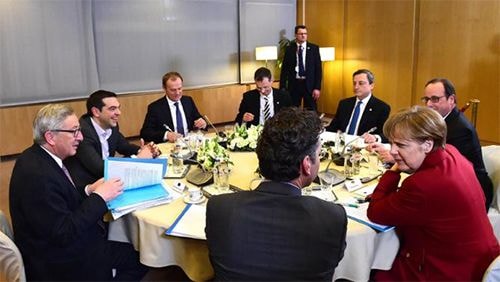 |
| EU leaders at a meeting in Brussels on March 19, 2015. Photo: AP |
Alongside diplomatic sanctions, both the EU and Russia have suffered significant losses related to each other's economic sanctions. According to the latest figures released by the Spanish Foreign Ministry, the EU has lost at least 21 billion euros in the trade war with Russia. Japanese economic experts estimate the EU's losses at around 30 billion euros. Meanwhile, Western sanctions have cost Russia 160 billion USD.
Not yetReturn to normal
Since the beginning of the year, relations between Russia and the EU have improved significantly. Both Russia and the EU hope to restore relations soon and maintain channels of dialogue on areas of cooperation, easing current tensions. In reality, neither side has taken concrete steps to improve bilateral relations. Furthermore, while the EU is still grappling with internal disagreements in adjusting its relationship with Russia, Russia is embroiled in diplomatic disputes with Ukraine in the Donbass region, leaving the EU seemingly uneasy about Russia's situation.
In this context, Russia's retaliatory move against the EU can be seen as a message to the EU that punishing Russia means the EU is hurting itself. Because relations between the EU and Russia have not improved significantly, Finland's new Foreign Minister, Timo Soini, assessed this move by Russia as "not a big surprise" and "an expected response" to a similar ban previously imposed by the EU on Russian citizens.
While the situation in eastern Ukraine remains chaotic, this latest Russia-EU tension will only make the problem more difficult to resolve. As long as the Ukraine issue remains unresolved, Russia-EU relations cannot return to normal. Russia's strong response to the EU raises concerns that the confrontation between Russia and the EU may never end. If the EU fails to reach a consensus and find a suitable dialogue with Russia, and if Russia does not change its approach to the EU, the retaliatory actions will only lead to a deadlock in bilateral relations.
Nguyen Cao Bien