

The effectiveness of the Reproductive Health Club model
(Baonghean) - In recent times, the Que Phong population sector has consistently focused on promoting healthcare for women and girls of reproductive age. Practical and effective methods in propaganda and mobilization have contributed to gradually raising women's awareness of reproductive health care...
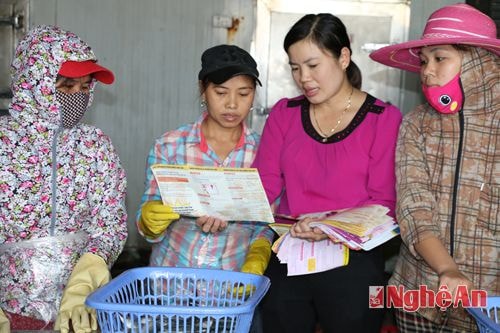 |
| Population officials provide reproductive health care counseling to women in Quang Phong commune (Que Phong district). |
As a mountainous commune with many ethnic minorities such as the Thai, Khmu, Nung, Muong, and Tho, the people of Que Son commune (Que Phong district) previously believed in the saying "God provides for all," leading to large families and the persistence of child marriage. To gradually raise awareness among the people, since 2012, the District Population Center has collaborated with the commune to establish "Adolescent Reproductive Health Care" clubs in eight villages within the commune. These clubs regularly meet once a month on weekends. The programs for these meetings integrate cultural performances with educational content, discussions, and psychological counseling, attracting young people to participate. This provides an opportunity for young people and students from the same villages to socialize, meet, and share their thoughts and feelings as teenagers.
Thanks to the club's continued activities, the awareness of young people in this mountainous commune, which still faces many difficulties, regarding reproductive health care is gradually improving. Ms. Lo Thi Thao, the population officer of Que Son commune, said: "Previously, most young people were indifferent to the annual reproductive health care campaigns, but now they participate very actively. Because they know how to care for their own reproductive health, many young people are no longer hesitant to visit the commune's health station for check-ups. To date, most young people in the commune have pre-marital health check-ups before getting married. In particular, the practice of child marriage in the area has significantly decreased; about 5 years ago, there were nearly a dozen child marriages each year, but now it has decreased to only 1-2 cases."
Chau Thon commune, with its 13 hamlets and villages, has established 3 "No Third Child" clubs, attracting a large number of women participants. The clubs meet once a month. For the women, this is a forum for cultural and artistic activities, as well as sharing experiences in building happy families. It's also an opportunity to listen to and openly share sensitive issues in reproductive health care that women often feel embarrassed to discuss.
Ms. Vy Thi Sinh (from Hien village, Chau Thon commune), one of the active members of the club, said: “Since joining the club, we understand the importance of proper health care, and therefore we pay more attention to and know how to take care of our own health. For example, during pregnancy, we know how to supplement nutrition, have regular prenatal checkups, and monitor the health of the fetus. My family only has daughters, so the knowledge about reproductive health care accumulated from the club's activities is really useful for me when taking care of my daughters.”
Thanks to intensified awareness campaigns, women in Chau Thon (a commune with 95% ethnic Thai population) no longer feel hesitant to discuss reproductive health care. Many women now proactively inquire about health check-up schedules and how to use contraceptive methods. The rate of women using contraception has increased annually, currently exceeding 90%. Women have also proactively visited the health station for regular reproductive health counseling and care. Thanks to effective awareness campaigns on reproductive health care for women and girls, the rate of third births in Chau Thon has significantly decreased in recent years (only one case in 2014). Since 2014, there have been no cases of child marriage in the commune.
In addition to promoting the effectiveness of the clubs, the Que Phong District Population Center also coordinates with the Department of Justice, Education, and the District Youth Union to organize the "Golden Bell Challenge" competition annually at two schools. This is an exchange program that helps students learn about the law, while also incorporating the dissemination of reproductive health knowledge. Over the past four years, the "Golden Bell Challenge" program has been organized in many schools such as Chau Thon Secondary School, Thong Thu Secondary School, etc. The schools selected to host the program usually have a large number of boarding students and have experienced cases of child marriage.
The program aims to provide basic knowledge about adolescent reproductive health; issues related to sexuality, friendship, love, etc.; and to offer counseling and answer questions, helping young people express their thoughts and feelings during adolescence. Annually, the Que Phong District Population/Family Planning Center collaborates with the District Health Center to organize two campaigns to promote and integrate reproductive health/family planning care to people in all communes in the district. Regularly, the center also organizes community counseling on reproductive health care in 14 communes and towns to educate women about accepting contraceptive methods and reduce the rate of women suffering from reproductive tract diseases.
Ms. Sam Thi Hanh, Director of the Population/Family Planning Center of Que Phong district, said: Although the dissemination of information on reproductive health care to women in the district still faces many difficulties, thanks to the synchronized implementation of many propaganda measures with diverse forms, the awareness of reproductive health care among women and girls in the mountainous district of Que Phong is gradually improving. This is reflected in the fact that the rate of acceptance of contraceptive methods among women always meets and exceeds the annual targets set by the district (over 200% of the annual plan). Not only do women actively participate in campaigns and health check-ups, but many women have also consciously gone to the health station for regular consultations and reproductive health care, or when they have health problems.
Thanks to the intensified efforts in adolescent reproductive health care, cases of child marriage have decreased annually. In the future, we will continue to promote the effectiveness of reproductive health care club models, while coordinating with youth organizations and women's associations to integrate awareness campaigns targeting women and girls. This aims to both provide women with access to reproductive health care services and, more importantly, gradually foster self-awareness regarding reproductive health care among women and girls – which contributes to improving the quality of the population.
Dinh Nguyet