

Land consolidation and reallocation - "Voices" from the fields. Part 2: New values.
(Baonghean) - After land consolidation and exchange, people have the opportunity to introduce mechanization and scientific and technological advancements into production, stimulating agricultural production services to save production costs and increase economic efficiency per unit area... gradually accelerating agricultural and rural development and improving the lives of farmers.
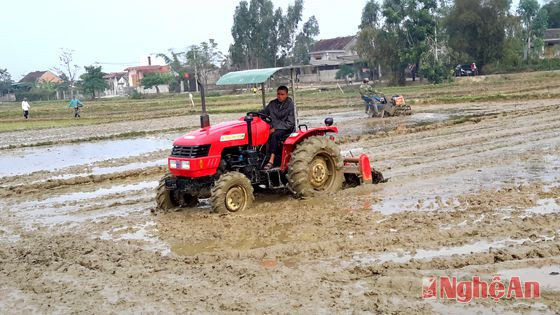 |
| Mechanized land preparation in Hung Thang commune (Hung Nguyen district). Photo: Phu Huong |
Reduce labor, increase production value.
It's not difficult to see the positive changes after localities have basically completed land consolidation work in the field. In Thanh Lien commune (Thanh Chuong district), Mr. Dinh Viet Nam, Vice Chairman of the People's Committee, led us to see the fields firsthand and said: "Now, cars can reach every field without any obstacles. Machinery has reached every field, ensuring convenient production, reducing labor and manpower for the people. The entire system of internal field roads is built with earthen embankments, 7 meters wide, with irrigation ditches 1 meter wide on both sides. Thanks to land consolidation, the commune has planned 22 hectares of poor-quality land near rivers and ponds to build 19 family farms and large-scale farms that generate high income." Here, we visited the farm of Mr. Pham Van Dung and Ms. Nguyen Thi Phuong. On an area of just over 1.3 hectares, in addition to cultivating one rice crop and raising fish, they have invested in raising 500 broiler chickens and 30 pigs (both meat and breeding sows), generating hundreds of millions of dong in income each year. Mr. Dung said: "Thanks to land redistribution, our family received more land, allowing us to build a farm, and now our economic situation is much better, enabling us to provide for our children's education."
Thanh Tien commune (Thanh Chuong district), a predominantly hilly and mountainous area, is frequently affected by droughts and floods every year. Despite having a large workforce, the limited arable land and the lack of proactive economic development and structural transformation have resulted in low incomes for its residents. The situation has improved after the commune completed land consolidation. Families with many children but little land have now confidently taken on land in poor-quality areas for improvement and cultivation to increase productivity. Similarly, families lacking labor have adopted mechanization in production, reducing manual labor while still ensuring a stable income. Mr. Nguyen Trong Bay, Chairman of the Thanh Tien Commune People's Committee, stated: "Thanks to land consolidation, the commune has planned specialized farming areas such as rice cultivation, vegetable farming, and the establishment of farms. Currently, there are hundreds of plows and threshing machines in the commune, and people no longer have to work as hard as before."
Phuc Thanh commune (Yen Thanh district) is considered a leading locality in land consolidation in Nghe An province. With over 500 hectares of cultivated land, Phuc Thanh has the conditions to develop and improve the efficiency of agricultural production. However, in the past, due to the fragmentation of farmland, with each household owning an average of 5-10 plots, organizing concentrated production and introducing mechanization into the fields was difficult. Land consolidation has been implemented since the 2000s, but only since 2010, in conjunction with the National Target Program for building new rural areas, has land consolidation in Phuc Thanh truly become vibrant. According to the Chairman of the People's Committee of Phuc Thanh commune, Mr. Dinh Van Duong: "Each household now only has 1-2 rice fields. Along with that, we are carrying out field restructuring to create favorable conditions for building large-scale model rice fields. Thanks to contracts for producing rice seeds with guaranteed product purchase by businesses on the 40-hectare large-scale model rice field, farmers in Phuc Thanh have achieved an income of up to 140-150 million VND/hectare/year from rice cultivation."
According to Mr. Ho Ngoc Sy, Director of the Department of Agriculture and Rural Development: "The most noteworthy achievement is the change in the awareness and habits of farmers in agricultural production. Previously, it was normal to have multiple seasons and different varieties of crops on the same field. Farmers produced according to their habits and family needs, without a sense of community or concentrated production oriented towards commercial goods. After land consolidation, with the introduction of large, square plots of land and mechanization, coupled with the efforts of the agricultural sector and localities in organizing production, joint ventures, and linkages with businesses, people have gradually become familiar with large-scale model fields and concentrated commercial production, gradually accessing and applying scientific and technological advancements in agricultural production. As a result, concentrated specialized commercial fields, creating large volumes of products to meet market demands, are increasingly being expanded."
Forming large-scale model fields
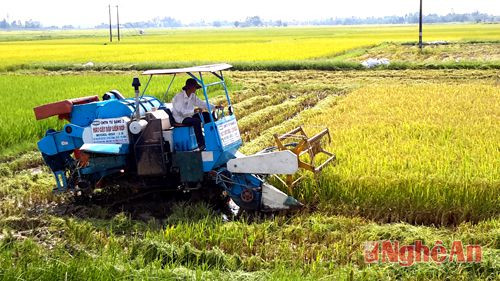 |
| Rice harvesting using a combine harvester in Hung Tan commune (Hung Nguyen district). Photo: Phu Huong |
Thanh Chuong is one of the leading districts in land consolidation. The most noticeable changes are that the water shortage during the summer-autumn crop season is no longer as complicated as before thanks to the comprehensively invested canal system. After the consolidation, the district is actively encouraging people to build livestock farms on poor, unproductive land. The total number of farms currently stands at 300, of which 206 were added after the consolidation. The introduction of mechanization into agricultural production has also seen significant development, with a total of 1,699 machines, an increase of 702 machines compared to before the consolidation. Across the fields, large-scale model fields and specialized fields for high economic efficiency have been established, such as the large-scale model field for corn cultivation in Thanh Lien commune, and the specialized rice production field in Thanh Phong... Mr. Phan Dinh Ha, Vice Chairman of the People's Committee of Thanh Chuong district, affirmed: The success in land consolidation has overcome the fragmentation of farmland, created conditions for the formation of some concentrated production areas, encouraged farmers to invest in and apply advanced techniques, and increased the value of agricultural production towards commodity production.
By completing land consolidation early, Yen Thanh district has favorable conditions to maximize the efficiency of large, square-shaped rice fields. Mr. Nguyen Vuong Ngoc, Vice Chairman of the District People's Committee, said: Currently, Yen Thanh has nearly 20 combine harvesters, serving over 80% of the district's rice area, and more than 1,000 tillage machines. Mechanization in land preparation has reached over 80%, and on-field harvesting has reached over 60%, contributing to faster seasonal work and increased labor productivity, shortening the harvesting time from 7-10 days to 2-3 days. Based on the results of land consolidation, the district is also promoting linkages with businesses inside and outside the province, building large-scale model fields for higher economic efficiency. Every year, this locality collaborates with businesses to produce nearly 1,000 hectares of rice seeds per season in communes such as Hoa Thanh, Tho Thanh, Do Thanh, Hau Thanh, Phuc Thanh, Lien Thanh, etc., creating many high-quality commercial rice production areas with an area of nearly 3,000 hectares, yielding 10 to 15% higher income each year, organizing production in nearly 40 large-scale fields, ensuring stable output for the people.
Currently, the province has nearly 196,000 hectares of agricultural land. Previously, agricultural land was fragmented and scattered, with each household owning many plots, from 3 to 5 plots per household, and some households even had more than 10 plots. After 3 years of implementing the land consolidation policy, the land situation throughout the province has changed in a positive direction. The number of plots per household has decreased, with some localities such as Phuc Thanh (Yen Thanh) and Nghia Dong (Tan Ky)... having only 1-2 plots per household. This is an important prerequisite for creating fundamental changes in production. Starting the construction of large-scale model fields in the spring of 2012 based on concentrated land, Nghe An now has 28 large-scale model fields with main crops being rice, corn, and peanuts, yielding higher productivity, output, and efficiency than conventional production by at least 10-15%. At the same time, 157 effective production models were implemented throughout the province.
Pham Bang - Phu Huong
| RELATED NEWS |
|---|