

China is building islands for military purposes.
That's the assessment of Admiral Harry B. Harris Jr., Commander of the U.S. Pacific Command, regarding China's rapid construction of illegal facilities in the South China Sea. He also emphasized that the U.S. is prepared to attack these facilities if they threaten U.S. interests and allies.
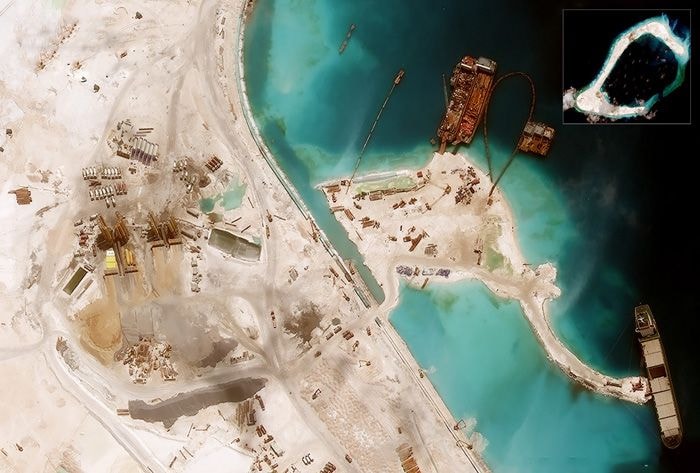 In addition to the 3km-long runway on Fiery Cross Reef, China is also believed to be building another runway on Subi Reef - Photo: DigitalGlobe In addition to the 3km-long runway on Fiery Cross Reef, China is also believed to be building another runway on Subi Reef - Photo: DigitalGlobe |
Speaking at a security forum in Aspen, Colorado, on July 24 (local time), the Commander of the U.S. Pacific Command, Admiral Harry B. Harris Jr., emphasized that China's increasing assertiveness in the South China Sea is an issue that the American public must be aware of and that the government must address. “While Vietnam, Malaysia, the Philippines, and Taiwan also have land reclamation activities, their total reclaimed area – approximately 40 hectares over 45 years – is nothing compared to the scale, scope, and magnitude of China's construction. In just 18 months, China reclaimed over 1,214 hectares,” Harris asserted.
Admiral Harris also expressed concern that China could use the illegally constructed artificial islands in the Spratly Islands as espionage bases, according to Defense Once. If this were true, he argued that U.S. warships could attack these artificial islands in the event of a conflict, and given U.S. capabilities, such attacks would be easily achievable. He also stated that the U.S. would use military force to protect its interests and allies against any threat emanating from these artificial islands.
Earlier, the new commander of the US Pacific Fleet, Admiral Scott Swift, also warned that China is building naval facilities at sea in the Spratly Islands, according to NHK. Admiral Swift made these remarks just days after he participated in a 7-hour patrol on a P-8A anti-submarine aircraft in the South China Sea.
Change the status quo
Also at the forum, Admiral Harris affirmed that China's construction activities in the South China Sea are causing significant harm, not only to the environment. He argued that the principles that have helped maintain security and prosperity in the region over the past few years are also under threat. If those principles are broken, the US economy and security will also be greatly impacted. He frankly criticized China for not making credible efforts to resolve sovereignty disputes with its neighbors. “Most countries pursue peaceful solutions to resolve disputes.”
Conversely, China is changing the status quo in the region through aggressive island building without any diplomatic efforts to resolve or arbitrate the disputes,” Defense Once quoted Harris as saying at the forum. Harris then called on China to use international dispute resolution mechanisms and abide by the agreements it has reached with its neighbors. “It is China’s actions that have pushed its neighbors in the South China Sea to strengthen their relations with each other and with the U.S., not any sudden U.S. effort to enhance regional stability and security,” Harris asserted.
Strengthening the US role in the South China Sea was also a topic of discussion at a hearing of the Asia-Pacific Subcommittee of the House Foreign Affairs Committee on July 23. Speaking at the hearing, Patrick Cronin, Director of the Asia-Pacific Security Program at the Center for New American Security, predicted that if China attempts to prevent the Philippines from resupplying troops stationed on the grounded naval vessel BRP Sierra Madre at Second Thomas Shoal in the Spratly Islands, the US could assist the Philippines. The US could even deploy troops there to train Philippine soldiers. Cronin asserted that this is one of the actions the US could take to respond to the risk of instability in the region, according to The Philippine Star.
Meanwhile, Mira Rapp-Hooper, Director of the Asia Maritime Transparency Initiative at the Center for Strategic and International Studies (CSIS), asserted that China is the only country among the disputing parties in the South China Sea that has completed the transformation of previously submerged features into artificial islands, according to The Philippine Star. Other countries have only applied techniques to add some surface area to features located above water, according to Rapp-Hooper. She also suggested that the Southeast Asia Support Fund, with an initial budget of $50 million, proposed by the US Senate Armed Services Committee, could provide necessary support to the coast guard and naval forces of countries with territorial disputes with China in the South China Sea.
(According to TNO)