
The domestic motorcycle market is gradually losing its appeal.
With a market considered to have reached saturation point, the lackluster atmosphere is perhaps understandable...
With a market considered to have reached saturation point, the lackluster atmosphere is perhaps understandable...
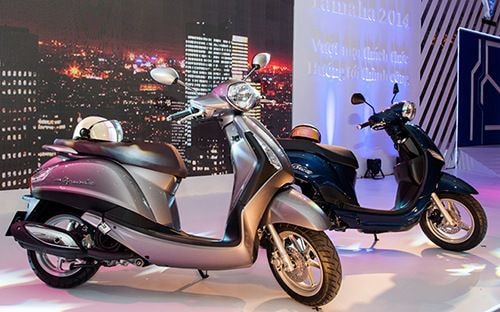 |
| The sales of the Yamaha Nozza scooter haven't really lived up to the hype surrounding it in the media and on social networks. |
The market size remains among the world's largest, with around 3 million units sold annually. However, the Vietnamese motorcycle market is showing signs of becoming less vibrant.
Running out of ideas
According to statistics from the Vietnam Motorcycle Manufacturers Association (VAMM), the total sales volume across the entire market in the 2014 fiscal year of the five major motorcycle manufacturers, including Honda, Yamaha, Piaggio, SYM, and Suzuki, reached 2.71 million units.
Of that total, Honda alone sold over 1.9 million vehicles.
It must be acknowledged that among these five "giants," Honda remains the most noteworthy name, still dominating and leading the market with a 70% market share. Besides having the largest product range, Honda also maintains its leading position in sales volume across most segments.
The market is large, but it seems that in the last few years, individual car manufacturers have been showing signs of running out of product ideas.
At the 2014 fiscal year summary ceremony, the General Director of Honda Vietnam, Mr. Minoru Kato, announced that approximately 10 new models would be launched in the 2015 fiscal year, from April 2015 to the end of March 2016. However, these would all be upgraded versions, not completely new models or generations.
Or consider Yamaha, the brand with the second-largest market share. Although its product portfolio in Vietnam is still quite limited, with many segments left untapped, the number of new models launched in the market in the last three years has been negligible.
Despite the hype surrounding the Nozza and Nozza Grande scooter models, the hype is largely confined to media and social networks due to the manufacturer's marketing strategy; actual market demand has yet to match their popularity.
Recently, this Japanese motorcycle manufacturer launched the Exciter 150 Camo version. In reality, this version isn't new; it's just a redesigned exterior in a military style. Nevertheless, the Exciter remains Yamaha's most popular model in the Vietnamese market, and its strongest selling point for young customers.
Meanwhile, the Jupiter, a once hugely popular scooter model, is gradually fading into oblivion; Sirius, Nouvo, and Luvias are also losing their appeal and are becoming increasingly rare; even the Cuxi, once introduced as a new trend among young people, has quickly become obsolete.
Looking forward to a new market segment?
Nevertheless, Honda and Yamaha remain the two most notable brands, dominating many market segments. This is largely due to their implicitly differentiating customer segments. While Honda is neutral, simple, and practical, suitable for a wide range of customers, Yamaha targets young people who prefer a sporty style in each model.
Due to their different positioning, another notable brand, Piaggio, although not achieving large sales volumes, has carved out its own niche. Piaggio's success largely stems from its brand value and fashionable style, rather than its practicality.
With the mainstream motorcycle market considered to have reached saturation point, the lackluster performance is perhaps understandable. At this point, most current models are in their "mid-life" phase, not yet ready for a complete replacement with a new generation. Meanwhile, the product range is already overcrowded, and demand cannot increase enough to create the need for manufacturers to invest in completely new products.
Therefore, the fact that motorcycle manufacturers are only tinkering with adding a few more paint touches like Yamaha, or changing a few decal designs and paint materials like Honda, seems to be a last resort.
That doesn't mean the motorcycle market lacks room for manufacturers to make a splash. This is where products targeting narrower, more specific, and more individualistic customer groups come in. For example, sports motorcycles, large-displacement bikes, etc.
These product segments are becoming increasingly vibrant with the entry of a range of new brands such as Ducati, Harley Davidson, Benelli, Kawasaki, KTM, etc.
However, it's easy to see that this increasingly bustling area is dominated by completely imported vehicles, rather than being a playground for domestic manufacturers. Therefore, the richness or blandness of the market doesn't depend on the domestic motorcycle industry itself, but rather on a small playing field dominated by imported vehicles.
According to VnEconomy