

Being a journalist is very difficult these days.
On the occasion of the 90th anniversary of Vietnam's Revolutionary Press Day on June 21st, Deputy Minister of Information and Communications Truong Minh Tuan shared some thoughts about the journalistic community and journalists today.
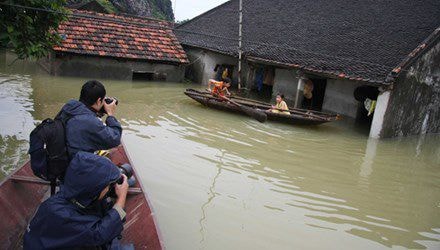 |
| Reporters cover the flooding incident in Thach That, Ha Tay, Hanoi. |
Mr. Deputy Minister, Vietnam is currently experiencing an information explosion with the emergence of many new media methods. This poses numerous challenges to the development of journalism. In this context, what is your assessment of the bright and dark sides of Vietnamese journalism today?
The emergence of online news, based on the development of the internet and mobile networks, presents both new opportunities and challenges for both news organizations and press management agencies. The bright and dark sides you mentioned in the current reality of journalism are the legal and ethical aspects. Alongside the bright aspects such as timely information, interactivity, and high reach and coverage, online newspapers and social media in Vietnam suffer from many specific "ailments" due to deliberate abuse by news organizations and journalists.
We can summarize the most serious issues currently: copyright infringement, invasion of privacy, defamation and damage to the reputation of organizations and individuals, image fabrication, corrections, and hyperlinks to external networks. In the internet environment, abuses such as information theft and personal defamation easily flourish due to the mindset of users, including journalists, who mistakenly believe that such illegal and unethical acts leave no trace in writing. But don't be too quick to rejoice; such acts are easy to carry out but also easy to detect. Recently, we have handled many cases involving media organizations and journalists violating the law, with several serious cases requiring referral to investigative agencies for handling according to regulations.
 |
| Deputy Minister of Information and Communications Truong Minh Tuan. Photo: Nhu Y |
No tolerance for copyright infringement.
Mr. Deputy Minister, in the current state of journalism, some argue that journalism is easy now, that journalists can simply monitor the Facebook profiles of models, actors, or singers to produce news articles. Others argue that journalism is difficult, that an exclusive article posted online is no longer exclusive within 15 minutes. The plagiarism and copying of articles are all too common. How do you assess the challenges facing journalists today?
The idea that "journalism is easy now" that you mentioned is a negative thought. I find journalism much more difficult now compared to more than 10 years ago. The lifespan of information is shorter, and the pressure of information delays is a major challenge for any genuine journalist. To meet these demands, journalists need to hone their skills, master technical tools, and organize information sources more effectively.
The practical issue of Facebook and copying articles, as mentioned, relates to the organization of news sources and copyright infringement. Using unofficial sources is not just a problem for Vietnamese journalism and media, but a challenge for journalism and media worldwide. Eric Schmidt, Executive Chairman of Google, has described this as a "news crisis." Vietnamese journalism is also currently experiencing a similar "news crisis."
With the increasing number of open networks allowing users to share information instantly and easily from anywhere, mainstream media outlets will become increasingly slow in providing information, even with skilled reporters and abundant sources. The time lag and short lifespan of information put pressure on many news organizations, especially online newspapers and websites, to indiscriminately use unofficial sources, leading to serious errors and negative impacts on society.
Based on the information compiled from violations previously handled by the Ministry of Information and Communications, the practice of citing unofficial sources from social media by online newspapers and websites is very common, with many newspapers even creating sections like "Facebook News." It's important to remember that information on social media is personal information, subjective in nature, and while it's inherently free, any actions of these "virtual citizens" must be regulated within the legal framework of the country where they reside.
In Vietnam, in 2013, the Prime Minister issued regulations on public speaking and providing information to the press, promptly meeting the information demands of society and ensuring the right to information as stipulated by law. Now, the important task of the vast majority of journalists and online news outlets and websites is to gather information, synthesize information, filter and carefully verify sources to decide on publishing information accurately and appropriately, in line with the interests of the community and the nation.
The situation you mentioned, that "journalism is now easy thanks to copying and plagiarizing information," has reached an alarming level. Copyright is being seriously violated by online newspapers and news aggregators in Vietnam.
Common behaviors that can be listed here include using a work without the author's or owner's permission; failing to pay royalties or remuneration as stipulated by law; intentionally deleting or altering electronic copyright management information contained in the work; and publishing a work without the owner's permission.
This situation is due to many online news sites disregarding ethical media standards, and news agencies and online newsrooms failing to protect their reporters from copyright infringement. The State management agency for the press will continue to take strong measures and show no tolerance for copyright violations in the future.
Thank you, Mr. Deputy Minister!
According to Tienphong