

To maintain and increase economic growth momentum.
(Baonghean) - With an estimated GDP growth rate of 6.28% in the first half of 2015 - the highest six-month growth rate for Vietnam in the past five years - it seems that the Vietnamese economy has truly recovered and is entering a period of accelerated growth, aiming for an average growth rate of 6.5% in the next five years, as affirmed by Prime Minister Nguyen Tan Dung.
The economy has a clearer market orientation.
It is worth remembering that at the 2014 annual Vietnam Business Forum, Prime Minister Nguyen Tan Dung stated that Vietnam would ensure more robust macroeconomic stability. Accordingly, in 2015, the Government would proactively control inflation below 5%, and exchange rates and interest rates would be stabilized to facilitate economic development. The budget deficit would decrease from 5.3% in 2014 to 5% in 2015. Public debt would be kept safe, not exceeding the permitted ceiling, and the Government would manage public debt more effectively, ensuring timely repayment. Non-performing loans would decrease to 3%. In this context, Vietnam projected GDP growth of 6.2% in 2015, a feasible target. Over the next five years, with the five-year plan (2015-2020), the Government set a target of an average GDP growth rate of 6.5% per year. Thus, the objectives are very clear; the remaining question is what needs to be done and how to achieve the socio-economic growth targets.
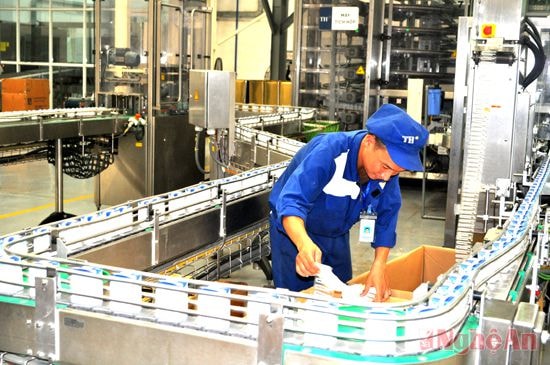 |
| Milk packaging line at TH Milk Factory (Nghia Dan). Photo: Dao Tuan |
According to the World Bank's report "Vietnam Economic Update for the first six months of 2015," released on July 20th, Vietnam's economic growth in the first six months of 2015 reached 6.28%. This recovery was primarily driven by positive performance in the manufacturing and construction sectors, which contributed half of the total GDP growth for the first six months. The World Bank also attributed this result partly to the State Bank of Vietnam's gradual easing of monetary policy amidst low inflation, aimed at supporting economic activities, while also adjusting the exchange rate to ensure the competitiveness of the economy. Total retail sales of goods and services also grew strongly, reaching 8.3%. Meanwhile, the service sector as a whole (which contributes nearly 40% to GDP) achieved only a modest growth of 5.9%, partly due to the struggling tourism industry. The number of foreign visitors decreased by 11.3% compared to the same period last year. The agricultural sector only increased by nearly 2.4% amidst falling prices and unfavorable weather conditions.
The World Bank report also points out the limitations of the Vietnamese economy, namely that the progress of structural reforms has not lived up to expectations, especially in the restructuring of state-owned enterprises (SOEs) and, to some extent, in banking reform. According to the World Bank, the pace of SOE restructuring appears to be slowing down, and the serious implementation of legal and regulatory provisions on the management and governance of SOEs, and increasing the private sector's ownership stake in privatized SOEs, should continue to be considered a major priority. “Banking reform has made significant progress, particularly in the area of mergers and acquisitions. Many mergers and acquisitions of smaller banks have been carried out by larger commercial banks. However, the lack of a comprehensive and appropriate legal framework for handling non-performing loans, while the VAMC (Vietnam Asset Management Company) has limited capital and capacity, continues to be an obstacle to resolving non-performing loans,” commented Sandeep Mahajan, the World Bank's Chief Economist in Vietnam.
The report also addresses the Vietnamese labor market, detailing the significant shifts in the employment landscape over the past 25 years. It also offers suggestions for the continued transformation of Vietnam's labor market, including proactive measures to strengthen industrial labor relations, balance labor market flexibility with sustainable productivity growth, and manage social risks in a more market-oriented economy. World Bank experts believe that Vietnam's economic growth outlook is generally positive. Future forecasts indicate that the recovery process will continue, with economic growth projected at around 6%.
Challenges of the next-generation FTA
In 2015, for the first time, the Vietnamese Ministry of Finance organized a conference to summarize the signed free trade agreements (FTAs) and announced the new generation of FTAs. Following this event, the Ministry of Finance focused on a series of FTA awareness campaigns to further promote the strong and profound impact of FTAs on Vietnam's socio-economic life to all segments of the population and businesses. This is because the new generation of FTAs is expected to have a strong and comprehensive impact not only on the market development prospects of Vietnamese businesses but also on the business environment and related policy and legal systems.
It is evident that Vietnam's ongoing negotiations for a series of new-generation FTAs, notably the Trans-Pacific Partnership (TPP) and the Vietnam-EU Free Trade Agreement (EVFTA), are expected to create a stronger second wave of integration for Vietnam, leading to greater optimism among the majority of Vietnamese businesses. According to a 2014 survey by the Vietnam Chamber of Commerce and Industry (VCCI) of nearly 10,000 businesses, 66% of Vietnamese businesses supported and believed in the benefits of the TPP. Another survey conducted by VCCI in June on the EVFTA yielded similar results, with a majority of businesses believing that the EVFTA would have a positive impact on their operations. Given the characteristics of these new-generation FTAs—including unprecedentedly broad and deep commitments, many of which relate to institutions—these agreements will have a direct and significant impact on domestic institutions and legal policies. Moreover, the new generation of FTA partners are particularly large, including Vietnam's leading trading partners such as the United States, the EU, and Japan. Therefore, it is necessary to fully understand the accompanying challenges and prepare the necessary conditions to overcome them. We must avoid a repeat of past years, where, for various reasons, despite most tariff preferences under FTAs being readily available, Vietnamese businesses only utilized about 30%, leaving 70% unutilized.
We need to seize the opportunities arising from integration.
Thus, 2015 is considered the year Vietnam actively and proactively integrated deeply into the international economy. This will be a significant milestone for Vietnam in potentially concluding or reaching agreements on a series of bilateral and multilateral free trade agreements (FTAs), such as the FTA with the EU, with South Korea, the European Customs Union... and especially the TPP agreement with the participation of 11 countries, particularly major countries like the United States, Japan, and Canada. If Vietnam successfully joins the TPP, its credit rating will increase, demonstrating the government's success in stabilizing the macroeconomy, as noted by Wendy Werner, Director of the Global Trade and Competitiveness Program at the World Bank.
Furthermore, the domestic market will open up more, bringing both benefits and challenges, but with new investment flows facilitated by agreements, the opportunities to help Vietnam move towards high income and development are immense. One of the core issues that domestic and foreign businesses are concerned about and want to improve is supporting businesses in taking advantage of the benefits from free trade agreements (FTAs) that have been and will be signed, and the Government needs to be well-prepared, proactive, and assertive in its commitments to join these agreements.
Seriously considering the reality, while facing significant opportunities to access international investment capital, the key to the entire domestic socio-economic system lies in how to absorb that capital. Because of numerous difficulties and limitations, more decisive and effective action is needed to ensure rapid and sustainable integration and development. The core issue that Vietnam needs to urgently realize in the coming period is to continue perfecting the market economy institutions, considering this a breakthrough. The government will focus on administrative reform, improving the business environment, and creating all favorable conditions for businesses to develop, thereby increasing labor productivity and competitiveness. In particular, the increasingly widespread simplification of administrative procedures, coupled with a high sense of responsibility from civil servants as a mandatory requirement, will create a new impetus for reforms focused on the people and businesses.
In a recent development, on July 23rd in Da Nang, the Inter-Ministerial Steering Committee on International Economic Integration (Ministry of Industry and Trade) collaborated with the Da Nang City People's Committee to organize a seminar to gather opinions on a plan to strengthen information and communication efforts regarding international economic integration and the dissemination of information on several newly signed FTAs. Accordingly, attention was paid to several groups of solutions to enhance the effectiveness of international economic integration. Notable proposals included developing a comprehensive set of official information materials on international economic integration; training a team of skilled speakers with both professional expertise and public speaking abilities; focusing on developing a plan primarily targeting small and medium-sized enterprises (SMEs); regularly updating information to support businesses in accessing integration information; and funding for communication activities.
Clearly, information about signed FTAs, implementation and utilization guidelines, and notes for businesses focusing on the characteristics of the markets covered by these FTAs are essential. It is the responsibility of state agencies to help businesses take advantage of these opportunities when entering these markets in a suitable and convenient manner, maximizing benefits for Vietnamese businesses while respecting international commitments.
Red River