

Ho Chi Minh Square - a historical and spiritual landmark.
(Baonghean) - When I was little, our house was along the North Canal of the city, so every afternoon my grandmother and I would stroll along the canal bank, enjoying the breeze. Back then, our "prime" location was the envy of my classmates. Houses on the main road were dusty and noisy; houses in small alleys were cramped, and after dusk everyone would go home, locking their doors tightly, feeling lonely and sad. Only we lived along the embankment, enjoying the bustling and lively streets while having the canal as a "shield" from the excessive chaos…
I remember the summer when I started first grade, my first time visiting Hanoi. We saw many sights, but the most memorable were Ba Dinh Square and the Ho Chi Minh Mausoleum. Standing there, mesmerized by the majestic structure, I whispered to my mother, "Mom, I wish we had a square like this back home so we could see Uncle Ho every day!" And soon after, my dream came true…
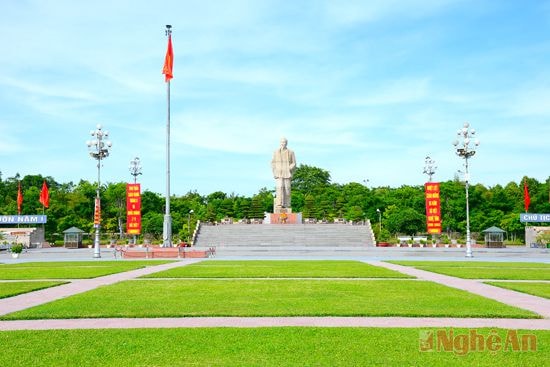 |
| Ho Chi Minh Square (Vinh City). |
In 2000, the entire province was abuzz with endless discussions about the upcoming construction of Ho Chi Minh Square in the city's most central location. There was joy, emotion, but above all, pride among the people of President Ho Chi Minh's homeland. In the late 20th and early 21st centuries, squares were a relatively new concept for people in many provinces and cities across the country; only a few major cities had them. Through books and history lessons, the concept of "square" in my mind was associated with extremely significant meanings. It was Red Square, with the earth-shattering October Revolution in Russia. It was Times Square in New York, USA – a symbol of success and the continuous progress and development of the world. That's the Place de la République in Paris, France – a witness to many ups and downs and events in the history of the hexagonal country, and also a place that records the incredible development of architecture and sculpture… And more than anything, I can never forget the feeling of emotion, pride, and deep affection when standing before President Ho Chi Minh's mausoleum in Ba Dinh Square. Later, after my teacher explained that it was where President Ho Chi Minh read the Declaration of Independence, my respect and attachment increased even more. And now, the city where I live also has a square, named after President Ho Chi Minh – what could be more prideful for the land of his homeland?
After three years of construction, the 11-hectare square, with over 30 completed features, has become the most prominent architectural complex – a highlight in the heart of the city. Positioned in the most prominent location is the statue of President Ho Chi Minh in a welcoming, affectionate pose. In front of him is a parade ground with a parade route and 99 lush green lawns stretching as far as the eye can see. Behind him is a model of Mount Chung, constructed from earth taken from Mount Doi, President Ho Chi Minh's hometown, where his mother rests. During the day, Ho Chi Minh Square is a green space, bringing a refreshing breeze to the city that is gradually transforming. At night, under the light of 79 lamps symbolizing the 79 springs of President Ho Chi Minh's life, the people of Vinh City gather here. On moonlit summer nights, with cool breezes, children fly small kites into the sky. Kites soaring in the sky, the tranquil Chung Mountain lying silently, the rustling leaves – all create a space that is deeply familiar and endearing, evoking memories of childhood and the countryside. President Ho Chi Minh's own childhood was intertwined with these simple, rustic things. Perhaps that is why Ho Chi Minh Square – beyond its vastness, grandeur, and solemnity – gives people a feeling of simplicity and closeness from the very first time they set foot here.
Later, while studying abroad, there were nights I would wake up, my eyes blurred with tears from dreams that took me back to my beloved hometown. In my dreams, I would suddenly feel like a child again, joining my friends and teachers to offer incense and flowers before the statue of Uncle Ho in Ho Chi Minh Square, telling him how diligently we had been doing and how many achievements we had made during the past school year. Then I would see my grandmother and mother holding my hand, walking among the lush green lawns on cool nights, me innocently looking up at the sky, my soul floating with the wind-filled kites. When I woke up, I found myself alone in a strange place, without a single familiar face, a fleeting feeling of sadness stirring in my heart…
Those were very long and distant days that I went through. How I got through them, perhaps even I can't answer. I only remember that there were times when I felt like giving up because of weakness and loneliness. I went and sat in front of the school's stadium, where the national flags of the countries whose students attended the school were displayed. The principal revealed to me that the Vietnamese flag was hoisted on the very day I enrolled, because before that, there were no Vietnamese students in the school. That was the greatest comfort, the only source of encouragement and spiritual support for me when I first set foot in this strange land. Sitting under the red flag with a yellow star, I softly sang the national anthem – the lyrics were a magical ticket across space and time, taking me back to my old school, my old classroom, to the mornings when I stood singing under the flag with my friends. And I also returned to the times I participated in parades and performed the Young Pioneers' ceremony at the foot of the statue of Uncle Ho, under the national flag in Ho Chi Minh Square. And so, I continued on the strange and lonely path I had chosen, sometimes feeling a pang of fear, but the bond that connected me to my homeland kept me calm and peaceful.
When I returned, Ho Chi Minh Square was no longer the awe-inspiring structure that initially captivated the city's residents and visitors alike. Partly because of the continuous development of society, many cities across the country now have squares and other structures of ever-increasing scale. But fundamentally, over time, Ho Chi Minh Square has become an essential, natural, and inseparable part of the city. When visiting President Ho Chi Minh's hometown, when visiting Vinh City, one cannot help but seek out Ho Chi Minh Square, bow before the statue of President Ho Chi Minh, and feel a sense of love and emotion. For the city's residents, strolling in the square, watching the fountains, and enjoying the breeze on Chung Mountain have long become everyday habits. The square is also the venue for important cultural events such as evening festivals with themes focusing on Lang Sen village, President Ho Chi Minh, and the unity of the ethnic groups. Most recently, a ceremony was held in Ho Chi Minh Square to honor the Nghe Tinh folk songs (Vi and Giam) as a representative intangible cultural heritage of humanity, recognized by UNESCO. What could be more joyful and proud than having this momentous event witnessed by our beloved President Ho Chi Minh – for he too was born and raised in the cradle and lullabies of the Vi and Giam folk songs? These melodies of his homeland, which nurtured his soul and character, are now recognized, honored, and preserved by the whole world…
During these historic autumn days, Ho Chi Minh Square is more crowded, welcoming more visitors. People from all corners of the country flock here as if seeking a sacred place, a place of origin for the father of the nation who gave birth to the country from the darkness of suffering. Beneath the statue of Uncle Ho, under the national flag, how can one not be overwhelmed with joy, sharing in the revolutionary autumn of the nation, extending into the future with new autumns – ever richer and more beautiful, as Uncle Ho always hoped? No longer a distant child, I let my soul gently drift into the early autumn afternoon, blending into the stream of people visiting the square. Looking up at the fluttering red flag with a yellow star, I unconsciously murmured the song: “The flag stained with the blood of victory carries the soul of the nation…” Or perhaps it is my soul, the soul of the Vietnamese people, that has been embodied in that heroic flag, bound together by the color of red blood, yellow skin, by the two words: Vietnam.
Text and photos:Thuc Anh