
Focus on developing human resources.
(Baonghean) - Two human-related factors were the focus of Thai Hoa Town's leadership during the 2010-2015 term: improving the quality of education, raising the intellectual level of the people, and caring for people's health, creating a comprehensive workforce. These are also two important criteria in building new rural areas, a prerequisite for building Thai Hoa into a civilized urban area in the 2015-2020 term.
(Baonghean) - Two human-related factors were the focus of Thai Hoa Town's leadership during the 2010-2015 term: improving the quality of education, raising the intellectual level of the people, and caring for people's health, creating a comprehensive workforce. These are also two important criteria in building new rural areas, a prerequisite for building Thai Hoa into a civilized urban area in the 2015-2020 term.
Building a national standard school.
To improve the overall quality of education in schools and create conditions for children to enjoy a good educational environment, immediately after its establishment, the Standing Committee of the Thai Hoa Town Party Committee issued Resolution No. 12, dated January 8, 2010, on promoting the construction of a system of schools meeting national standards.
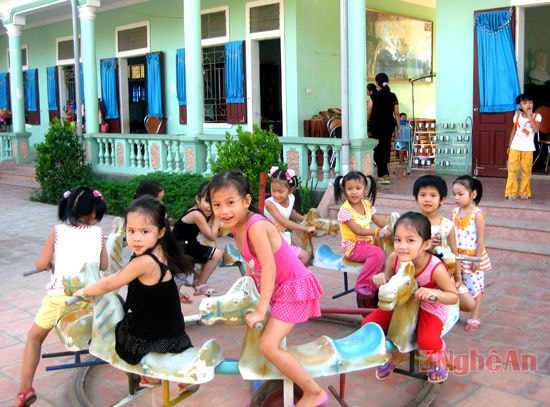 |
| Children at Hoa Hieu 2 Kindergarten during playtime. |
Quang Phong Ward, separated from Nghia Quang Commune (formerly Nghia Dan District), faced numerous difficulties, with the lives of its residents entirely dependent on agricultural production. Implementing Resolution No. 12-NQ/ThU of the Thai Hoa Town Party Committee, Quang Phong issued a specialized resolution, developed a plan, clearly defined the roadmap, and clarified the responsibilities of the Party Committee, government, mass organizations, and schools in building national standard schools. Nearly 1 billion VND was mobilized through social contributions to renovate and upgrade school facilities and classrooms; at the same time, emphasis was placed on measures to improve the quality of education, school management, and the quality of the teaching staff. Through this approach, during the term, the ward built and brought two kindergartens and primary schools to national standard status.
It is noteworthy that in Thai Hoa town, during the process of building standard schools, some schools were newly separated or had their classrooms rebuilt, but they still focused on achieving the standard. For example, Quang Tien Secondary School was established on the basis of merging Nghia Quang 1 Secondary School and Nghia Tien Secondary School. The school faced difficulties because up to 40% of its students were children of ethnic minorities with low levels of education and income, affecting the mobilization of resources to invest in facilities and improve the quality of education – two fundamental factors in building a standard school. However, with determination and high consensus from the local authorities, the school, parents, and students, Quang Tien Secondary School was recognized as meeting the standard at the end of 2014. Ms. Nguyen Thi Hong Canh, Principal of Quang Tien Secondary School, shared: “Building a school that meets national standards is an ‘investment’ from the entire political system and the parents and students themselves. Currently, the school has enough classrooms for one shift, a computer lab, and a multi-purpose room that meets the prescribed standards and operates effectively. Every year, the school has over 20 students who achieve excellent student awards at the city and provincial levels. This is the condition, the foundation, and the motivation for the school to continue to develop at a high level in the coming school years.”
Mr. Tran Minh Hai, Head of the Education and Training Department of Thai Hoa town, affirmed: Resolution 12 of the Standing Committee of the Thai Hoa Town Party Committee has significantly enhanced the responsibility of Party committees, government agencies, mass organizations, and the people in building standard schools in general and improving the quality of education in particular. Specifically, it clearly defines responsibilities such as Party committees and government agencies investing in and supporting the construction of facilities; the Fatherland Front and mass organizations coordinating with schools to address issues and mobilize public interest in education through concrete actions; and the Education and Training Department and schools implementing solutions to improve the quality of education. The town has also implemented policies prioritizing the attraction of talented teachers to the locality, along with focusing on planning and promoting excellent teachers to management positions. For contract teachers, priority is given to recruiting them into permanent positions... As a result, Thai Hoa town has 21 more schools meeting national standards, raising the total number of schools meeting standards in the town to 30 out of 32 schools, reaching 93% (16 more schools were added during the 2010-2015 term alone).
Taking care of the people's health.
Commune and ward health stations are the closest and most direct healthcare facilities to the people; they are the first point in the system for monitoring, detecting, organizing disease prevention and control, and providing primary healthcare for the population. Recognizing this, during the past term, Party committees and authorities from the town level down to the communes and wards have integrated healthcare into the local socio-economic development programs. They have also focused on securing investment to build many modern health stations, including four communes and wards with two-story health stations. Based on the new rural development policy, Nghia My district has planned and relocated health stations to more convenient central areas. Simultaneously, it has mobilized capital totaling 6.7 billion VND, with only 700 million VND from the local budget, to build a spacious two-story station on an area of over 2,000 square meters, complete with all necessary functional rooms. Comrade Le Van Tuu, Secretary of the Party Committee of Nghia My commune, affirmed: "The greatest achievement in building Nghia My commune to meet national standards for healthcare is that it has contributed to strengthening the infrastructure, equipment, and human resources of the commune-level healthcare system, meeting the increasingly high demand for healthcare and access to medical services for the people."
Comrade Dinh Van Thi, Vice Chairman of the People's Committee of the town, said: Currently, the facilities and equipment at the health stations are fully equipped with 18 rooms and departments as prescribed by the Ministry of Health; they have 18-parameter testing machines, obstetric equipment, fetal heart monitors, etc. Each station has 7-10 inpatient beds. Along with facilities, the town also focuses on training and improving the quality of the staff; at the same time, it deploys and strengthens the health stations. To date, 100% of health stations have doctors and obstetric and pediatric medical assistants working there, meeting the needs of primary healthcare for the people, contributing to reducing the burden on higher-level facilities. Simultaneously, localities have also implemented many measures to mobilize the people to participate in various aspects to complete each criterion of the national standard for health communes. Specifically, local people have contributed money, trees, and medicinal plants to create beautiful grounds and landscapes for health stations, and to build traditional medicine gardens that meet the prescribed standards. They have actively implemented the population and family planning policy, promoted a cultured lifestyle, used clean water and sanitary toilets, ensured environmental hygiene and food safety, and prevented disease outbreaks in the area. To date, all 10/10 wards and communes have met national standards for health, with 8 units achieving Level II standards. This is one of the 19 criteria in the new rural development program, which the town will continue to strive for to achieve the new rural development standard and the urban civilization criteria during the 2015-2020 term.
MAI HOA