

Creating new momentum for the fisheries economy.
(Baonghean) - The fisheries sector is a pioneering industry in creating a concentrated, large-scale commodity production system, with enterprises as the core, developing according to a value chain approach, establishing vertical linkages from fishing and aquaculture to preservation, processing, and export. Baonghean newspaper had an interview with Assoc. Prof. Dr. Nguyen Huu Dung, Chairman of the Vietnam Fisheries Association (VASEP), on how to create new momentum for the fisheries economy.
PV:Sir, what is your assessment of the current state of Vietnam's fisheries economy?
Assoc. Prof. Dr. Nguyen Huu Dung:After a period of rapid and strong growth from 2008 to the present, Vietnam's fisheries sector has gradually lost momentum and is facing increasingly severe difficulties and challenges. Production and exports have stagnated and are fluctuating in a negative direction. Businesses and fishermen have been and are going through an extremely difficult period, with some already facing or currently facing the risk of bankruptcy. Meanwhile, the overall goal is that by 2020, the marine economy should contribute 53-55% of GDP, 55-60% of the country's export turnover, address social issues, and significantly improve the lives of people in coastal and marine areas.
However, eight years have passed, and the implementation of the Maritime Strategy has been largely ineffective. Why? Besides adverse external impacts and objective domestic difficulties, existing shortcomings, weaknesses, and limitations in mechanisms and state management capacity are further hindering this important economic sector. What is puzzling is that, immediately after issuing the Maritime Strategy, the only ministerial-level agency responsible for maritime affairs (the Ministry of Fisheries) "disappeared," and for the past eight years, no ministry has taken the lead in implementing the Maritime Strategy (?!). In the context of a completely new period of international integration and competition in 2016-2020, I believe that some practical solutions regarding state management are needed to reduce obstacles, create new momentum, and generate new energy so that producers in the fisheries sector can gain new impetus, implement restructuring of the fisheries sector smoothly and in the right direction, and create new methods for sustainable development in the coming time.
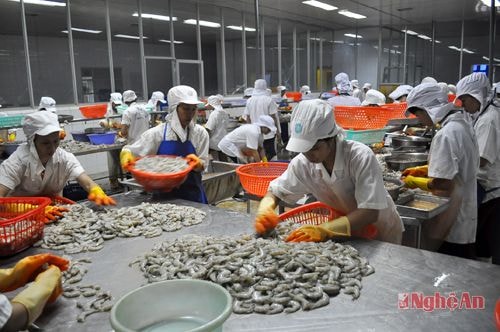 |
| Shrimp processing at Nghe An II Aquatic Products Joint Stock Company. Photo: Van Hai |
PV:Specifically, what are those solutions, sir?
Assoc. Prof. Dr. Nguyen Huu Dung:Firstly, regarding priority economic entities, there must be a rapid shift from individual households to enterprises. International competition demands that each economic sector accelerate development towards improving quality, competitiveness, and economic efficiency. Value chains are the correct approach to achieving these goals. And economic policies need to prioritize the leading producers in these value chains.
In a self-sufficient economy, we have given high priority to the goal of "poverty eradication," focusing on direct support for the weakest link: small-scale producers. In a large-scale commodity production system supplying the global market, this approach is ineffective because it fails to create the impetus for development. It is time to focus investment on the strongest link in the value chain – businesses – to build strong vertical linkages throughout the entire chain, connecting fishermen with the market, leading the entire chain towards sustainable development, and enhancing international competitiveness.
Secondly, we need to control production. We must shift from planning to quotas. The current fisheries economy frequently experiences both surpluses and shortages of raw materials. The lack of mechanisms linking raw material production with processing, export, and trade is the main cause, and it's time to stop the policy of encouraging free-market production, increasing supply in one direction without control mechanisms, without a clear understanding of the market, and without mechanisms to proactively develop demand.
Thirdly, we must control quality, shifting from the final product to the entire chain. Quality control of seafood products should not be implemented at the final stage, but at critical control points throughout the value chain. For example, in the aquaculture value chain, at least three stages need to be controlled: the quality of broodstock, the quality of feed, and the quality of the exported product.
Fourth, regarding credit, we must shift from short-term to medium- and long-term. Many seafood companies (especially those dealing with pangasius, shrimp, and tuna) have transformed their production and business models, moving from purely purchasing raw materials from farmers for processing and export (with relatively low working capital required for each production cycle) to mastering both farming (including the production of fish fry and feed) and fishing, ensuring a self-sufficient supply of raw materials and a closed value chain. This requires significantly more capital and a longer production cycle. However, the current credit mechanisms of banks only provide limited working capital loans for short-term processing and export, and demand stringent collateral requirements. It is essential to establish a new credit mechanism for commercial banks, removing the bottlenecks that are currently hindering capital access due to loans being solely based on collateral.
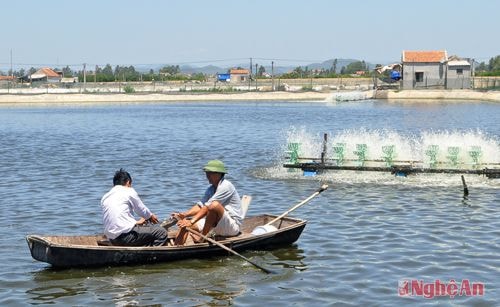 |
| Intensive shrimp farming (in Quynh Bang commune) is one of the key economic sectors of Quynh Luu district. Photo: Van Hai |
PV:Investing in the aquaculture industry still carries many risks, especially natural disasters and diseases. Is there any way to address this situation? And are businesses capable of overcoming these challenges, sir?
Assoc. Prof. Dr. Nguyen Huu Dung:That's for sure, and it's even more certain that businesses alone cannot solve this situation. Therefore, the fifth solution I want to discuss is controlling the consequences of risk. We must shift from support to insurance. Investment in aquaculture production and business is linked to risks related to animal disease safety, natural disasters, market fluctuations, etc. Many types of risks are unavoidable, but their consequences can be controlled through various financial mechanisms. To date, the Government and local state management agencies have considered providing financial support to producers when large-scale risks occur, causing serious damage. However, this support has had very limited effect.
In the new context of large-scale commodity production, it is necessary to shift the method and responsibility for controlling the consequences of risks from the State to insurance organizations, so that the premiums from the majority can compensate for economic entities that suffer losses. The State needs to issue policies to strongly develop insurance service systems for the fisheries sector, according to diverse criteria and conditions. At the same time, there needs to be a regulation requiring large-scale fisheries production and trading entities to purchase insurance and proactively apply preventive measures to control risks. Along with that, new solutions for market development are needed: shifting from subsidies to export funds.
Currently, the state budget allocated to market development in Vietnam is only about 100 billion VND, which is less than 5 million USD per year. To create a concentrated financial source for trade promotion, covering the costs of trade disputes, combating barriers, and promoting technological development in the fisheries sector, the Government needs to consider allowing the application of a mechanism to collect a surcharge for the development and protection of export markets to establish a Market Development and Protection Fund for a number of key product sectors.
Sixth, regarding the solution for seafood: We must shift from fishing to aquaculture. Due to the declining resources, the world's seafood supply will always be insufficient to meet demand, and the situation is becoming increasingly serious. Therefore, aquaculture is a high priority for many countries with access to the sea. Developing large-scale aquaculture not only solves the problem of diverse seafood raw materials for processing and export, but also creates a strong impetus for the fisheries sector, contributing to stability and maintaining security at sea.
Seventh, it is necessary to establish a Ministry of Maritime Economy. Vietnam still lacks a unified state institution to manage its maritime affairs. To implement the Maritime Strategy, a sufficiently strong national institution is needed, with consistent principles and discipline in action, and a unified policy for managing the sea, continental shelf, and islands.
Ultimately, the solution is that the State's relationship with businesses needs to shift from administrative to co-management. Historically, the relationship between government agencies and businesses has been one between a regulatory body and an economic entity being managed. Recently in Vietnam, public-private partnerships (PPP) have been proposed, but only in theory and within certain areas (such as investment), and lack a truly comprehensive legal framework. It is necessary to build institutions that establish the role of the business community in a comprehensive relationship of mutual control and supervision with the system of government agencies. To implement a co-management mechanism, the State needs to institutionalize the role of business associations; create conditions for establishing and strengthening the position of associations within the community and society; support and empower associations to perform their functions effectively; and assign associations to handle some of the State's tasks.
PV:Thank you for this conversation!
Hong Ha
(Perform)