

Exploring the Hmong Community in Western Nghe An - Part 8: Taboos and Customs
(Baonghean) - Each Hmong clan has its own taboo, stemming from stories that happened within their clan from ancient times. This forms a unique tradition passed down from generation to generation to educate their descendants not to violate these prohibitions.
Main pillar and staircase
One evening, we were sitting in Mr. Va Xenh Lu's house in Tham Hin village (Nam Can commune) when we noticed a small house pillar in the middle of the house that seemed about to fall. The pillar was only the size of a fist, but Mr. Xenh Lu had affixed a Hmong ancestral tablet to it. Curious, I was about to approach and touch it when the homeowner stopped me: "This pillar may be small, but it's the main pillar in our Hmong house. Guests from outside shouldn't touch it. This is the most important taboo among the Hmong people, and it's the same for all clans." Mr. Xenh Lu's warning startled us; it turned out that seemingly ordinary objects held such great significance in the spiritual life of the Hmong people.
Grandpa Xenh Lu said: "That main pillar is where the souls of the Hmong ancestors reside, so no one except the homeowner is allowed to touch it. Even children or women in the family, if they accidentally hit the pillar, must light incense and offer a pig or chicken as a sacrifice to ask their ancestors to forgive their disrespectful act. Therefore, anyone outside who hits the main pillar or the ancestral altar will be punished according to the family and clan's rules." Grandpa Xenh Lu also added that while nails can be driven into any other pillars or parts of a Hmong house, the main pillar must be inviolable. The Hmong have one of the biggest taboos: insulting their ancestors by hitting the main pillar or the ancestral altar.
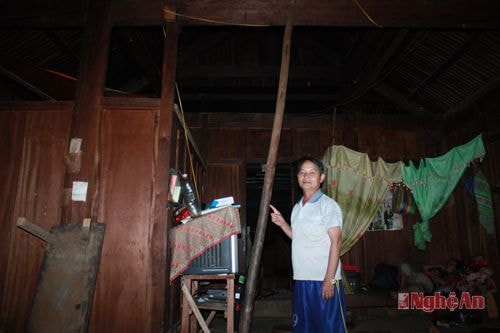 |
| The main pillar in Mr. Va Lia Nenh's house in Nam Can commune (Ky Son district). |
Armed with our limited knowledge, we visited the home of Mr. Va Lia Nenh, the Party Secretary of Nam Can commune. Despite holding the position for over 10 years, he remains a down-to-earth Hmong man with unique characteristics specific to the Va clan. Through our conversation, Mr. Va Lia Nenh revealed that, in addition to the taboos surrounding the main pillar of the house and the ritual of offering sacrifices, his Va clan has many other taboos compared to other Hmong clans in the area.
The story goes that, long ago, the Va clan had a family who married a very beautiful daughter-in-law. Initially, everything went smoothly; they lived together happily like any other Hmong family. But after some time, feelings developed between the father-in-law and the beautiful daughter-in-law. And what was bound to happen, happened. One day, when everyone in the family was out working in the fields, leaving only the father-in-law and daughter-in-law at home, they conspired to commit incest in the attic above the house, destroying the long-standing moral values of the Va clan.
This happened so many times that the father-in-law's sister became suspicious and discovered it. From then on, the family had a custom of forbidding daughters-in-law from ever stepping onto the stairs leading to the attic, entering their parents-in-law's bedroom, and the father-in-law from entering his daughter-in-law's bedroom. Anyone who violated this rule would be blinded.
Sour fruit from the mountains and animal hearts
In the stories told by Mr. Lia Nenh, we found something interesting about the eating habits of the Va clan. Mr. Lia Nenh said that the Va clan could eat anything when hungry to survive, but no matter how hungry they were, they would never eat one thing: the sour fruit found in the forest. Anyone from the Va clan who accidentally ate this fruit would vomit violently and would not be able to eat rice again for several days. If they deliberately ate this fruit, they would go blind in both eyes.
It's unclear whether this taboo applies to all cases of the Va clan of the Hmong people, but the story that Mr. Lia Nenh told us was truly fascinating. The story goes: One year, there was a severe drought, causing widespread crop failure and famine. The Va clan also suffered, so everyone went into the forest to find anything they could to survive the hunger. A father and daughter from the Va clan wandered the forest for two days without finding anything to eat. Suddenly, the daughter cried out, "No chi, no chi!" (Eat sour fruit, eat sour fruit!). Ironically, in his hunger, the distraught father thought, "Could it be that my daughter wants to eat me?" (In the Hmong language, "chi" means father, and "chi" is a type of sour fruit found in the forest; their pronunciations are similar). Thinking this, he turned around, grabbed a piece of wood from the roadside, and beat his poor daughter to death.
After his daughter's death, he looked up to the sky and lamented his unfortunate fate. But unexpectedly, above his head was a cluster of ripe, delicious sour fruits. He realized he had murdered his innocent child. Returning home, he knelt before his relatives to beg for punishment. Knowing his mistake, and already burdened by the immense punishment of his conscience, everyone sympathized with him and forgave him. However, from then on, the Va family had a rule: they were never allowed to eat sour fruits from the forest while eating.
We went to Na Ngoi, traversing a winding, narrow road to Huoi Xai village, where the Gia clan lives. There, we heard from the descendants of the Gia clan that, under no circumstances, they would ever eat animal hearts. According to the village head, Gia Ba Bi, the most difficult thing is when attending feasts elsewhere. Older members can taste or smell a little and know if food contains animal hearts, but younger people find it very difficult to distinguish. If a member of the Gia clan accidentally eats an animal heart, they will vomit violently and for several days afterward can only drink water, not eat rice. Therefore, the Gia clan greatly fears eating and drinking with other clans.
To understand the root cause of this, we heard the following story from Elder Ba Bi: Long ago, when the Gia clan was settled in China, they enjoyed a prosperous life and often held ceremonies to thank their ancestors. One day, during a ceremony, the Gia clan slaughtered a very large buffalo. Normally, they would offer the animal's internal organs (except for the intestines and stomach) to the altar. However, when cooking the buffalo's heart, they mixed it with the other parts, and when it was offered, a piece was missing. Suspecting a child standing near the pot had eaten it, the entire clan became enraged, believing the child had dared to disrespect their ancestors. They discussed killing the child to take the heart for the sacrifice, to replace the missing buffalo heart. But after the child was killed, someone in the clan cried out in alarm, "Here's the heart! Here's the heart!" It turned out that the buffalo heart was at the very bottom of the pot, so they didn't see it, and thus the child died unjustly. The entire Gia family was ashamed; no one could say a word. They gathered together and declared that from now on, no one in the Gia family would eat animal hearts, and anyone who violated this prohibition would be blinded in both eyes.
This story is similar to the one we heard about the Ly family in Muong Long. The only difference is that the Ly family abstains from eating animal spleens. Thus, it can be said that the taboos of the Hmong people in their daily lives today all have deep-rooted causes. This reflects a very characteristic Hmong belief: preserving the purity of their lineage.
Dao Tho - Huu Vi