
The brocade weaving village by the Ta Tau River
(Baonghean) - This is Hoa Tien brocade weaving village in Chau Tien commune, Quy Chau district. The skillful hands and diligent nature of the Thai women here have created soft, traditional garments that reflect the unique characteristics of the Thai people. The village not only provides jobs and increases income for the people but is also an interesting destination for tourists along the Ta Tau river.
(Baonghean) - This is Hoa Tien brocade weaving village in Chau Tien commune, Quy Chau district. The skillful hands and diligent nature of the Thai women here have created soft, traditional garments that reflect the unique characteristics of the Thai people. The village not only provides jobs and increases income for the people but is also an interesting destination for tourists along the Ta Tau river.
Visitors to Quy Chau district cannot miss Hang Bua, a natural scenic spot steeped in historical legends, and Chieng Ngam Temple, dedicated to mountain gods and those who contributed to the founding of villages in Chau Tien and Chau Thuan communes. During the festival season, visitors can immerse themselves in the sounds of plowing, the traditional dances, and the vibrant folk games of the Hang Bua Festival: stick pushing, throwing the ball, and beauty contests. After enjoying a cup of rice wine and dancing the bamboo pole dance with Thai ethnic minority girls, visitors will surely long to visit Hoa Tien village, a traditional craft village preserving the unique cultural characteristics of the Thai people.
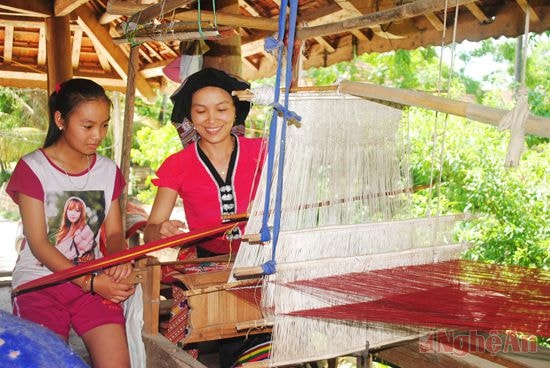 |
| Teacher Sam Thi Lan and her daughter are passionate about traditional crafts at the loom. |
Less than 1 km from Hang Bua, on National Highway 48, near the Chau Tien bridge, which crosses the confluence of the Nam Viet and Nam Hat rivers, turn right onto a winding concrete road through the fields, straight into the Pu Huong mountain range, and you will arrive at Hoa Tien Brocade Village. On either side of the sun-drenched road leading to the village are the Tong Mong rice fields. The lush green fields of young rice or the vibrant golden fields of ripe harvest season will bring a strange sense of tranquility to your heart. In these fields, giant waterwheels slowly and peacefully turn. Made of bamboo and reeds, these wheels not only serve for irrigation, bringing cool, fresh water from the Ta Tau stream into the small canals to irrigate the Tong Mong fields, but also symbolize the skill, patience, and ingenious creativity of the highlanders, shaping the unique identity of this land.
The elders in Hoa Tien recount the origin of the name Tong Mong field: Long ago, a village wife bid farewell to her husband as he set off on a military campaign. In the middle of the field, she watched him disappear behind the mountains before turning back. From then on, the locals called it Tong Mong field (Tong being a local place name, and Mong meaning to see). Ta Tau is a section of the Nam Hat River... The field, the waterwheel, the river... all combine to create a picturesque landscape with many colors at this destination in the land of incense.
Village head Vi Van Hao, who is just over 30 years old, greeted us with a quick and enthusiastic demeanor. He explained that Hoa Tien village has existed for hundreds of years, meaning that the craft of mulberry cultivation, silkworm rearing, and yarn spinning has also existed here for a long time, becoming a traditional occupation of the village. Hoa Tien village has two hamlets, Hoa Tien 1 and Hoa Tien 2, with a total of over 340 households of the Thai ethnic group. Besides farming, the villagers' lives revolve around weaving brocade. Therefore, almost every house has a loom. Village head Hao said that the village has nearly 300 looms. In 2009, Hoa Tien was recognized as a Brocade Weaving Village by the Provincial People's Committee. Currently, there are two units in the village: Minh Huong Brocade Weaving Cooperative and Hoa Tien Brocade Weaving Cooperative, which specialize in supplying raw materials and purchasing and selling products for their members and the villagers. The craft village has fertile fields, where mulberry trees are grown year-round for silkworm rearing and yarn spinning, ensuring a significant portion of the villagers' raw materials.
Mrs. Lang Thi Khuyet, the mother of the village headman Hao, is 65 years old with snow-white hair. Sitting beside her loom under the eaves of her stilt house, her hands nimbly move the shuttle, her eyes following each thread. She says that her ancestors were all weavers, so she learned to weave cloth when she was only 12 years old. This loom has been with her for nearly 20 years now. Although it's not very sturdy anymore, she still keeps it, sitting with it every day like a family member. "All of us Thai women here are skilled at weaving and embroidery. This craft requires perseverance and hard work to produce a lot and beautiful work. During the harvest season, the women go to the fields to plant and harvest, and even though they are tired, they still light lamps and sit at the loom, working until 10 pm before resting. After the harvest season, when the women have finished their housework, everyone is engrossed and diligently working at the loom. In the evening, every house is lit up with lights, the clacking of shuttles is so joyful!"
Ms. Sam Thi Lan, a kindergarten teacher at the village school, proudly spoke about the traditional brocade weaving craft of Hoa Tien village: “As a child born in this village, I learned to go to the fields with my mother to pick mulberry leaves, spin silk, and weave fabric when I was 10 years old. As a teacher, after teaching, I do all the housework at home and then take advantage of my free time to sit at the loom. My monthly teacher's salary and the extra income from brocade weaving are enough to support my family. Occasionally, tourist groups come to visit, film, and take pictures of Thai women weaving brocade products, and I am proud of the traditional craft of my village. That's why my daughter, who is 15 years old this year, not only knows how to weave but also knows how to embroider!”
At the Minh Huong brocade weaving cooperative in the center of the village, two stalls displaying Thai traditional clothing made of brocade were very eye-catching. In a small corner behind them was the mattress-making area. Ms. Vi Thi Hong, holding a bamboo stick and pushing handfuls of cotton into cloth bags to be sewn into mattresses, confided: "I've been working here for several years. Every day, working diligently from morning to night, I make 8-10 mattresses, each 1.8 meters long and 80 centimeters wide. The cooperative pays me 180-200 thousand dong. This work isn't physically demanding, but you have to be diligent and quick to produce many products." Speaking about the mattresses made by the Thai ethnic group, Ms. Sam Thi Huong, the head of the cooperative, said: “According to the customs of the Thai people, before a girl gets married, she must buy 8, 10, or 12 mattresses made by the Thai people. Along with the mattresses, there are also pillows. For each mattress, there is a pair of pillows. In addition, there are 2-4 pairs of cushioned chairs, also made by the Thai people. The materials used to make the mattresses, pillows, and chairs are brocade fabric dyed red or blue, sewn into covers. Thanks to the strong stitching and the experience and skillful hands of Thai women, the mattresses, pillows, and chairs are comfortable and durable. Therefore, these products are mainly sold locally. Especially during auspicious months of the year, when the Thai people hold many weddings for their children, the cooperative has to mobilize more workers to meet the demand. In some months, the cooperative sells hundreds of these items.”
The Minh Huong brocade weaving cooperative has 30 members, all skilled brocade weavers in the village. In addition, villagers register to receive raw materials to make products. Those women without land to grow mulberry trees or raise silkworms receive yarn from the cooperative to weave and embroider perfect products, which they then sell to the cooperative. Through this method, the cooperative provides advances to women in difficult circumstances, or those needing money to send their children to college or university, which are then deducted from the product price. The cooperative's brocade products sell well, ensuring that members and women in the village always have work. The Hoa Tien brocade weaving village continues to develop, with a wide variety of products...
Ms. Sam Thi Huong said that since the village was recognized as a traditional craft village by the province, the cooperative members and villagers have been proud, excited, and enthusiastic about planting mulberry trees, raising silkworms, spinning yarn, and weaving fabric, creating a wider variety of products that are easier to sell. However, she added that if the cooperative members were supported in purchasing looms and industrial sewing machines, production efficiency would be higher and the products would be even more beautiful. Currently, most members of the Hoa Tien 1 and Hoa Tien 2 brocade cooperatives are using old, self-made looms that are no longer sturdy; the sewing machines used by the cooperatives are foot-operated, making the work difficult for the members and resulting in low productivity.
The people of Hoa Tien are always proud of their traditional brocade weaving craft, which has been deeply ingrained in their lives for generations, just as the Ta Tau River never runs dry and the Tong Mong rice fields provide fragrant rice for the villagers year-round, and the majestic Pu Huong mountain range embraces and protects the village. This picturesque landscape is enough to captivate visitors to Hoa Tien...
Text and photos:Xuan Hoang