

Exploring Muong Quang: Part 1: The Hunter God Establishes the Village
(Baonghean)The area encompassing Quang Phong and Cam Muon communes (Que Phong district) was once home to an ancient Thai ethnic minority settlement called Muong Quang. Today, traces of this ancient settlement remain only in stories, mountains, caves, and rivers, yet it holds many fascinating aspects of a unique culture. Nghe An Newspaper would like to introduce these interesting facts through the special feature "Exploring Muong Quang".
It is believed that the hunter god Mo Phan and the maiden Vi Xom were the first to establish Muong Quang. Their dwelling place was a cave called Tham Me Mon in Chieng village (Quang Phong - Que Phong) today.
Where the sky is vast and the river is long
Including the two communes of Quang Phong and Cam Muon, Muong Quang has 25 Thai villages and 1 Khmu village, with a population of nearly 10,000 people. Yet, when it was first formed, Muong Quang only had 8 villages. This information comes from village elder Lang Van Ngo, residing in Mong 3 village, Cam Muon commune (Que Phong district), a former official of the Nghe An Provincial Youth Union and then the Que Phong District Party Committee, who retired in 1978. Now 65 years old and 85 years old, Mr. Ngo remains very sharp-minded and enjoys research and writing. He is truly a treasure trove of information about the Muong Quang region, which still holds many mysteries.
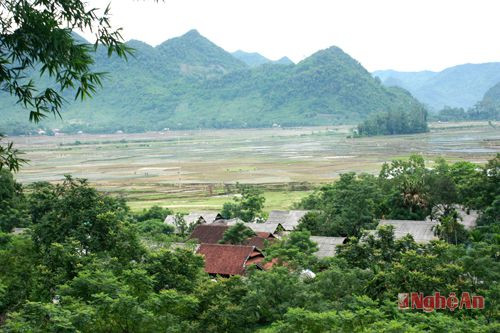 |
| Chiếng village as seen from Tham Me Mon cave. |
On a cool, early autumn morning, sitting in the living room of his wooden house in Mong 3 village, Mr. Lang Van Ngo told us about the old Muong Quang. He began by describing the area's geographical location: Muong Quang is located in the southwestern part of Que Phong district, situated between the Pu Huong mountain range of Tuong Duong district and the Pu Kep mountain range of Chau Kim and Muong Ngoc communes in Que Phong district, bordering Tri Le and Nam Nhoong communes on one side. Surrounding Muong Quang are 27 towering limestone mountains with many beautiful caves extending deep into the mountains. From afar, the limestone formations resemble a giant marble carpet.
During the French colonial period, Muong Quang was called Quang Khan commune, later renamed Quang Phong commune, comprising three villages: Bang Nghe, Quang Phong, and Phu Thanh. After the August Revolution, Quang Phong commune was renamed Cam Muon commune. The name Cam Muon commemorates the ancient origins of the people who founded the village (Kham Muon - Laos). This name is also understood to mean pleasant words. The Thai people have an idiom that roughly translates to "beautiful smile, pleasant words" to refer to girls who are beautiful in both appearance and character.
Muong Quang stretches along the Quang River basin, originating from the Pha Ca Tun mountain range bordering the Vietnam-Laos border. Along the river are prosperous Thai villages. Instead of cultivating upland rice like many other areas, the Thai people in Muong Quang have long practiced wet rice cultivation. The lush green rice fields evoke a sense of tranquility. The name Muong Quang suggests a vast expanse of sky and a long river.
Mo Phan established Muong Quang.
The stories of the Thai people establishing villages in western Nghe An mostly exist only in semi-fictional tales. The heroic figures who founded Muong Quang are also largely unknown. Among the stories that Mr. Lang Van Ngo has painstakingly collected over the years is the tale of Mo Phan, a hunter-god from the Khammouane region (Laos) who founded Muong Quang.
Regarding his origins, the hunter god Mo Phan is quite special. Long ago, the Do Chi region, in what is now western Nghe An province, was teeming with tigers. These tigers brazenly attacked people, and no one could resist them. The King of Au Lac sent Xu Thao, a man of supernatural powers, to help quell the tiger plague. During the tiger extermination effort, Xu Thao rescued a fairy and took her as his wife. The King of Do Chi appointed Xu Thao as an official to govern the lands where he had driven away the tigers. Later, Xu Thao's youngest daughter, Quang, was married to Tao Khun in Khammouane (Laos) and gave birth to Mo Phan.
Being fond of hunting, Mo Phan and his hunting party ventured into a fertile land teeming with produce and wildlife. There, Mo Phan became wealthy with his abundance of deer antlers, stag horns, rhinoceros horns, and elephant tusks. Pho Vi Thong, the father of Vi Xom from Ca Da village, wanted to seize his inheritance and arranged for his daughter to marry Mo Phan. At that time, the Muong Quang region was uninhabited. Mo Phan and his wife lived in a cave called Tham Pha Chieng. They loved each other deeply. When Vi Xom became pregnant, Mo Phan stayed by her side, caring for her. They lived together until they were a hundred years old and died in this mountain cave. Later, young men and women in Muong Quang admired the enduring love between Mo Phan and Vi Xom. During Tet (Vietnamese New Year), young men and women would gather here to court each other, hoping to find a lifelong partner. In spring, the sounds of singing from young men and women always fill this place, hence its name Tham Me Mon, meaning "place of the singing of young men," not "silkworm cave" as commonly understood. Currently, this mountain cave is located in Chieng village, Quang Phong commune. This was also the central village of Muong Quang in the past.
Mo Phan had three sons: Hun Quang Hoc, Hun Quang Phong, and Hun Quang Thanh. Each established their own village in the mountainous region of Muong Quang. However, at that time, there was no organized community, and the villages lacked a leader. Later, other hunters came and conflicts arose. Some accidentally shot each other, but no one stepped forward to resolve the issue. Lady Vi Xom discussed with her husband the idea of gathering their sons and the hunting groups at Pha Chieng cave. There, they elected Mo Phan, the most capable of all, as the leader of all the villages. Mo Phan named the new village after his mother, Lady Quang. The river flowing through the village was also called the Quang River.
Expanding the districtand the struggles
After Mo Phan's death, it is unknown whether his eldest son, Hun Quang Hoc, was appointed as the village chief, but he was involved in the events of the region. According to the records of Mr. Lang Van Ngoi, Hun Quang Hoc had two exceptionally beautiful daughters, one of whom, On Quang Pieng, married Tao Lo Nghe. Lo Nghe, being exceptionally strong, expanded the land considerably. Lo Nghe lived as a son-in-law in Hun Quang Hoc's house, but later developed an affair with his mother-in-law, which was discovered. Hun Quang Hoc left and returned to Chieng village to live with his younger brother, Hun Quang Thanh. From then on, he established a custom forbidding daughters-in-law from sharing meals with their fathers-in-law, and sons-in-law from sharing meals with their mothers-in-law. This custom is still observed in many ethnic communities in western Nghe An province.
Tạo Lo Nghệ returned to his hometown to bring his younger brother, Tạo Lo Páng, to live with him. Later, Lo Páng married and reclaimed land, creating rice paddies. The people of Mường Quàng believe that Lo Páng was the one who taught them how to cultivate rice. Today, there are rice paddies in Mường Quàng named after Lo Páng. Later, when the Han Chinese came to mine for gold, Lo Páng also learned how to cultivate rice and moved to Cắm village, where there was abundant alluvial gold.
Later, under an unspecified dynasty, the Han Chinese from the North came to exploit gold and silver in Muong Quang. Having their land encroached upon, the people of Muong Quang, under the leadership of the village chief Lo Ngan, rose up in resistance. Muong Quang existed until the success of the August Revolution, when the feudal and colonial governments were overthrown and the village organization disintegrated.
Although Lang Van Ngo's stories about Muong Quang are half fact and half fiction, they authentically reflect a bygone era of a land rich in cultural traditions and a history of struggle to build and protect its community.
(to be continued)
Huu Vi - Dao Tho