

A vaccine against Ebola has been found.
VSV-ZEBOV - A vaccine against Ebola has been studied and found to be 100% effective in preventing the Ebola virus in trials in outbreak areas in Guinea.
VSV-ZEBOV - A vaccine against Ebola has been studied and found to be 100% effective in preventing the Ebola virus in trials in outbreak areas in Guinea.
Safety testing
Initial test results for this vaccine show it is highly effective, providing rapid protection in 100% of cases. “This is a landmark study,” commented Dr. Michael Osterholm, Director of the Center for Infectious Disease Research and Policy at the University of Minnesota.
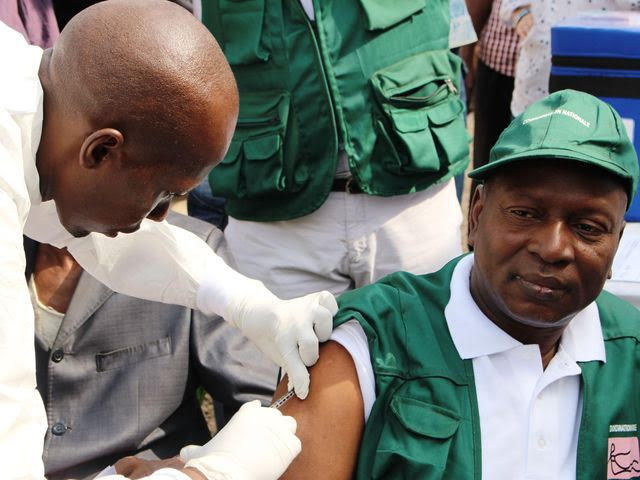 |
| This man received the Ebola vaccine on March 10, 2015. |
A man receives a vaccination on March 10, 2015, at a health center in Conakry during the first clinical trials of the VSV-EBOV vaccine against the Ebola virus. The vaccine was effective within 10 days of administration. “This is a very promising development,” said Dr. Margaret Chan, Director-General of the WHO. “Celebration for the Government of Guinea, the people living in the communities, and our partners in this project. An effective vaccine will be a very important tool for current and future Ebola outbreaks.”
Recently, trials were conducted on a large scale involving over 4,000 people in collaboration with scientists, doctors, sponsors, and pharmaceutical companies.
To test whether these vaccines provided protection, clusters of cases were randomly selected to either receive vaccination immediately or wait three weeks after confirmation of Ebola. Of the 2,014 people vaccinated immediately, none contracted Ebola within 10 days of vaccination – allowing time for immunity to build up. For the delayed vaccination cluster, 16 out of 2,380 contracted the disease. These results were published online in the medical journal Lancet.
"The silver bullet" against Ebola
Norwegian Foreign Minister Borge Brende said: “Seeing the devastating impact of Ebola on communities is what truly shows how terrible it is. If this vaccine proves effective, it could be a ‘silver bullet’ against Ebola, helping to control this disease in the future. I want to thank all the partners who contributed to achieving this remarkable result.”
Since late 2013, when the latest outbreak began in West Africa, there have been 27,600 cases of Ebola, including more than 11,000 deaths. Liberia has suffered the worst with over 4,800 deaths, although the disease has subsided in Sierra Leone and Guinea.
An effective vaccine could help control the Ebola epidemic by preventing infected people from spreading the disease to those around them, as well as protecting those at high risk of infection such as doctors, nurses, hospital staff, and funeral workers.
Doctors hope the Ebola vaccine will protect many people through a phenomenon called "community immunity," in which vaccination reduces the number of viruses in the environment, protecting those who do not have immunity.
Bertrand Draguez, medical director of Doctors Without Borders, said: “Too many people have died from this extremely dangerous disease and it has been a headache for healthcare workers who feel helpless in the face of it. Much data is needed to tell us how effective we are at preventing outbreaks, but this is a unique breakthrough.”
Draguez suggested focusing on a group of people at highest risk of contracting Ebola for mass vaccination, noting that outbreaks are in local communities, not nationwide, in any given country.
VSV-ZEBOV is expected to become the world's first Ebola virus vaccine to be licensed.
According to Health and Life