

"Greed leads to ruin."
(Baonghean) - For a long time, whenever people talked about people or things that exist only for show, in the sense of being "famous but without substance," lacking any concrete power or effect, they often used the analogy of a "scarecrow guarding melons." This is based on the phenomenon of farmers erecting human-like figures called scarecrows in their fields to scare away birds and animals. It's just empty threats; in reality, they can't cause any harm, not even the slightest.
However, times have changed, and these new "scarecrows" are proving to be even more effective than real people. For example, for over a week now, on National Highways 91 and 80 in Thot Not District, Can Tho City, many life-sized models of traffic police officers holding speed measuring devices have been erected at intersections and densely populated areas. Similar to the "scarecrow guarding the melons," these cardboard police officers, though immobile, have startled many drivers, causing them to slow down. They constantly check their speedometers to see if they're driving correctly. Many drivers admit they know they haven't violated anything, but seeing the yellow uniform standing neatly by the roadside makes them nervous, so they drive more carefully. Some drivers even know it's a model, but they still feel uneasy, automatically slowing down, staying in their lane, and refraining from speeding or reckless overtaking.
Both residents and traffic police have noted that since the introduction of these models, reckless driving, speeding, driving without helmets, parking in the wrong lane, running red lights, and especially traffic accidents have decreased significantly. Furthermore, the awareness of the people along the roads has become much more serious regarding compliance with traffic laws. This shows that even scarecrows can sometimes be valuable.
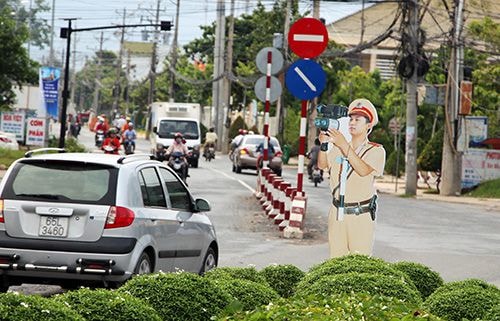 |
| A model of a traffic police officer holding a speed gun in Can Tho. Photo: Internet |
But this raises the question: why can't flesh-and-blood traffic police officers, who can move, walk, blow their whistles to stop vehicles violating traffic laws, and even have speed guns like the models—meaning they are far more "dangerous"—do as well in reducing traffic violations as the paper police officers? As the Chief of Police of Thot Not District, Can Tho City, admitted to the press, in the first quarter of 2015, traffic safety violations in the area, especially on National Highway 91 passing through the district, increased dramatically. After a field inspection, the Chairman of the District People's Committee suggested that the district police should experiment with setting up model traffic police officers at traffic safety hotspots. Unexpectedly, the results were quite positive. This means that paper police officers are more effective than real police officers. It's not difficult to explain this paradoxical phenomenon of the fake being more effective than the real. Because the "paper police officer" stands solemnly and dignifiedly in broad daylight by the roadside, carrying a speed gun, everyone sees him, is intimidated, and fears him, driving carefully. This is why traffic violations have decreased significantly. Meanwhile, real police officers often hide behind roadside stalls or bushes, secretly using speed guns, so no one sees them, no one fears them, and drivers just speed recklessly. Only when they are pulled over and fined do they realize they've been caught. But they don't realize it, so they continue speeding and driving recklessly. As a result, while fines are high, traffic violations and accidents don't decrease; in fact, they tend to increase.
Thus, a small change towards greater transparency in the results of preventing and reducing traffic safety violations and accidents has immediately created positive changes. This is not something people have only just realized; it has been known for a long time. That's why there's a requirement for traffic police to "stand openly" in their designated positions instead of working in hidden corners. Unfortunately, that requirement hasn't been strictly followed. The reason is, "a blank slate makes it hard to work." Standing there exposed makes people afraid; if they don't violate the rules, who will they fine? Without someone to fine, there's no one to bribe or plead for leniency. Without someone to fine, the assigned targets won't be met. Not meeting the targets means missing out on bonuses. And missing out on bonuses... Therefore, even knowing this, few people want to do it. That's why achieving the target for issuing fines for violations is far more attractive than achieving the target for reducing violations and accidents. However, reducing traffic violations and accidents is the main objective. It's a national objective.
This is clearly a case of people being greedy and neglecting the main course.
Buddha Mountain