
The drums of the 1930s still resound...
(Baonghean) - Eighty-five years have passed since the Nghe Tinh Soviet movement, yet the echoes of cheers, drums, trumpets, and gongs still resound throughout the land of Nghe An, a region rich in patriotic traditions. The desire to hear witnesses of the 1930-1931 period recount the heroic spirit of that time prompted us to seek out veteran revolutionaries, witnesses to the "earth-shattering" event – the Nghe Tinh Soviet.
(Baonghean) - Eighty-five years have passed since the Nghe Tinh Soviet movement, yet the echoes of cheers, drums, trumpets, and gongs still resound throughout the land of Nghe An, a region rich in patriotic traditions. The desire to hear witnesses of the 1930-1931 period recount the heroic spirit of that time prompted us to seek out veteran revolutionaries, witnesses to the "earth-shattering" event – the Nghe Tinh Soviet.
Mr. Tran Van Dieu's house is hidden behind a small alley about 200 meters from the Soviet-Nghe Tinh Memorial (Hung Nguyen Town). We followed a young boy to Mr. Dieu's house. "Are you asking for Mr. Dieu's house? Why are so many people asking for him?" The boy's innocent question brought a smile to our faces… When we arrived, Mr. Dieu wasn't feeling well, but he didn't refuse our conversation. As soon as we mentioned the period of revolutionary fervor, he became engrossed in his reminiscences, drawing us along with him to those historical days.
“Back then, I was just a child, only 7 years old. At that age, I didn't understand what was happening. I saw my parents, my siblings, and my neighbors beating drums, carrying sticks and flags, marching in groups to protest, so I followed along. I heard everyone shouting 'Down with French colonialism!' and I overheard adults talking vaguely about revolution. I only vaguely understood that revolution was something very important, very great, something that stirred up great enthusiasm in everyone.” Another reason why a 7-year-old boy had such a profound impression of an event he wasn't yet old enough to understand is because his loved ones also participated in the famous Nghe Tinh Soviet movement in particular, and the revolutionary movement of the entire nation in general.
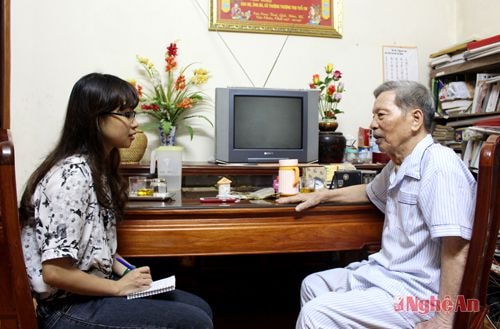 |
| Mr. Tran Van Dieu is chatting with a reporter from Nghe An Newspaper. |
He proudly recounted that his father, Tran Khieu (also known as Tran Diem), participated in the revolutionary movement and was captured and imprisoned by the enemy three times. Previously, his house was a secret meeting place for patriotic intellectuals and revolutionaries. During the 1930s, when the order to revolt and seize power was given, every night, the elders would gather at his house to discuss the location, weapons, and methods of demonstration. He recounted: “While the uncles and brothers discussed national affairs, someone would be assigned to stand guard outside the gate. When soldiers arrived, that person would immediately pretend to shout loudly to signal. If the meeting took place during the day, my mother would prepare a feast and place it on the ancestral altar, so that if the soldiers saw a large crowd, they could use the excuse that there was a family memorial service.”
The meetings were held in secret, but when the demonstrations were organized, they were public and full of fervor. On September 12, 1930, peasants flocked to the district capital in Hung Nguyen, displaying slogans such as: Abolish taxes, redistribute land, Down with imperialism, Down with feudalism… A sea of people with slogans and red flags poured from all directions towards Yen Xuan Station in Vinh, their shouts, drums, and spears echoing loudly. The French colonial government responded fiercely, mobilizing aircraft to bomb the demonstrations, killing 217 people and injuring 125.
But how could the enemy's bombs and bullets stop the surging, red river of protest, filled with hatred, smashing prisons, burning down district offices, surrounding the French colonial army's barracks, and launching a fierce attack on the strongholds of the corrupt colonial and feudal regime? Many village chiefs and district magistrates fled in fear, and the government system, in some places, collapsed, in others, was shaken and trembled before the powerful revolutionary wave of the people.
Continuing our journey through history, we traveled back along the Lam River to Thanh Chuong – the birthplace of the first Soviet government and the cradle of the revolution in 1930-1931. We were fortunate to meet Mr. Phan To Duc in Kim Tien village, Vo Liet commune. At 99 years old, he remains remarkably sharp and agile, regularly reading newspapers, following current events, and offering insightful commentary. When discussing the 1930-1931 period, his eyes lit up, his voice clear and resonant, making us feel as if we were not before a centenarian but a young man from the revolutionary movement of yesteryear.
According to his account, in 1930-1931, the people of Vo Liet commune used the Vo Liet communal house (which still exists today) as the headquarters for revolutionary movements. On the morning of June 1, 1930, people from the surrounding area, armed with sticks and rulers, gathered there and marched to the district office to present their demands to the government. On September 1, 1930, Thanh Chuong was seething with revolutionary fervor; 20,000 people from five communes simultaneously crossed the Lam River to surround and destroy the district office with the force of a "rising tide and cascading waterfall." Mr. Duc still vividly remembers the image of those leading the way carrying red flags, flanked by self-defense forces armed with knives and sticks, and the rest being farmers, men and women, old and young, united in their determination to rise up and seize power.
Faced with this situation, District Chief Phan Sỹ Bàng fled, and power passed into the hands of the people very smoothly. The Party cell met at Võ Liệt communal house and decided to establish the Red Peasant Association, representing the interests of the workers and openly handling all affairs like a revolutionary government. The Soviet government, on the one hand, implemented new policies, and on the other hand, dismantled the old government system, confiscating land, rice, and money from landlords. Võ Liệt communal house became the headquarters of the worker-peasant Soviet government - the first Soviet government in the revolutionary upsurge of 1930-1931 throughout the country.
The memories faded, but Mr. Duc's proud smile remained in the present moment, just as the drums of 1930-1931 resonated for 85 years and beyond. Mr. Duc added that the popular uprising at that time was eventually suppressed, but the glorious revolutionary history of the nation will never fade the mark of the first miracle that initiated a powerful wave of revolution, guiding the nation's ship through dark times to the shores of peace, freedom, and happiness of today.
The witnesses of that historical period are few in number, but interacting and talking with them, one can still feel the revolutionary spirit and heroism echoing from the past. Having lived through the painful yet heroic moments of the nation, they not only contributed to the Nghe Tinh Soviet movement but also participated in the two protracted resistance wars of the nation. But perhaps for them, when history is mentioned, when recalling the past, the first and most enduring echo in their subconscious is the sound of the drums from 1930-1931.
We bid farewell to the two elderly people, feeling a surge of intense emotions. There was excitement and exhilaration, echoing the rhythm of the marching crowd in their stories. There was admiration and honor at having met and spoken with these flesh-and-blood figures of the old Red Movement – living monuments preserving the heroic spirit of the heroic Nghe Tinh region. There was also a lingering sense of regret, present in the stories of previous generations and the reflections of today's generation, about a movement brutally suppressed and extinguished after only a few months. Yet, that early Soviet government left behind glorious historical imprints of the indomitable will and burning desire for freedom and independence of the nation – imprints that remain vibrant and fiery to this day and will forever be.
Phuong Thao
| RELATED NEWS |
|---|