

Final article: Emphasizing practicality and the goal of serving tourism.
(Baonghean) - Reorganizing the system of craft villages, investing in depth, and focusing on industries with stable output and income are important solutions to promote the development of craft villages in Nghe An province today. Among these, developing craft villages in line with the practical needs of the locality and combining craft village development with tourism is the most sustainable approach.
Developing vocational skills to meet local needs.
The development, growth, or decline of each craft village in reality serves as a lesson for the development orientation of craft villages in our province today. Perhaps, after a period of focusing on quantity, it is time for Nghe An to pay attention to the quality and efficiency of its craft industries.
In reality, industries with stable development are those linked to local practical needs, with stable output and not heavily influenced by intermediary consumers. In Quynh Long commune (Quynh Luu district), a few years ago, implementing Resolution 06 of the Provincial Party Committee, the commune restored traditional craft villages with the aim of creating jobs for coastal workers. After a short period of intensified vocational training, the commune established the Minh Thanh export-oriented rattan and bamboo weaving village and developed several other local crafts such as seafood processing and embroidery. However, these craft villages only thrived for a short time before gradually declining due to low income, irregular employment, and difficulty in selling the products.
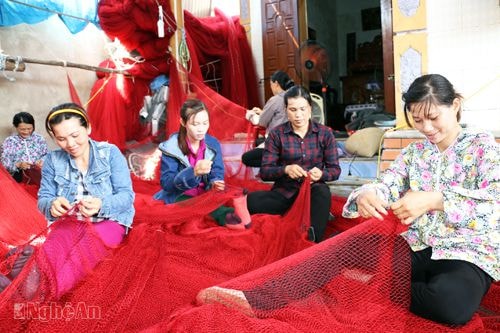 |
| The craft of weaving gold seine nets in Quynh Long commune (Quynh Luu district). |
Gradually, realizing the inadequacy of having a surplus of labor and unemployment while hundreds of households engaged in fishing annually spent tens of billions of dong on purchasing seine nets from northern provinces, the villagers boldly borrowed capital and established seine net-making groups based on the traditional net-mending skills of the local people. The industry stabilized, providing regular employment for the villagers. Furthermore, it enabled families engaged in offshore fishing to be more proactive in investing in and upgrading their fishing nets at only two-thirds the cost of before, saving on transportation and labor expenses. Speaking about this profession, Mr. Tran Quang Ve, Secretary of the Party Committee of Quynh Long commune, said: “Previously, we developed this profession but lacked a reliable market, so the products had no place to be sold. Now, recognizing Quynh Long as a coastal commune, the industry must be linked to the sea, and net fishing must be one of the main occupations, alongside seafood harvesting. Currently, the entire commune has nearly 200 purse seine fishing boats, each using 2 to 3 nets, so the women in the commune never have to worry about running out of work, not to mention supplying products to other communes in the region.”
After years of struggling and shifting industries and products, Do Nha village (Hung Nhan district, Hung Nguyen province) has restarted its traditional craft of weaving mats and woven baskets. This area was once invested in by the district to develop the export-oriented rattan and bamboo weaving industry, and the Provincial Industrial Promotion Center organized training courses on joining bamboo and lacquerware for export. Although it attracted hundreds of trainees, the craft declined after completion because it was not suitable for the local reality and the products could not be sold. Ms. Pham Thi Huong, from Hamlet 9, Hung Nhan, said: “Before, we couldn't develop the craft because we didn't understand consumer tastes and lacked flexibility in product sales. Now, in addition to producing building material coverings, many households have actively changed designs, creating woven baskets with patterns and raised lettering for decoration and ceilings, which are chosen by many consumers.”
Developing products to serve tourism.
In many provinces and cities across Vietnam, such as Hanoi, Da Nang, Hue, Da Lat, and many provinces in the Southwestern region, tourism combined with traditional craft villages is becoming increasingly popular. However, in Nghe An, while travel companies are constantly striving to diversify their offerings, traditional craft villages – considered to have great potential for tourism development – are experiencing a lack of visitors. Mr. Nguyen Manh Cuong, Deputy Director of the Department of Culture, Sports and Tourism, commented: “The province’s craft villages mainly produce traditional goods that can compete in the market, such as confectionery, seafood products, wooden furniture and handicrafts, incense, etc. However, the connection between these craft villages and tourism businesses has largely not been established.”
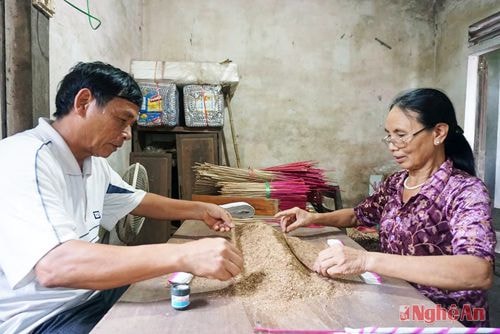 |
| Incense making is a traditional craft in Quynh Doi commune, Quynh Luu district. |
The reality is that traditional craft products catering to tourism are currently scarce, if not non-existent. This issue has been discussed at numerous conferences and seminars related to tourism in the province: Nghe An lacks distinctive traditional products suitable as souvenirs for tourists. Some long-standing and well-known craft products, such as Nam Dan soy sauce, Hai Giang fish sauce, Quynh Dy fish sauce, Hung Chau wine, and Quynh Hung wood carvings, have hardly been considered for creating products that would attract tourists to these villages.
The above situation is partly the responsibility of the relevant authorities. Mr. Tran Van Chuong, Vice Chairman of the Cooperative Union, stated: “In 2012, the Cooperative Union proposed to the Department of Culture, Sports and Tourism four traditional craft products to be considered for development into tourism products: brocade, embroidered paintings, and some handicraft products made from readily available materials (seashells, wood, stone). However, to date, the Cooperative Union has not received a response from the Department of Culture, Sports and Tourism.” This reality, for a province like Nghe An with over 500 traditional craft villages, is truly regrettable. However, a deeper analysis reveals this to be an “inevitable” situation given the current fragmented and under-invested nature of Nghe An's traditional craft product development.
Ms. Nguyen Thi Huong, Director of the Nghe An Tourism Promotion Center, also stated: “We do not yet have craft village tours, and tourism promotion and marketing in craft villages is almost non-existent. Perhaps the only thing we see is the quick adaptation of a few travel companies to include craft village tours. As for the craft villages themselves, currently all the people creating the products are folk artisans, not formally trained, but relying on experience. Therefore, the designs are limited, repetitive, and not attractive enough to tourists. Furthermore, most craft villages are currently facing difficulties with infrastructure and transportation. Craft villages have not received in-depth investment for tourism development, and the villagers themselves are not yet aware of the value that tourism brings. Consequently, there is a lack of investment in tourism development by the craft villages, resulting in monotonous and unattractive products for tourists.”
However, a positive sign is that some businesses in the province are now bravely applying a new, highly practical approach to developing traditional craft villages: integrating them into accommodation services. Returning from the "International Workshop on Sustainable Economic Development for Local Areas through the Development of Traditional Brocade Fabrics" and having heard about experiences in developing raw material areas, designing and displaying products, preserving and developing traditional embroidery techniques, Ms. Ha Thi Phuong Van, Chairwoman of the Hai Van Brocade Cooperative, immediately embarked on a project to develop a brocade craft village linked to community tourism in Nua village, Yen Khe commune (Con Cuong district). This area has been on the Nghe An tourism map for many years, but in reality, development has been very slow and has not yet created a distinctive feature. Ms. Huong's ambition is not only to transform this area into a concentrated mulberry cultivation and silkworm farming region but also to open many brocade production workshops on-site to both promote and serve tourists visiting and staying there. At the same time, the craft village will not only simply create products for household use as before, but will also utilize everyday sewing and embroidery techniques to create improved products such as wall hangings, pillowcases, bed sheets, sofa cushions, bags, wallets, and pao balls to meet the demands of tourists.
As is well known, the craft village economy plays a crucial role in the rural economic structure, especially in creating jobs, increasing income for rural workers, contributing to poverty reduction, economic restructuring, promoting rural modernization, preserving and promoting national cultural values, helping to mitigate other negative social issues, and creating opportunities for cultural exchange through tourism. If the connection between tourism businesses and craft villages is established, the support and interaction will not only help craft villages develop sustainably, but also boost tourism. Therefore, it is suggested that relevant agencies should conduct several surveys on tourists' opinions regarding tourism activities in craft villages, and conversely, the readiness of craft villages to serve and cooperate with tourism. Only then will we understand the true needs of tourists and the capacity of craft villages to meet those needs.
Furthermore, craft villages must collaborate with travel agencies to develop products, retain skilled artisans and craftsmen, and create exhibition spaces showcasing the historical development of the craft village, as well as showrooms where visitors can choose their desired products. To achieve this, in addition to policies, guidelines, and even partial financial support and technical guidance from government agencies, it is crucial to raise awareness among villagers about the value of tourism development linked to craft villages. This will encourage them to invest more in improving product designs and quality, building brands, and enhancing the landscape and environment.
Reporters' Team