
Cha Ca mothers learned to read and write.
(Baonghean.vn) - One June afternoon, we traveled nearly 30 km from Xieng Thu intersection in Chieu Luu commune to Bao Thang commune (Ky Son district). Amidst the scorching sun of western Nghe An province, we suddenly heard the voices of women and mothers chanting and learning to read and write in a literacy class. We felt a strange sense of relief and coolness. This is a "special" class in Cha Ca village (Bao Thang - Ky Son).
(Baonghean.vn) - One June afternoon, we traveled nearly 30 km from Xieng Thu intersection in Chieu Luu commune to Bao Thang commune (Ky Son district). Amidst the scorching sun of western Nghe An province, we suddenly heard the voices of women and mothers chanting and learning to read and write in a literacy class. We felt a strange sense of relief and coolness. This is a "special" class in Cha Ca village (Bao Thang - Ky Son).
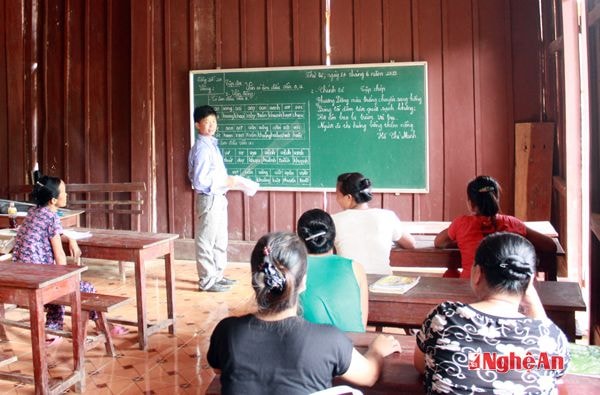 |
| Teacher Nguyen Si Hai is guiding students in spelling. |
Standing outside the classroom and observing for a long time, we still didn't dare speak up for fear of disrupting the teacher and students' learning. Teacher Nguyen Si Hai was enthusiastically teaching the Khmu mothers how to spell, guiding them through each simple letter on lined paper. Twenty Khmu literacy students and a teacher from the lowlands were diligently working on each letter, their sweat pouring down, but no one seemed to notice; they continued to study diligently, making the most of their limited time. Seeing this, we felt both astonished and somewhat melancholic.
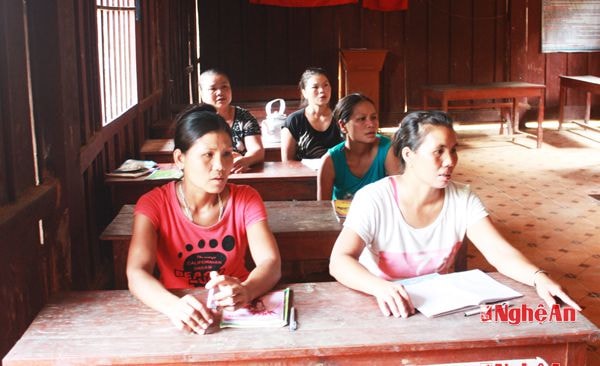 |
| Students in a literacy class in Cha Ca village. |
During our break, we went to meet the teacher and students of the class. Teacher Nguyen Si Hai, born in 1978 in Tan Ky district, is small in stature but has a warm and expressive voice. Hai has been connected to this land for more than 10 years, so now the villagers consider him like one of their own. Teacher Hai confided: “I just returned from my summer vacation a few days ago and immediately came to Cha Ca to teach this literacy class. The class was established in March of this year with the support of the Women's Union to help women from the five villages of Cha Ca 1, Cha Ca 2, Ca Da, Tha Lang, and Xao Va in the commune escape illiteracy. Although it has only been established for a few months, thanks to their efforts in learning, many women have learned to read and write. Some, despite their busy farming work, still make time to attend classes to keep up with the other students.”
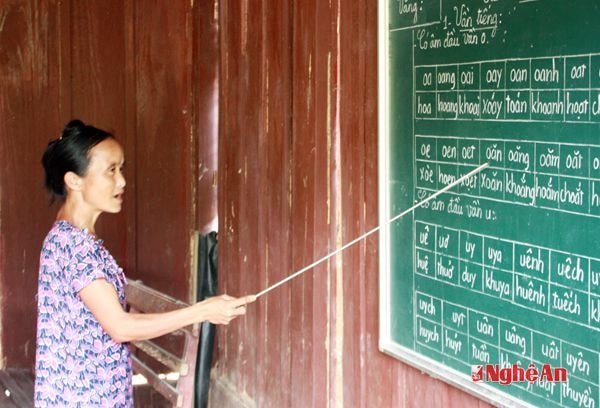 |
| Student Moong Me Bich guides "the kids" in spelling. |
Ms. Moong Me Bich, over 40 years old, is the class leader of the literacy class and is considered by teacher Hai to be the fastest progressing student. She is tasked with guiding the students in spelling. When asked about her experience, Ms. Bich shyly recounted: “Before, I didn’t have the opportunity to go to school, so now that I’m older, I have to work so hard. When I first heard I was going to school, I was so excited. During the day, the teacher taught me how to read and write, and at night I would light an oil lamp to review the lessons. Sometimes, even while working in the fields, I was so eager to get back in time for class.” Ms. Bich’s words inspire admiration. The determination to learn to read and write in this remote area is difficult, especially for women like Ms. Bich. However, what the students feel when they come to the class is excitement and confidence.
Seeing a woman struggling to write, she looked flustered as we approached. She was Xeo Me Hai, who had only recently started attending literacy classes. With our encouragement, she spoke haltingly in Vietnamese, explaining that she had to drop out of school due to poverty. Since March, seeing that the Women's Association was offering literacy classes, she asked her husband for permission to join so she could keep up with her peers. Ms. Hai confided that she felt ashamed of not knowing how to read and write, but because her family was poor and had many children, she could only attend sporadically. Therefore, she had to try harder than others to keep up. "Even so, writing is really difficult. I can read it all today, but tomorrow it'll just disappear," Ms. Hai said cheerfully.
Speaking with us, Mr. Nguyen Xuan An – Vice Principal of Bao Thang Ethnic Boarding School – said: “We mobilize teachers to teach the mothers during their free time, avoiding classes during the farming season, thus attracting many mothers to attend. However, absenteeism among students is unavoidable because everyone's family circumstances are different. The most difficult situation is in remote villages like Xao Va, Tha Lang, and Ca Da, where it takes 3-4 hours to walk. We are also pleased to see the high level of enthusiasm for learning among the women here.”
The Cha Ca village has faded into the distance, but the sounds of children reciting their lessons still echo throughout the mountains and forests. There, women gaze towards the written word, hoping for a brighter tomorrow. Suddenly, I thought of the song: “When the sun goes to sleep, mother goes to class by lamplight, the village resounds with songs, mother writes the first page with boundless faith…”
Dao Tho