

A bright and beautiful tradition of patriotism and humanism.
(Baonghean) - These days, the joyful news that Choong Temple was ranked as a provincial-level historical relic on July 16, 2015, spread throughout the nine villages and ten hamlets, delighting the people who are attached to and love the sacred mountainous region of Muong Choong, especially those who have a great passion for preserving, conserving, and restoring the tangible and intangible values of the Choong Temple relic.
Choọng Temple has long been a sacred place, a convergence of spirituality and culture, and a source of pride for the Thai ethnic people in the vast northwestern region of Nghe An province. The Choọng Temple relic (located in Choọng village, Châu Lý commune, Quỳ Hợp district) is a sacred site preserving and remembering stories of patriotism and the spirit of unity and harmony between the lowlands and highlands throughout history.
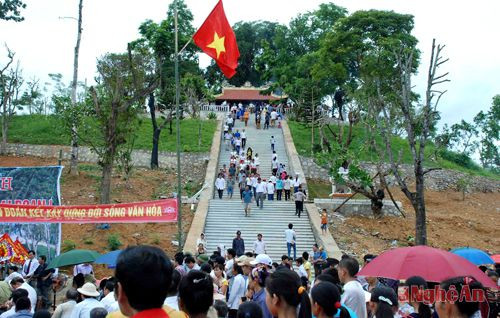 |
| Choong Temple on the day of the inauguration of phase 1. Photo: Cao Duy Thai |
Muong Choong, in the Thai language, means "land that values people and is hospitable." In the community's memory and in research documents about this land, the name Muong Choong was most likely given by the Lam Son rebels themselves to acknowledge the beautiful kindness of the Thai people here towards the rebels during difficult times. In the 15th century, when the Lam Son rebels retreated to Nghe An province to build a base to drive out the invading Ming army, the Muong Choong region was one of the strategically important areas where Le Loi's army stopped. The mountains, forests, and open hearts of the people of Muong Choong welcomed the rebels, making it one of the gathering places for the rebels to recruit and train soldiers. People throughout the Muong Choong region actively provided provisions, products, and weapons to Le Loi's army. A vivid testament to this is the series of place names in Muong Choong today that are associated with many activities of the Lam Son rebels during a glorious period in the country's history. These include Huồi Vang Cơ – located in Bàng village (Châu Lý district), meaning "stream where the flag is abandoned," where the rebel army stored their battle flags; Pù Canh Vệ – located in Lấu village (Châu Lý district), meaning "guard post," a hilltop observation point for guarding the granary at Đon Kho; Văng Mố Khung – located in Choọng village, meaning "shooting mound," where the rebel army trained and practiced using weapons; Đon Khó, Đon Chợ – situated between Thắm and Choọng villages (Châu Lý district), meaning "warehouse mound," "market mound," remnants of a place where provisions were stored and where the rebel army held a market with the local people; Thẩm Ông Hâu – an area located between Bắc Sơn and Châu Lý communes (Quỳ Hợp district), meaning "the cave where the old man came," a respectful name for the place where Lê Lợi is believed to have hidden and discussed military strategies, preparing for the battles of Trà Lân, Bồ Ải, and Khả Lưu, resounding victories in history. According to village elders and chiefs, many people have personally seen the two "sacred objects," the bronze drum and the cauldron used for feeding the troops; unfortunately, both have now been lost.
Muong Choong has become a "sacred land" not only because of the place names and "sacred objects" that remain in memory, in historical records, and on the ground, but also because it is associated with the legend of a character of special importance, arguably the central figure in the legends that remain here: the legendary-historical figure Nang Phom Hom – "The Lady with Fragrant Hair".
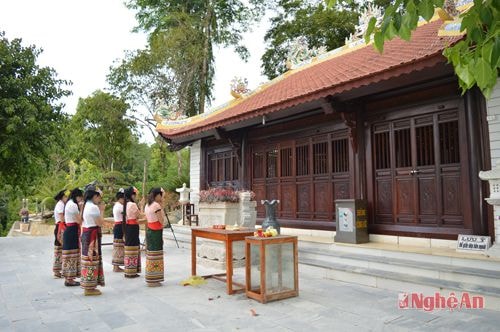 |
| In front of the sacred temple. |
In the community memory passed down from generation to generation in Muong Choong, "The Fragrant-Haired Maiden" is the main figure worshipped at Choong Temple. She was a Thai girl born into a poor family, but beautiful in both character and appearance. She possessed the pure, captivating beauty of precious flowers from the mountains and forests. Wherever she went, grass welcomed her, flowers greeted her, her beauty enchanted people and enhanced the splendor of the mountain landscape. What was special was that her hair always emitted a naturally pleasant fragrance. Therefore, the villagers called her Nang Phom Hom, meaning "The Fragrant-Haired Maiden." The peaceful life of the villagers was suddenly plunged into ruin along with the country's tragic fate of enslavement and utter devastation. The brutal and exploitative policies of the Wu invaders caused widespread devastation and chaos. Nguyen Trai's "Great Proclamation of Victory over the Wu" recorded: "How wicked the bamboo of Nam Son cannot record all their crimes / How filthy the waters of the East Sea cannot wash away their stench." At this time, the beauty of the "Fragrant-Haired Maiden" became the object of desire for the ruthless and tyrannical invaders, but with her intelligence and resourcefulness, she not only protected herself but also helped many people escape into the deep forest.
During the years when the Muong Choong village was plunged into hardship, the arrival of patriotic rebels from the Lam Son mountains quickly received enthusiastic support and response from the villagers. "The fragrant-haired woman" was the one who actively mobilized people from deep within the mountains and forests to join the rebels, helping to establish the army, gather forces, and stockpile provisions. Le Loi's rebel army, like fish in water or kites in the wind, was invigorated by the immense difficulties and shortages of operating in the treacherous mountains, leading to decisive victories.
Out of respect for the loyalty and integrity of the rebel army, and deep gratitude to the land that sheltered them during difficult times, "The Fragrant-Haired Maiden" and a talented Kinh general in the rebel army fell in love and swore eternal love to each other.
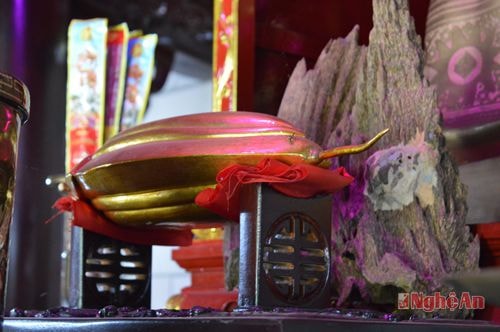 |
| Rice grains – sacred objects worshipped to commemorate the "Fragrant-Haired Lady" who contributed provisions to feed the army. Photo: nk |
One sunny June day, longing for her general who was away on the battlefield, "The Fragrant-Haired Maiden" went to a stream to wait for him. While washing her hair, she absentmindedly dropped her comb, and in her attempt to reach for it, she fell into a deep ravine (Vang Co Cu). Upon hearing of her disappearance, the general and his soldiers returned, mobilizing elephants and horses, and together with the villagers, searched day and night for her. They dug up mountains of earth but could not find her, only strands of hair mixed in with the water, which, when retrieved, still retained their fragrant scent. Out of love and respect for her, the soldiers and villagers buried the recovered strands of hair in the mound dug up during the search and erected a shrine to "The Fragrant-Haired Maiden" on that hill.
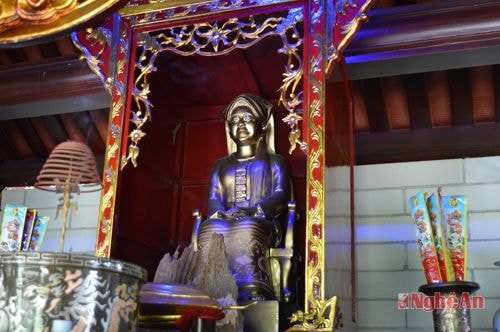 |
| Statue of "The Lady with Fragrant Hair". |
"The Fragrant-Haired Maiden" is a figure whose beauty represents the devotion and contributions of the Muong Choong people to Le Loi's army and to the cause of defending the country. Their beautiful love story in the pristine mountains embodies the harmonious unity of the people under the banner of patriotism, the aspiration to unite regions and gather strength to rise up against foreign domination. Therefore, the temple dedicated to "The Fragrant-Haired Maiden" – Choong Temple – has become a sacred place, a center of spiritual and cultural activity, a place for interaction and connection, fostering solidarity among the people of the region and other villages and hamlets. Every year, the villagers hold ceremonies to worship "The Fragrant-Haired Maiden" and other deities on the 15th and 1st days of the lunar month, especially during the two main festivals: the Luc Ngoat Festival (on the 15th and 16th of the 6th lunar month) and the New Year's Eve (25th of the 12th lunar month).
In remembrance of the contributions of our ancestors, and in the spirit of "drinking water, remembering the source," on the foundation of the ancient relics that remain, and with the heartfelt wishes of collectives, individuals, philanthropists, and businesses in the region, the Choọng Temple complex was begun on the 8th day of the 12th lunar month of 2013 (January 8, 2014), and completed on the 15th day of the 6th lunar month of 2014. On July 29th and 30th, the People's Committee of Quỳ Hợp District solemnly organized the Choọng Temple Festival and received the Certificate of Recognition as a Provincial-level Historical Monument at Choọng Temple, Châu Lý Commune. The restoration and recognition of Choọng Temple as a Provincial-level Historical Monument not only promptly meets the spiritual and cultural needs of the people but also affirms and acknowledges the vibrant vitality of a historical monument rich in patriotic and humanistic traditions in a region of deep mountains and sacred landscapes!
Ngo Kien