

After three rounds of admissions, many universities are at risk of closing down.
Despite employing both their own admission methods and utilizing the results of the national high school graduation exam, many universities and colleges, including public ones, have failed to recruit students after three rounds of admissions and face the risk of closure.
Diligently conducting the admissions process.
While many universities have already started their academic year several weeks ago, some others are still diligently conducting admissions. “Based on our training capacity, the university plans to recruit 5,000 students this year. However, after the first and second rounds of admissions, only 1,907 students enrolled. In the third round, 124 students applied, and perhaps only about half of them will actually enroll. Therefore, we still need about 3,000 more places,” said Professor Vu Van Hoa, Vice Rector of Hanoi University of Business and Technology.
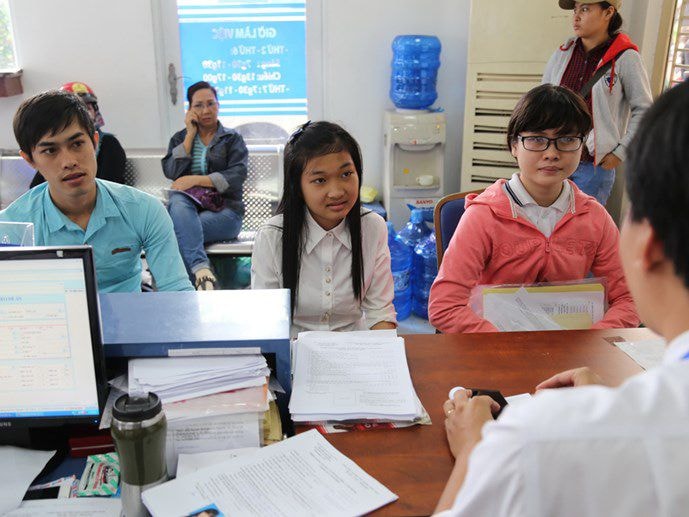 |
| Many universities and colleges are still continuing their admissions process in the hope of finding new students to maintain the institution's existence - Photo: Dao Ngoc Thach |
A number of other universities are facing similar difficulties, such as: Phuong Dong Private University, Hai Phong Private University, Viet Hung Industrial University, Hoa Lu Ninh Binh University, Dong Asia Technology University, Hanoi Textile and Garment Industry University, and member universities of Thai Nguyen University… A representative from Sao Do University (Hai Duong) stated that the university has only recruited about 1,000 students while the target is 3,800 (for undergraduate programs). Professor Tran Huu Nghi, Rector of Hai Phong Private University, lamented: “The university will keep its doors open for applications until September 30th, but we don't know if we will be able to recruit enough students to meet the target.”
Nguyen Tat Thanh University announced it would accept up to 1,500 additional students but received fewer than 100 applications. Meanwhile, according to a representative of the university, the number of students admitted in previous rounds who have enrolled is also insufficient. “The difficulties in student recruitment have existed for many years, but this year it is even more challenging. Previously, it was mainly private universities complaining, but this year many public universities have had to speak out,” commented Professor Vu Van Hoa. [The following sentence is unrelated to the preceding text and appears to be a separate thought:] [The text then abruptly shifts to unrelated topics: "Eliminating academic programs, closing universities."]
Master Tran Manh Thanh, Vice Principal of Bach Viet College, observed: “With enrollment reaching only around 50% of the target, some private universities and colleges risk closing down departments, or even the entire school, if they lack the resources to sustain operations. When enrollment is insufficient, they are forced to cut expenses (including investments, full-time lecturers, etc.) because funding primarily comes from tuition fees.”
Closing a school is one thing, but eliminating a major within a university is imminent. "The university's agronomy program has had difficulty recruiting students for the past two to three years, but the university has tried to keep it open. I don't know if the university will be able to maintain this program this year, given that the current enrollment is only around ten students," said Professor Tran Huu Nghi.
Phuong Dong Private University has several departments that are likely to close down due to already low student enrollment, and this year they only managed to recruit around 10 students. Professor Vu Van Hoa lamented: "The university currently has 1,114 full-time lecturers; what will their future be like if the current situation of recruiting less than 50% of the target continues?"
"Schools keep asking each other, 'Where is the PhD holder hiding?'"
According to Professor Vu Van Hoa's explanation, it's "strange" that many universities are successfully recruiting students, given the current inflation in the scale of higher education enrollment and the number of universities and colleges. "Universities keep asking each other, 'Where are the candidates hiding?' My initial answer is that the candidates aren't hiding anywhere; they've all enrolled in the universities. But because we have so many universities (over 400 nationwide, averaging nearly 7 per province/city), we can't distribute all the candidates equally."
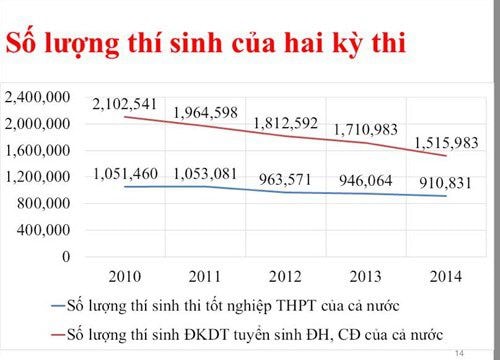
According to data from the General Statistics Office, the number of high school students gradually decreased from the 2006-2007 school year to the 2013-2014 school year. Specifically, the 2006-2007 school year had the highest number of students at 3.075 million, after which it steadily declined. In recent years, the number has decreased by approximately 500,000 students. For example, the number of students was 2.675 million in the 2012-2013 school year and 2.532 million in the 2013-2014 school year.
 |
| Chart: Dr. Nguyen Duc Nghia |
The number of high school graduates has also been declining in the last three years. In 2013, 946,064 students took the high school graduation exam nationwide, in 2014 there were 910,000, and in 2015 only 871,935. The number of candidates registering for university and college entrance exams has also decreased annually. From 2011 to 2015, the number of candidates dropped from nearly 1.7 million to 1 million. Therefore, the K coefficient (competition ratio) calculated based on the number of candidates and the number of available places has decreased sharply, from 10.24 (in 2001) to only 2.14 (in 2014).
For example, in 2013, there were 1,298,522 candidates registered for the exam, in 2014 this number decreased to 1,190,546. In 2015, it further decreased to 1,004,487, of which approximately 279,000 candidates only took the graduation exam and did not use the results for university or college admissions. The remaining approximately 725,000 candidates took the graduation exam and applied for university admissions. After the Ministry of Education and Training announced the minimum quality assurance threshold for admission, according to the Ministry's statistics, 531,182 candidates had at least one subject combination with a total score of 15 points or more (eligible for admission).
While the number of applicants is decreasing, the enrollment quotas for universities and colleges are increasing annually. According to data from the Information Technology Department of the Ministry of Education and Training, the enrollment quotas of universities and colleges have increased rapidly every year, from 165,570 (in 2001) to 640,000 (in 2014). Statistics from the Ministry show that in 10 years, the enrollment quotas have ballooned 3-4 times, for both universities and colleges. For example, in 2005, the number of applicants was 6.5 times greater than the university enrollment quota, but this year it is only 1.52. In 2013, the university enrollment quota was 329,896, in 2014 it was 370,000, and this year it is 439,000, considering both the national high school graduation exam and separate admission methods.
Although the number of high school and university entrance exam candidates has gradually decreased, the number of universities and colleges has increased rapidly. According to the General Statistics Office, in the 10 years from 2003 (the year the national entrance exam system began), there were 214 schools, and by 2013, the number had increased to 427, a rise of 213. By the beginning of 2014, another 14 schools had been established.
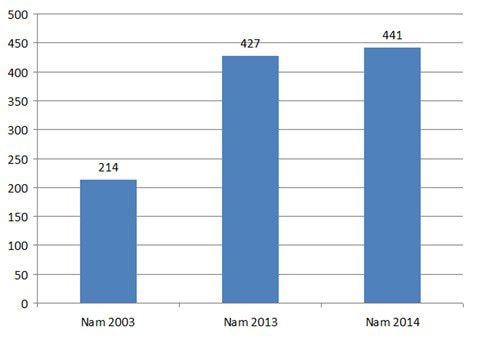 |
| Number of universities and colleges |
According to the Ministry's statistics, from 2007 to 2013, out of 133 schools established nationwide, 108 were upgraded. In March 2014, the Ministry issued a document announcing the suspension of accepting applications for upgrading and establishing new schools, but continued to review, report, and propose to the Prime Minister solutions for upgrading and establishing new universities and colleges that had been submitted to the Ministry before the issuance of this document.
For example, Dong Nai province has a population equivalent to that of just one district in Ho Chi Minh City. However, in the last few years, a number of universities and colleges there have been upgraded, resulting in the province alone having 5 universities and 3 colleges. Being far from the city center and facing a shortage of qualified students, these universities and colleges are unable to meet their enrollment targets.
This imbalance, coupled with the vast disparity in quality between universities and colleges, means that despite numerous changes in the university and college entrance exams and admissions processes, many institutions still fail to recruit enough students each year. This situation is particularly serious this year. Therefore, there have been suggestions to consider restructuring and merging universities and colleges.
According to thanhnien.com.vn
| RELATED NEWS |
|---|