

Driving experience through flooded areas
Maintain a steady speed, shift to a lower gear, and most importantly, accurately assess the extent of the flooding before deciding to drive through.
Over the past few days, several provinces in northern Vietnam have experienced prolonged thunderstorms, particularly in Quang Ninh, where rainfall peaked at 500 ml. Highway 18A was severely flooded, preventing many vehicles from passing through. Additionally, in some areas, dams containing coal ash have broken, causing mud and sand to flow down from the hills. More importantly, if these materials enter engine components, especially in cars, they can cause damage or blockages.
Technical experts advise that dealing with flooded vehicles doesn't usually take much time, mainly involving changing engine oil and transmission fluid, checking the air filter (replacing it if necessary), lubricating, and cleaning the interior and exterior. For vehicles that have been deeply submerged and have dirty water inside the engine, cleaning will take more time and effort. Below are some ways to prevent or deal with cars and motorcycles that have been flooded.
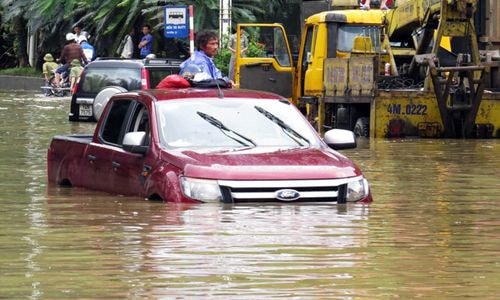 |
| The car is submerged in water and awaiting rescue. Photo: Giang Chinh. |
Before crossing the flooded area
If you absolutely must cross the flooded area, first determine the water level (depth). According to standards, the safe depth should not exceed the center (axle) of the wheel. Observe other vehicles crossing the flooded area to see if the depth is safe for your vehicle.
If you are certain about the depth of the flooded area, before driving through, you should turn off all loads such as the air conditioner, entertainment system, etc. In addition, you should also determine the position of the dipstick, air filter, hoses, and battery relative to the water level.
When driving through flooded areas, shift to a low gear, maintain a moderate speed, and slightly increase the throttle. Don't go too fast to avoid water splashing over the hood and into the air intake, causing damage; don't go too slow to avoid water entering the exhaust pipe and stalling the engine. Absolutely do not stop in the flooded area. If you must stop, shift to neutral, engage the parking brake, and slightly increase the throttle. When you can continue driving, quickly shift to first gear and move through the flooded area.
How to handle a stalled engine.
For cars that stall in flooded areas, absolutely do not attempt to restart them. Attempting to start the engine can bend the connecting rods, or in severe cases, break them, leading to engine block damage. This is because water entering the engine causes water compression (hydro-locking).
A car submerged in water will directly affect the electrical system, so you should turn off the ignition. This helps protect electronic devices and prevent short circuits. Furthermore, if the water level is above the bottom edge of the doors, absolutely do not open the car doors. Water will flood inside and damage the control units. Call a roadside assistance team immediately.
While waiting for rescue, turn off the ignition, and if possible, disconnect the negative battery terminal or push the car to a less flooded area. At this time, you can check the engine oil, transmission fluid, and engine air filter to see if any water has entered.
With motorbikes
If your vehicle gets submerged in water while driving, simply cleaning the spark plugs and draining the water from the exhaust pipe should allow it to operate normally. However, this is only a temporary solution. For safety, the engine oil should be changed immediately afterward.
For scooters, in addition to changing the oil, you need to check the air filter. Because it's located low, it's easily susceptible to water ingress, leading to difficulty starting the engine. If the vehicle is completely submerged or has been submerged in water for a long time, the electrical system is the first thing to check, especially for vehicles equipped with electronic fuel injection technology.
Vehicles that have been submerged in water definitely need a new oil change, carburetor inspection, complete fuel draining (including the carburetor), and cleaning or replacing the spark plug if necessary. Replace the air filter, and for scooters, dry the drivetrain. Pay attention to the wheel bearings and consider taking them to a garage to have them removed, dried, and lubricated.
According to VnExpress