

CSIS: China continues to destabilize the South China Sea.
The conference on the South China Sea at the Center for Strategic and International Studies (CSIS) opened on the morning of July 21 in Washington D.C.
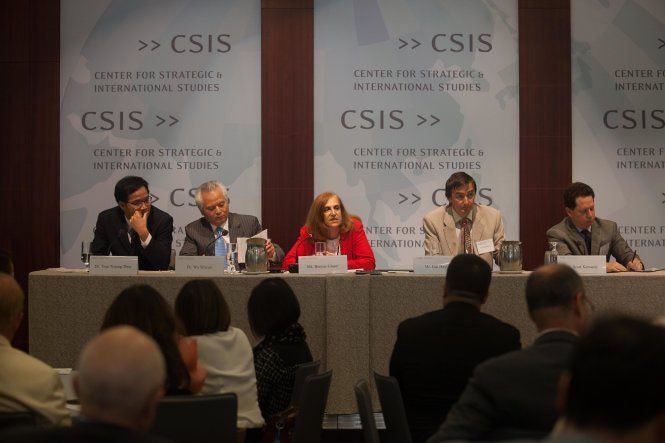 Experts debate at a South China Sea conference at CSIS. Experts debate at a South China Sea conference at CSIS. |
This is an annual conference that has been organized by the CSIS center for the past five years. This year's conference, in addition to discussing new developments in the South China Sea, will also feature experts discussing the military balance and regional order related to the situation at sea.
BBC's Bill Hayton, author of a recent book on the South China Sea, said: "Most countries have spoken out against China's position."
According to Hayton, for several years now, the South China Sea and the ambitions of Zhongnanhai have consistently been the focus of international attention.
According to Danny Russel, US Assistant Secretary of State for East Asia, there are three Chinese land reclamation points in the Spratly Islands that are even larger than the largest natural island there.
The total area of land that China has reclaimed is equivalent to approximately 800 hectares, or the size of 1,500 football fields. On the larger chessboard, the South China Sea is naturally becoming an area of intense competition for influence between the United States and China.
Bonnie Glaser of CSIS discusses the military and civilian purposes of China's island building. In addition to increasing its maritime presence, she suggests that China may engage in more assertive actions, such as seizing fishing vessels in waters it claims as its own.
Regarding military purposes, Glaser suggested that China might want to conduct aerial surveillance operations from 2017, the time when the runway that China is building at Fiery Cross Reef could become operational.
According to her, China currently has about 8 fishing patrol vessels regularly operating in the South China Sea, and its offshore surveillance capabilities are very limited. The construction of artificial islands, while not very significant in conflict (due to weak defensive capabilities), would significantly increase China's maritime surveillance capabilities in peacetime, particularly as a deterrent to the United States.
Furthermore, China could completely use these bases to "push other countries off their islands."
According to Ms. Glaser, even if China were the last to build, it couldn't possibly build to that extent," Bonnie said. Dr. Tran Truong Thuy of the East Sea Institute pointed out that Vietnam's island construction and development over 20 years only covers 1.5% of the area that China has built in the past 18 months.
Ms. Glaser proposed that the parties building islands should immediately cease their activities and that the claims of sovereignty should be adjudicated through a legal process. She reiterated that the ambiguity of the nine-dash line is the root cause of the current instability in the South China Sea.
Beijing fears Japanese interference in the South China Sea.
Chinese representative Wu Shicun, chairman of the National Institute for South China Sea Studies, reiterated that China needs to protect its sovereignty in its island-building activities.
Beijing has expressed particular concern over Japan's involvement in the South China Sea situation, as well as the Philippines' unilateral lawsuit against China in an international court.
China's proposal to the US was to "keep Japan from getting involved in the South China Sea situation... because this would not contribute anything and would not help stabilize the region."
Mr. Tran Truong Thuy, director of the East Sea Research Center at the Vietnam Diplomatic Academy, expressed concern that land reclamation in the sea increases China's presence and the risk of future conflict.
According to him, Beijing could use these artificial islands to "rephrase" the UNCLOS maritime law and argue that the artificial islands are habitable for human habitation, turning "rocks into islands."
According to him, the situation in the South China Sea is now more important strategically than purely in terms of resources as before.
(According to TTO)
| RELATED NEWS |
|---|