
Take advantage of opportunities in integration.
(Baonghean) - Participating in the Trans-Pacific Partnership (TPP) and joining the ASEAN community... presents a great opportunity for Nghe An businesses to integrate deeply and expand their markets to the US, Japan, Canada, and ASEAN countries... This trend requires businesses to pay attention to and grasp information in order to seize more business opportunities.
(Baonghean) - Participating in the Trans-Pacific Partnership (TPP) and joining the ASEAN community... presents a great opportunity for Nghe An businesses to integrate deeply and expand their markets to the US, Japan, Canada, and ASEAN countries... This trend requires businesses to pay attention to and grasp information in order to seize more business opportunities.
In Nghe An province, there are currently not many businesses producing consumer goods, and the level of competitiveness is not high. Therefore, when expanding trade with countries in the region and around the world, small and medium-sized enterprises (SMEs) will find it difficult to survive.
Mr. Thai Dai Phong, Director of Thai Dai Phong Company, believes that when joining international economic organizations, the competitiveness of Nghe An businesses is very weak and worrying. This is because the companies are small in scale, have limited financial resources, and operate in narrow markets, making trade a major challenge for businesses...
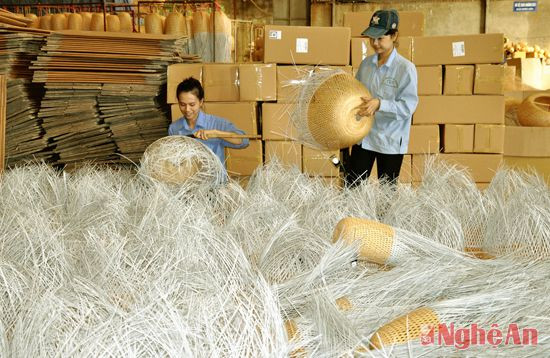 |
| Lantern lampshades are manufactured at Duc Phong Co., Ltd. |
Nghe An currently has over 7,000 small and medium-sized enterprises (SMEs) in operation, with 18 branches and over 1,000 members. Although their scale is still limited, they have made a significant contribution, forming a widespread business network from economic centers to rural areas, both producing and distributing products for society.
However, many businesses still have a vague understanding of integration. Recently, the Association of Small and Medium Enterprises planned to implement activities to promote and disseminate information on integration to businesses in Vinh City, the Quynh Luu cluster, the Thai Hoa cluster, and the Do Luong cluster. Specifically for manufacturing businesses, the focus will be on disseminating knowledge about branding and trademarks for goods and services. The Association is also conducting a survey of businesses' training needs to categorize them, design classes, and invite instructors.
According to Mr. Nguyen Duy Tuan, Senior Advisor of VCCI in Nghe An, the issue of integration has not received adequate attention from businesses for a long time. “At the macro level, Vietnam must adjust and change its management and legal frameworks to adapt to the new conditions, or in other words, reform domestically in public procurement, e-commerce, intellectual property, and competition. Businesses, on the other hand, need to prepare well, which means improving their competitiveness. Doing business requires professionalism, reflected in corporate governance and labor productivity management…” Mr. Tuan said.
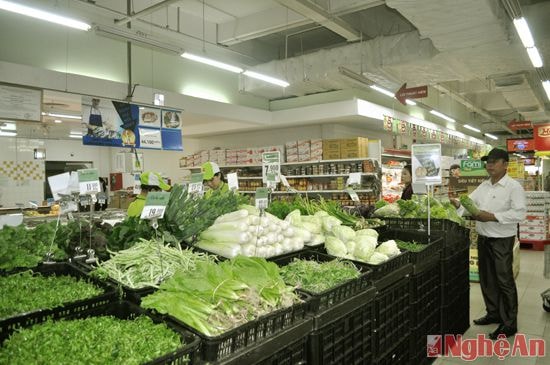 |
| Agricultural products sold at Metro Supermarket (Vinh City). |
Mr. Tran Anh Son, General Director of Nghe An Agricultural Products Import-Export Corporation and Chairman of the Association of Outstanding Enterprises, stated: According to projections, Vietnam will join the ASEAN Economic Community (AEC) in December 2015, initially focusing on the formation of the ASEAN economy. This will provide Vietnamese businesses in general, and those in Nghe An in particular, with opportunities for development. However, businesses currently do not see the involvement of relevant levels and sectors in this matter. He requested that the Provincial People's Committee organize a conference to disseminate necessary information on ASEAN integration and the TPP, so that Nghe An businesses can be aware of these opportunities and respond to the challenges.
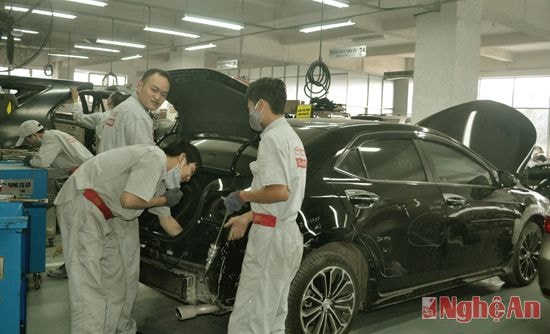 |
| With the opening up to international integration, the automotive industry is facing significant pressure from both the production and service sectors. |
According to the Department of Industry and Trade, one of Nghe An's strengths, but also a vulnerable area in the context of international integration, is agricultural exports. This sector is linked to the income of a large segment of the rural population in Nghe An, directly affecting industries such as sugarcane production, livestock farming, and crop cultivation. The limitations of fragmented production and low productivity and efficiency in the province's agriculture need to be quickly addressed. Sharing his views on this issue, Mr. Tran Anh Son stated: While countries in the region have made significant progress in productivity and output, our agriculture is still lagging behind in innovation.
The sugar industry is a case in point. Currently, the price of raw sugarcane in Thailand is 30-35 USD/ton (approximately 600-700 VND/kg), while the price of raw sugarcane in Vietnam ranges from 800,000 to 1,000,000 VND/ton (800-1,000 VND/kg). Therefore, sugarcane businesses in Nghe An are facing challenges on the threshold of integration.
With Vietnam's accession to the TPP and AEC, the goods predicted to benefit most from TPP participation are textiles, footwear, and electronics. Regarding imports, the import structure is also concentrated on these major items, including textiles, clothing, footwear, and services.
Joining the TPP is a very important milestone because the TPP region accounts for 40% of global GDP and 30% of global import and export turnover. Some requirements in the TPP negotiations are even higher than those in the WTO negotiations. These high requirements could pose difficulties for Vietnam, especially in terms of the government's implementation costs and the compliance costs for businesses, but a careful examination of some of these standards reveals significant challenges.
According to Ms. Vo Thi An, Deputy Director of the Department of Industry and Trade, if businesses in Nghe An in particular, and Vietnam in general, know how to take advantage of opportunities from integration, they will be able to access large markets with zero import tariffs. Combined with clearer commitments to improving the investment environment and protecting intellectual property rights, this will certainly contribute to attracting foreign investment. This new wave of investment will create many jobs, form new production capacities to take advantage of export opportunities, and participate in regional and global value chains brought about by integration.
The Trans-Pacific Strategic Economic Partnership Agreement (TPP) originated from the Trans-Pacific Strategic Economic Partnership Agreement (P4), signed on June 3, 2005, and effective from May 28, 2006, between four countries: Singapore, Chile, New Zealand, and Brunei. To date, 12 countries have participated in the negotiations, including the four founding members, plus Australia, Peru, the United States, Malaysia, Vietnam, Canada, Mexico, and Japan. On the evening of October 5th (Vietnam time), trade ministers from 12 countries participating in the Trans-Pacific Partnership (TPP) negotiations in Atlanta, USA, reached an agreement. Speaking at a press conference in Atlanta, Vietnam's Minister of Industry and Trade, Vu Huy Hoang, affirmed that despite Vietnam being one of the least developed economies in the TPP, the country remains committed to fulfilling all its obligations and exercising its rights under the TPP. |
Thu Huyen