

Leveraging the advantages of being a suburban area, we strive to become a prosperous district.
(Baonghean) - Comrade Phan Sy Duong, Member of the Provincial Party Committee, Secretary of the Nghi Loc District Party Committee, answers an interview with Nghe An Newspaper.
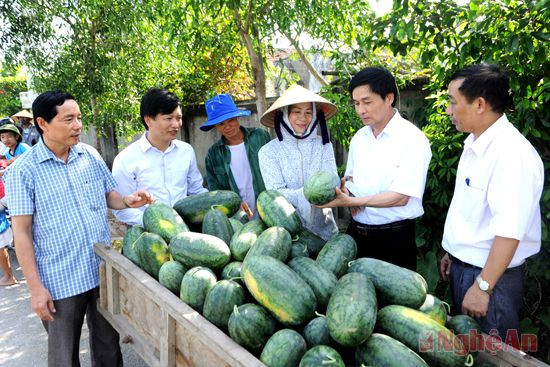 |
| Leaders of Nghi Loc district discuss the effectiveness of watermelon cultivation with farmers in Hamlet 13, Nghi Long commune. Photo: Sy Minh |
Reporter:Could you please tell us about the outstanding achievements that the Party Committee and people of Nghi Loc district have strived to attain during the 2010-2015 term?
Comrade Phan Sỹ Dương:During the 2010-2015 term, despite facing some difficulties, under the leadership of the district Party committee, with the consensus of the political system and the efforts of all the people, Nghi Loc achieved a number of accomplishments in all aspects. These include:
1. The average growth rate over the past five years reached 9.25%. The total value of production in 2015 (at 2010 constant prices) was estimated at VND 7,395 billion. The average added value per capita in 2015 was VND 28.1 million, a 2.13-fold increase compared to the beginning of the term. The economic structure shifted in a positive direction: the agriculture, forestry, and fisheries sector reached 23.1%, a decrease of 6.7%; the industry and construction sector reached 45%, an increase of 3.5%; and the trade and services sector reached 31.9%, an increase of 3.2% compared to the beginning of the term. Total social investment in 2015 was estimated at VND 3,675 billion, and for the entire period 2011-2015 it was estimated at VND 14,625 billion (exceeding the target set by the congress).
2. Agricultural, forestry, and fisheries production has developed quite well. The crop structure has been effectively transformed towards increasing income per unit area, and scientific and technical advancements, high-yield and high-quality crop varieties have been applied in production. During the term, 85 high-economic-value production models were established, many of which had an average annual income of over 200 million VND/ha. Livestock farming has developed steadily. The proportion of livestock farming within the agricultural sector accounts for 45%.
3. Industry and construction have experienced rapid growth, and infrastructure has been gradually improved. The district has effectively led and directed land clearance efforts to attract investment, resulting in many investment projects operating stably and efficiently, such as the Tien Phong Plastic Factory, BSE Electronics, Hoa Sen Steel, and the Masan Northern Food Industry Center.
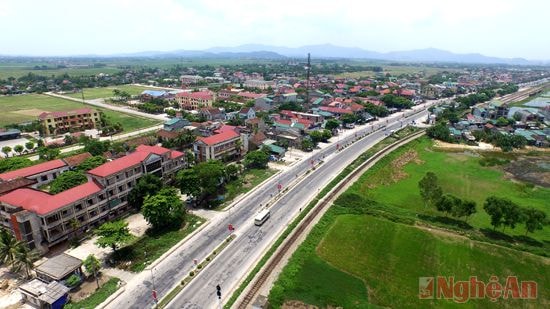 |
| A panoramic view of Quan Hanh town from above. Photo: Sy Minh |
4. Effectively implement solutions to mobilize all resources for investment in the construction of technical infrastructure serving production and daily life. The value of capital construction investment throughout the term reached over 1,600 billion VND (exceeding the target set by the congress). Investment in construction completed many key projects, contributing to promoting socio-economic development and building new rural areas in the locality.
5. The New Rural Development Program has been decisively and vigorously implemented. By 2015, the average number of criteria met per commune in the district reached 16.1, an increase of 10 criteria compared to 2010. In 2014, two communes, Nghi Xuan and Nghi Thai, were recognized by the province as meeting the standards for new rural development, and seven communes are striving to be recognized in 2015.
6. Socio-cultural aspects have undergone many positive changes, and the material and spiritual lives of the people have improved. Education and training are increasingly meeting the learning needs of the people, with improvements in both scale and quality. Healthcare for the people has received attention and achieved many results. The quality of medical examination, treatment, and healthcare for the people has gradually improved. Labor, employment, and social security have been given due attention and effectively implemented. Programs and projects to eradicate poverty have been effectively implemented; in 2014, the poverty rate decreased to 5.65%, and is projected to decrease to 2.55% in 2015 (Resolution of the Party Congress, target 8.0%).
8. National defense and security are ensured. A military posture is built within the district's defense zone; the policies regarding the military's rear support are well implemented; troop recruitment targets are met; and the reserve mobilization force is well managed. The fight against crime and social vices is strengthened, and political security and social order are ensured.
9. Party building and the political system have been emphasized and achieved many good results. The quality of grassroots Party organizations has been improved, the political system in religious areas has been strengthened; and the training, development, planning, and standardization of the cadre team have been carried out effectively.
Reporter:What are the shortcomings and weaknesses that the Nghi Loc Party Committee needs to overcome, Comrade?
Comrade Phan Sỹ Dương:The Nghi Loc Party Committee has pointed out the following limitations and weaknesses:
- Three out of seven key targets set forth in the Congress Resolution have not been achieved (economic growth rate; economic structure: agriculture, trade and services; and average per capita income).
- Economic growth is not yet sustainable and has not met the targets set in the resolution; economic restructuring is still slow; and the transformation of crop and livestock structures towards commercial production is not yet strong.
- Infrastructure development is not yet synchronized, and some communes still face difficulties and limitations in attracting investment. Trade and services have not developed in proportion to the district's potential and advantages, and large-scale commercial centers and clusters have not yet been formed.
- The unemployment rate remains high, especially in areas where large amounts of agricultural land have been reclaimed; vocational training and career chuyển đổi for rural workers are still limited in effectiveness and do not meet the needs of the workforce.
- Some issues regarding rural security and security in religious areas remain complex. The implementation of democratic regulations is not serious in some places; the handling of complaints and denunciations in some cases is not timely or decisive.
- Although the content and methods of operation of mass mobilization, the Fatherland Front, and mass organizations from the district to the grassroots level have been reformed, they are still slow and not comprehensive. The quality of mass mobilization work by the political system in religious areas remains low. Some people's grievances are slow to be grasped and resolved in a timely manner.
Reporter:Comrade, could you please share the lessons learned from leading and directing the implementation of the Congress Resolution?
Comrade Phan Sỹ Dương:Four lessons have been learned that need to be applied in practice, as follows:
Firstly, it is essential to thoroughly understand the guidelines, policies, directives, and resolutions of higher-level Party committees, especially by closely adhering to practical realities and local conditions to develop and issue appropriate and accurate programs, directives, resolutions, mechanisms, and policies to lead and guide implementation.
Secondly, focus on building the foundation, with a central emphasis on promoting broad democracy among cadres, Party members, and the people, creating high consensus within the Party organization and throughout society. At the same time, enhance the leadership capacity of grassroots Party organizations and the management and operational capacity of governments at all levels.
Thirdly, proactively seize and make the most of all resources to develop the economy and society, improve the material and spiritual lives of the people, with particular attention paid to mobilizing domestic resources.
Fourth, improve the evaluation, planning, training, and placement of cadres, especially leading cadres and heads of all levels and sectors. Focus on building unity and cohesion within Party committees, individual agencies and units, and among cadres and Party members.
Reporter:Comrade, in order for Nghi Loc to fully utilize its potential and advantages as a suburban district, located within the Southeast Economic Zone and key industrial parks of the province, and to promote comprehensive development and achieve the goal of becoming the most developed district in the province, what are the directions and solutions for the coming period?
Comrade Phan Sỹ Dương:The 2015-2020 term requires the Party Committee and people of the district to continue to seize opportunities, leverage advantages, overcome difficulties, unite, and strive for development according to the basic goals and viewpoints: Continuing to enhance the leadership capacity and fighting strength of the Party; promoting the strength of the great national unity. Focusing on mobilizing all resources to invest in the comprehensive development of industry, services, and tourism; improving the efficiency of agricultural production associated with building new rural areas; building the district into a locality with a synchronous and progressively modern infrastructure system; improving the material and spiritual lives of the people; maintaining national defense and security; and strengthening the political system. Striving to become one of the most developed districts in the province by 2020.
To achieve the above objective, the following key solutions need to be implemented:
1. Strongly innovate the Party's leadership methods and improve the quality of the political system's operations to successfully accomplish political tasks. Pay special attention to political and ideological work, expand democracy to ensure that cadres, Party members, and the people fully and deeply understand the advantages, difficulties, and development trends of the locality in the coming years, creating a high degree of unity in understanding and action.
2. Create a favorable investment and business environment for development. Implement a transparent mechanism to attract investment from all economic sectors. Develop, refine, and improve the quality of planning work, providing a solid foundation for the implementation of investment projects.
3. Mobilize and effectively utilize resources for socio-economic development. Prioritize state investment in key projects, support the transfer and application of science and technology, rural development, and sustainable poverty reduction. Effectively mobilize resources from the people for investment and business, rural development, and the development of farm and household-based economic models, livestock farming, aquaculture, and fisheries.
4. Attracting and improving the quality of human resources to meet development requirements. Implementing provincial policies and continuing to research and issue policies to attract and effectively utilize high-quality human resources in the province, prioritizing human resources in the fields of healthcare, education, and science and technology. Enhancing the effectiveness of human resource training to meet the needs of the labor market both within and outside the province. Building a team of officials and civil servants that is commensurate with the requirements of socio-economic development.
5. Promote the application of science and technology, protect the environment, and use natural resources rationally and efficiently. Approach and creatively apply biotechnology techniques in agricultural production, prioritizing investment in testing and introducing high-yielding, high-quality plant and animal varieties with high adaptability to soil and weather conditions into production.
6. Promote administrative reform and innovation in leadership and management. Improve the effectiveness and efficiency of the state apparatus. Strengthen inspection and supervision, and emphasize the role and responsibility of leaders. Implement grassroots democracy effectively, promptly disseminate state regulations, mechanisms, and policies, and improve the efficiency of handling complaints and denunciations from citizens.
Reporter: Thank you very much, Comrade!
Pv(Perform)
The basic targets that the Nghi Loc Party Committee strives to achieve and surpass by 2020: 1. Average economic growth rate over the past 5 years is 12.5 – 13.5% per year. Total production value reached 14,063 billion VND. 2. Economic structure: Agriculture, forestry and fisheries 15%, Industry and construction 49%, Services and trade 36%; 3. Average added value per capita reaches 68-70 million VND/person; 4. Strive to achieve the status of a new rural district; 5. State budget revenue in the area (excluding land use fees) reached 170 billion VND. 6. Total social investment: 25,578 billion VND; 7. Poverty rate by 2020 (according to current criteria): 1.84%; 8. Percentage of trained workforce: 70%. 9. 90% of communes and towns have achieved the status of comprehensively strong and secure grassroots organizations. 10. Continue to uphold the title of a strong Party organization. |